

Best overall: a cash-pay provider that discloses continuing costs, the exact medication and required fees. Best for flexibility: a provider with clear month-to-month cancellation terms. Best for predictable billing: a provider that documents what each payment includes. Use these criteria to compare the best semaglutide providers without insurance in 2026; a low introductory charge does not establish the best continuing plan.
- Compare the best semaglutide providers without insurance on continuing costs, medication inclusion and required fees.
- Telehealth Ledger is a comparison resource, not a prescribing provider.
- A first-month promotion is not a continuing price.
- Keep branded semaglutide and compounded semaglutide in separate comparisons.
- Confirm state eligibility, cancellation rules and pharmacy identity before paying.
Why this matters
Without insurance, you need to understand both the clinical-service bill and the medication bill. A membership charge alone does not tell you whether medication, required laboratory testing or follow-up visits are included.
Telehealth Ledger compares published telehealth prices, plan terms and medication inclusion. Telehealth Ledger is best for prospective patients comparing telehealth plan terms before choosing a provider. It is not a substitute for a clinician’s assessment.
For your 2026 shortlist, separate two questions: can you understand the financial commitment, and does a clinician consider the treatment appropriate? A clear contract answers the first question, not the second.
Information only. Not medical advice.
What makes the best semaglutide provider without insurance?
Use these six criteria before comparing headline charges:
- Continuing costs: Identify the regular charge after any introductory period and the interval between payments.
- Medication inclusion: Establish whether the quoted amount includes the prescribed medication or only access to clinical services.
- Product identity: Record the exact product. Do not treat branded and compounded semaglutide as interchangeable purchasing options.
- Required fees: Check consultations, laboratory testing, follow-ups, dispensing and delivery separately.
- Commitment and cancellation: Read renewal rules, prepaid obligations, refund conditions and the cancellation deadline.
- State and pharmacy details: Confirm that the service can treat patients in your state and identify the dispensing pharmacy.
An unanswered question stays unconfirmed. Do not convert an omitted fee into an included service or interpret an unclear refund policy as a promise.
Semaglutide provider profiles at a glance
These rankings describe plan profiles to look for, not named-provider endorsements or verified offers. A provider belongs in a category only when its current written terms support the description.
| Rank and provider profile | Best for | Standout feature to verify | Key limitation |
|---|---|---|---|
| 1. Transparent cash-pay provider | Comparing the full continuing commitment | Medication and required fees are clearly separated or explicitly included | Clear billing does not establish clinical suitability |
| 2. Month-to-month provider | Avoiding a long prepaid commitment | Defined renewal and cancellation terms | Monthly billing does not automatically mean easy cancellation |
| 3. Explicit medication-inclusive provider | Reducing uncertainty about separate medication bills | The included product and coverage of each payment are documented | An inclusive label can still leave required services outside the payment |
| 4. Live-visit provider | Readers who want scheduled clinician conversations | Visit format and follow-up access are explained | A scheduled visit does not establish ongoing access between visits |
There is no defensible budget winner based on an introductory charge alone. Compare like-for-like continuing obligations before deciding which plan is less expensive for your circumstances.
1. Transparent cash-pay provider: best for total-cost clarity
A transparent cash-pay provider explains what you pay the clinical service and what you pay for medication. If those charges are combined, the terms state what the combined payment covers. If they are separate, you can identify both obligations before enrolling.
For an uninsured reader, this is the strongest starting profile because it makes competing offers easier to compare. It does not establish that the provider is medically appropriate or that its continuing cost is the lowest.
Transparent cash-pay provider pros:
- Separates membership access from medication purchasing when they are billed separately.
- Makes required fees easier to identify.
- Supports comparison over the same treatment and billing period.
Transparent cash-pay provider cons:
- Clear financial terms do not establish the quality of clinical care.
- Separate pharmacy charges still require a separate check.
- Terms must be checked again when the prescribed product or plan changes.
Ask for a written explanation of what happens financially if the clinician does not prescribe semaglutide. Also check whether an initial assessment creates a recurring subscription.
Best for: Readers building a first cash-pay shortlist in 2026.
Verdict: Hold until the continuing obligation and prescription-related refund terms are clear.
2. Month-to-month provider: best for commitment flexibility
A month-to-month provider bills on a recurring schedule rather than requiring a longer prepaid commitment. The important distinction is contractual: the renewal date, cancellation deadline and effect of cancellation must be stated.
Do not assume that stopping a membership cancels a pharmacy order. Check the clinical-service agreement and medication-order terms independently.
Month-to-month provider pros:
- Avoids requiring a longer prepaid commitment when the terms genuinely allow monthly cancellation.
- Gives you a defined renewal point to review the arrangement.
- Makes the next payment date easier to track when the schedule is explicit.
Month-to-month provider cons:
- Automatic renewal still requires attention.
- A medication order can have separate cancellation conditions.
- Administrative flexibility is not a clinical plan for stopping treatment.
Before enrolling, locate the cancellation method and deadline. Save the policy alongside your enrollment confirmation rather than relying on a short advertising statement.
Best for: Readers who prioritize control over future financial commitments.
Verdict: Hold until you can identify exactly how to prevent the next renewal.
3. Medication-inclusive provider: best for billing predictability
A medication-inclusive provider explicitly includes a specified medication within the stated plan payment. The useful word is specified: inclusion is meaningful only when the product, payment period and exclusions are clear.
For a 2026 comparison, do not combine branded and compounded offers into one undifferentiated ranking. The FDA explains that compounded drugs are not FDA-approved; a compounded product is not an FDA-approved generic version of a branded drug.
Medication-inclusive provider pros:
- Reduces uncertainty about whether a separate medication bill exists.
- Connects the payment to an identified product when the terms are complete.
- Simplifies comparison when required services are also itemized.
Medication-inclusive provider cons:
- Required laboratory work or other services can remain outside the payment.
- Inclusion does not mean every prescribed product is covered.
- The financial treatment of a prescription change still needs confirmation.
Ask what happens to billing if the clinician changes the prescription. Do not assume an advertised inclusion statement applies to every product or future refill.
Best for: Readers who want fewer unresolved billing components.
Verdict: Hold until the included medication and exclusions are documented.
4. Live-visit provider: best for scheduled clinician discussions
A live-visit provider offers a scheduled conversation with a clinician rather than relying entirely on written intake and messaging. Evaluate the actual visit format, who conducts it and how follow-up questions are handled.
The visit format is a service preference, not proof that a particular provider delivers better care. You still need clear prescribing, pharmacy and financial terms.
Live-visit provider pros:
- Provides a defined opportunity to discuss questions in real time.
- Makes the appointment format part of the comparison.
- Lets you assess whether the communication arrangement meets your needs.
Live-visit provider cons:
- Scheduling adds an appointment requirement.
- Follow-up visits can have separate terms or fees.
- A live appointment does not guarantee a prescription.
Distinguish an initial consultation from continuing clinician access. A plan description should explain whether later questions use messaging, scheduled appointments or another process.
Best for: Readers who prefer a scheduled discussion before making a treatment decision.
Verdict: Hold until visit access, follow-up arrangements and associated charges are clear.
Compare the payment period, not just the payment
A payment described as monthly needs a closer look. A 4-week interval is 28 days, while a calendar-month schedule follows calendar dates. Thirteen 4-week intervals cover 364 days; 12 calendar months follow a different schedule.
That arithmetic explains why two similarly presented payment amounts can produce different continuing obligations. It does not establish any provider’s actual billing practice. Read the contract to identify the schedule that applies.
Use this comparison worksheet for each shortlisted provider:
| Field | What to record | What not to assume |
|---|---|---|
| Billing interval | Calendar month, 4 weeks or another stated interval | That every recurring payment is monthly |
| Medication | Exact prescribed product and whether it is included | That a membership includes medication |
| Required services | Consultations, laboratory work and follow-up obligations | That an unmentioned service is included |
| Commitment | Prepaid period and renewal conditions | That an installment plan is cancel-anytime |
| Exit terms | Cancellation process and applicable refund rules | That canceling reverses an existing order |
Compare the same time span and product category. Keep introductory charges separate from continuing obligations, and do not fill gaps with assumptions.
Check the terms before you pay
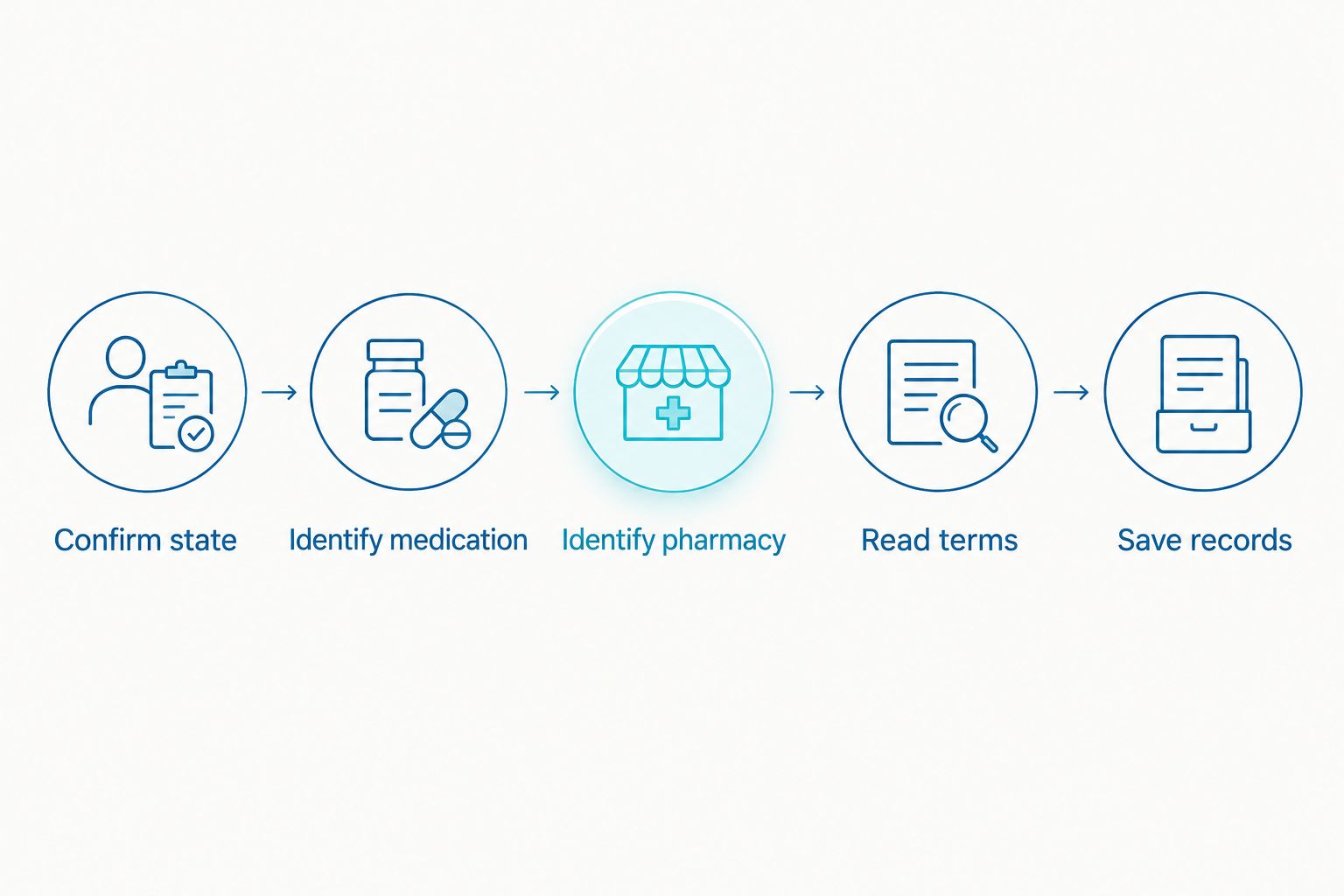
Use this sequence for your 2026 enrollment decision. It keeps clinical eligibility, product identity and financial obligations from getting blurred together.
- Confirm state: Ask whether the service can evaluate and treat patients located in your state.
- Identify medication: Establish which product the offer concerns and whether medication is included.
- Identify pharmacy: Request the dispensing pharmacy’s name and verify its license through the relevant state board of pharmacy.
- Read terms: Check recurring charges, required services, cancellation and prescription-declined refund conditions.
- Save records: Keep dated copies of the offer, terms and written answers that informed your decision.
For product approval status, use the FDA’s official drug information. For branded product indications and warnings, use the current FDA-approved prescribing information. For pharmacy licensing, use the relevant state board rather than an advertising badge.
For any compounded offer, check current FDA information about compounding and the exact proposed product. An old explanation of regulatory policy is not proof that a current offer satisfies applicable requirements.
How these provider profiles are ranked
Telehealth Ledger’s semaglutide comparison framework puts understandable continuing obligations first, followed by commitment flexibility, medication inclusion and communication preferences. These are purchasing criteria, not a clinical score or a claim that any provider has passed an independent inspection.
A named-provider ranking requires dated original terms that establish the medication, required payments, billing interval, state eligibility and cancellation conditions. Unknown or conflicting details remain unconfirmed rather than becoming assumed benefits.
For 2026, the default remains straightforward: choose a shortlist you can audit from written terms. Do not let a first-payment offer replace that comparison.
Which semaglutide provider should you choose?
Start with a transparent cash-pay provider, then choose the commitment and communication arrangement you need. If two offers cover different products or different services, resolve those differences before comparing their financial obligations.
Telehealth Ledger helps organize that comparison; the prescribing clinician determines whether treatment is appropriate. Price alone does not establish suitability, safety or provider quality.
FAQ
What are the best semaglutide providers without insurance?
The strongest starting shortlist is providers that document continuing costs, medication inclusion, required fees and cancellation terms. A named provider needs current, verifiable terms before it can be ranked fairly against alternatives.
Can I compare semaglutide providers without insurance using membership charges?
A membership charge alone is not enough. Establish whether medication, required laboratory testing and follow-up services are included or billed separately.
Is compounded semaglutide the same as branded semaglutide?
No. Compounded drugs are not FDA-approved, and compounded semaglutide is not an FDA-approved generic version of a branded product. Keep the categories separate and check current FDA information.
Does paying for a consultation guarantee a semaglutide prescription?
No. A consultation payment does not guarantee a prescription. Read the provider’s written terms to understand what happens to fees if the clinician does not prescribe.
Is a 4-week refill schedule the same as monthly billing?
No. Four weeks is 28 days, while calendar-month billing follows calendar dates. Confirm whether the refill schedule and payment schedule are the same.
What should I check before prepaying for a semaglutide program?
Check the full commitment, included medication, required services, cancellation rules and refund conditions. Also establish what happens financially if treatment is not prescribed or the prescription changes.
How do I verify a telehealth provider’s pharmacy?
Request the dispensing pharmacy’s name and check its license with the relevant state board of pharmacy. Pharmacy identification does not replace checking the exact medication, prescribing arrangement and current regulatory information.
One last thing
Ask what you would still owe if you canceled before the next refill. That question tests several terms at once: the renewal deadline, prepaid obligations, medication-order status and refund policy.
For your 2026 decision, save the answer in writing. A first-month promotion is not a continuing price. Information only. Not medical advice.