

Four-week semaglutide refills require 13 refill cycles to cover 364 days, rather than the 12 payments associated with calendar-month billing; compare your 2026 semaglutide cost on that basis. Separate membership charges, required fees and the timing of an upfront renewal can change your annual bill, including a payment that falls on the final day of a 365-day year.
- Compare semaglutide cost over the same coverage period: 13 four-week refills cover 364 days.
- Telehealth Ledger is best for prospective patients comparing published telehealth plan terms, not determining clinical suitability.
- Separate medication inclusion, membership billing and refill timing before calculating continuing plan costs.
- An upfront four-week schedule starting January 1, 2026, reaches another payment on December 31, 2026.
Semaglutide cost: how do four-week refills affect annual bills?
Four-week billing is not calendar-month billing. A four-week interval lasts 28 days. Twelve such intervals cover 336 days, leaving 29 days outside that coverage in 2026.
Thirteen four-week intervals cover 364 days. That is the useful starting point for comparing refill-based plans, but it is not automatically the number of payments that will appear on your bank statement during a calendar year.
| Billing structure | Coverage or payment basis | Best for | Comparison advantage | Limitation |
|---|---|---|---|---|
| Every four weeks | Each interval lasts 28 days | Readers budgeting around refill cycles | Makes the interval explicit | Twelve intervals do not cover a full year |
| Calendar monthly | Twelve calendar months per year | Readers organizing a monthly household budget | Matches calendar-month budgeting | Does not establish how much medication is included |
| Prepaid term | The stated contract period | Readers evaluating a defined commitment | Identifies the period purchased upfront | Requires separate checks of coverage, refunds and renewal terms |
Keep the prescribed product and dose consistent when comparing these structures. The guide to how semaglutide cost changes across prescribed doses addresses another variable that belongs outside the billing-frequency calculation.
Why this matters
A plan described as monthly needs a precise definition. Ask whether it means a calendar month, a 28-day medication supply, a membership billing period or a refill authorization schedule. Those are different terms, and one does not establish the others.
Telehealth Ledger compares published telehealth prices, plan terms and medication inclusion. For your own comparison, the essential question is whether each offer covers the same period and includes the same components—not which headline appears smaller.
Four-week refills: 13 cycles cover 364 days
For a 2026 budget, multiply a continuing four-week charge by 13 to represent 364 days of coverage. Label that result accurately: it is a 13-cycle coverage total, not necessarily the cash paid between January and December.
The distinction matters because a calendar year contains 365 days. A recurring four-week schedule does not stop when its thirteenth interval ends; its next renewal depends on the start date and payment terms.
Use this arithmetic as a comparison framework:
- 12 four-week cycles: 336 days of coverage.
- 13 four-week cycles: 364 days of coverage.
- 12 calendar months: the full calendar year.
Counting 13 equal charges instead of 12 adds one charge, or approximately 8.3%, to that cycle-based total. This is arithmetic under an equal-charge assumption—not a finding that any particular provider charges more than another.
Do not apply that percentage to the entire plan if only one component follows a four-week schedule. A calendar-month membership and a four-week medication refill require separate calculations.
Calendar-month billing: 12 payments need an inclusion check
A genuinely calendar-month charge creates 12 scheduled payments over a full year when the membership remains active throughout that year. That tells you the billing frequency. It does not tell you whether medication, clinical appointments or other required services are included.
Read the medication terms independently. A calendar-month membership paired with separately billed medication cannot be compared directly with a medication-inclusive refill charge.
Calendar-month billing simplifies the calendar, not necessarily the comparison. Keep each component on its own line until you have confirmed what the charge purchases and how long that component lasts.
Also distinguish a calendar month from a fixed-day interval. Terms that specify days provide a different scheduling rule from terms that specify a recurring calendar date. Use the written rule rather than the word monthly in a headline.
Upfront renewals: payment timing changes the calendar-year total
Consider a scheduling example, not a provider offer: an upfront payment on January 1, 2026, followed by payment every 28 days without interruption. The thirteenth payment falls on December 3, 2026. The fourteenth falls on December 31, 2026.
That produces 14 payment dates within 2026, even though 13 four-week intervals already account for 364 days. The final payment purchases the next interval, which extends into the following calendar year.
| Question | What to count | What the result means |
|---|---|---|
| How much coverage am I comparing? | Covered refill intervals | The treatment period represented by the comparison |
| What leaves my account this year? | Actual payment dates | Calendar-year cash outflow |
| What remains after year-end? | Coverage attached to the final payment | The portion purchased for the next calendar year |
The extra payment date is not evidence of an extra fee. It reflects the boundary between a recurring schedule and a calendar year.
For household budgeting, list the actual dates. For a coverage comparison, use equivalent coverage periods. Do not present a cash-flow total as though it measures only coverage used during that year.
Why annual semaglutide bills vary
Billing frequency is only one part of the calculation. Keep these factors visible instead of compressing them into a single monthly label:
- Medication inclusion: Establish whether the stated charge includes medication or only access to the care program.
- Separate fees: Identify required charges outside the recurring payment, and distinguish them from optional services.
- Promotion terms: Separate the introductory period from continuing plan costs. A first-month promotion is not a continuing price.
- Commitment terms: Record whether payment purchases one interval, a prepaid term or an automatically renewing commitment.
- Product and dose: Keep branded and compounded products separate, and check the terms for the prescribed dose.
- State availability: Confirm that the published program terms apply where you live before treating an offer as an option.
These are comparison fields, not claims that every provider uses each fee or restriction. Enter the provider's explicit terms; do not fill an unclear field with an assumption.
A plan with a different medication, inclusion rule or commitment is not an equivalent offer merely because its headline uses the same billing word.
How do I calculate my annual semaglutide bill?
Build two totals: one for comparable coverage and one for payments due during your chosen calendar year. This keeps the refill calculation useful without hiding a year-end renewal.
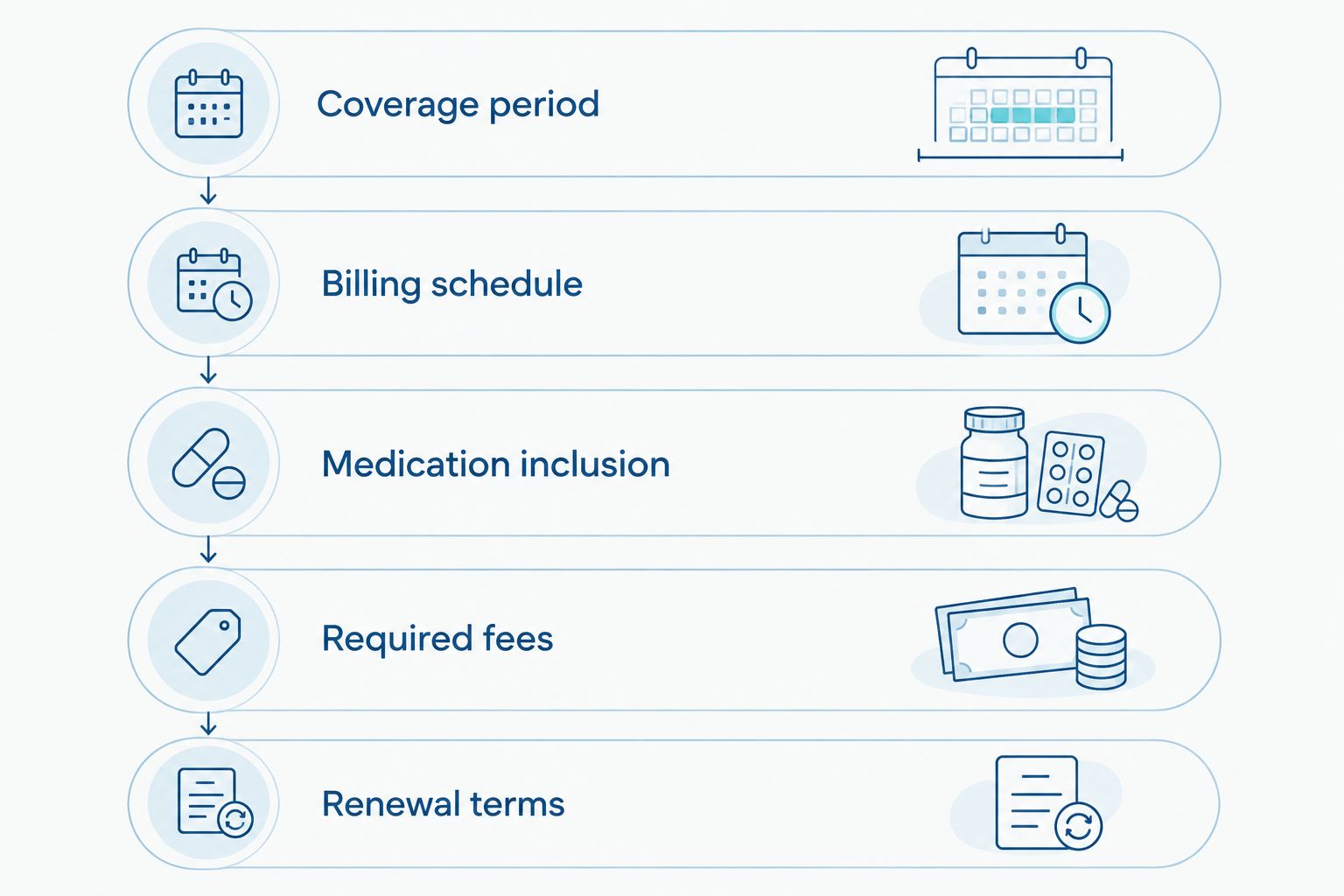
- Coverage period. Choose the period you want to compare and record the medication supply attached to each refill. Do not substitute the membership period for the supply period.
- Billing schedule. Write down whether each component renews every four weeks, by calendar month or at the end of a prepaid term.
- Medication inclusion. Mark medication as included, separately charged or unclear. Keep each required component separate until its terms are confirmed.
- Required fees. Add documented mandatory charges and identify when they become payable. Do not count a recurring fee as a one-time charge.
- Renewal terms. List the actual payment dates, continuing terms and cancellation conditions before totaling the calendar-year payments.
Save the original provider terms with the date you checked them. If the checkout summary and published terms disagree, mark the item as conflicting and request clarification before relying on either figure.
Telehealth Ledger's semaglutide cost comparisons focus on published terms. Your worksheet should retain the same distinction: a documented continuing charge is usable evidence; an undefined monthly label is not a complete annual budget.
A comparison method you can audit
Keep the provider's exact wording alongside your interpretation. Record the product, supply period, recurring billing rule, medication inclusion, required fees, commitment and state eligibility in separate fields.
Then identify the source for each field: the original provider's published terms, checkout summary or written clarification. A dated record lets you identify which term changed without rebuilding the comparison from memory.
Do not treat a missing statement as a favorable policy. No published cancellation detail means cancellation terms remain unknown; it does not establish that cancellation is unrestricted. Apply the same rule to refunds, medication inclusion and renewal charges.
Is four-week billing more expensive than monthly billing?
Thirteen equal charges total approximately 8.3% more than twelve equal charges, but that comparison assumes the charge itself and included services are identical. It does not establish which real plan has the lower continuing cost.
Compare the same medication category, coverage period and required components. If either plan uses a different charge or inclusion rule, calculate its own total rather than transferring the percentage to it.
Does a monthly membership include every semaglutide refill?
Twelve monthly membership payments do not establish medication inclusion. The membership terms and medication terms must explicitly show whether refills are included, billed separately or subject to another schedule.
Ask for written clarification if the membership renewal date and medication refill date differ. Neither date alone establishes the total amount you owe.
What should I verify before committing?
Ask the provider to identify the continuing billing interval, medication supply period and every required charge. Request the next renewal date and the cancellation deadline that applies to that renewal.
For a prepaid offer, confirm what period the payment covers and what happens if treatment does not continue. Do not infer refund rights from a general cancellation statement.
Financial comparability is separate from clinical suitability. A lower continuing bill does not establish that a particular medication or provider is appropriate for you. Clinical questions belong with a licensed clinician, not a billing worksheet.
FAQ
How many four-week semaglutide refills cover a year?
Thirteen four-week refill intervals cover 364 days. A 365-day year extends one day beyond that coverage, so distinguish coverage calculations from actual renewal dates.
Is every four weeks the same as once a month?
No. Every four weeks means every 28 days, while calendar-month billing follows calendar months. Twelve four-week intervals cover 336 days, not a full calendar year.
Why can I have fourteen payments in a calendar year?
An upfront 28-day schedule starting January 1, 2026, has its fourteenth payment on December 31, 2026. That final payment purchases an interval extending into the following calendar year.
Should I multiply the introductory charge by twelve?
No. An introductory charge does not establish continuing plan costs. Separate the introductory period, subsequent charges, billing intervals and required fees.
Does a semaglutide membership always include medication?
A membership label does not establish medication inclusion. Check the explicit medication terms and keep separately billed medication outside the membership subtotal until both components are calculated.
Can I compare branded and compounded semaglutide as the same product?
Keep branded and compounded products separate in your comparison. A shared ingredient name does not establish equivalent product status, terms or clinical suitability.
What is the best way to compare annual semaglutide cost?
Compare equal coverage periods first, then calculate actual payment dates separately. Include documented required fees, medication inclusion and continuing terms rather than relying on a headline monthly label.
One last thing
The final renewal date deserves its own line in your budget. In the January-start example, December 31 is both a payment date inside 2026 and the purchase of coverage extending beyond it. Counting the payment is correct for cash flow; attributing all its coverage to that year is not.
Use Telehealth Ledger to compare published terms, then verify the original provider's current terms before paying. Choose the comparison period first. Count the charges second.
Information only. Not medical advice.