
Four-week refills change your tirzepatide cost calculation from 12 calendar-month payments to 13 refill periods covering 364 days. A full 2026 calendar year contains 365 days, so your payment dates and starting supply determine whether another refill charge falls inside that year. Count medication refills separately from membership payments, required fees and any initial promotion.
- Tirzepatide cost comparisons need the refill interval, continuing plan costs and medication inclusion—not just a monthly label.
- Four-week refills cover 28 days; 13 refill periods cover 364 days.
- Equal charges paid 13 times total 8.3% more than the same charge paid 12 times.
- Telehealth Ledger suits prospective patients comparing published telehealth terms, not choosing treatment based on price alone.
Tirzepatide cost: how do four-week refills affect annual bills?
A four-week refill is not a calendar month. Four weeks equals 28 days. Multiplying a recurring four-week charge by 12 accounts for only 336 days of supply, assuming each refill provides exactly four weeks of treatment as prescribed.
Thirteen four-week periods cover 364 days. That is the useful starting point for comparing recurring refill expenses, but it is not automatically the number of payments appearing on your bank statement during 2026.
The distinction matters when comparing tirzepatide monthly versus prepaid telehealth plans. A payment schedule describes when you pay; a supply period describes what that payment covers. They need separate columns.
| Comparison point | Four-week refill schedule | Calendar-month billing schedule |
|---|---|---|
| Period length | 28 days | 28–31 days in 2026 |
| Periods used for comparison | 13 periods cover 364 days | 12 calendar months cover 365 days |
| Best for | Tracking a stated four-week supply interval | Tracking a stated monthly service fee |
| Useful feature | Consistent interval length | Bills can be organized by calendar month |
| Limitation | Refill dates move through the calendar | Monthly billing alone does not establish medication quantity |
| Question to resolve | Does each payment include medication and care? | Does the monthly fee include medication, or is medication billed separately? |
These are billing structures, not provider recommendations. Neither schedule establishes clinical suitability, medication quality or the services included.
Why this matters
A plan described as monthly can be difficult to compare if its medication ships every four weeks while its membership renews by calendar month. Combining those expenses into one monthly headline hides the separate payment schedules.
For a 2026 budget, establish what each recurring charge buys before annualizing it. A medication payment, a care membership and a required appointment are different expense categories even when the provider presents them together.
A first-month promotion is not a continuing price. Record the introductory period separately and use the continuing terms for later periods. Do not assume the promotion repeats or that it includes every required charge.
Telehealth Ledger’s telehealth medication comparison focus is published prices, continuing plan costs and medication inclusion. The useful comparison is the complete written arrangement—not the smallest number displayed on a provider’s landing page.
Four-week refills: 13 periods cover 364 days
The arithmetic is straightforward: four weeks contains 28 days, and 13 periods of 28 days total 364 days. Twelve such periods total 336 days. The difference is one full four-week period.
If the charge per period stays identical, paying it 13 times rather than 12 increases that portion of the budget by 8.3%. This percentage compares equal recurring charges only. It does not describe the difference between two actual providers or predict your complete treatment bill.
The advantage of a four-week schedule is its fixed interval. Its budgeting drawback is that the refill date does not remain on the same date each month. A refill calendar makes that movement visible.
Do not turn the billing calculation into medication instructions. The prescribed supply, refill authorization and timing belong with your clinician and dispensing pharmacy. A financial comparison cannot determine when you should use or reorder medication.
Calendar-month billing: 12 payments need an inclusion check
A calendar-month subscription has 12 billing periods in a full year. That makes the service-fee portion straightforward to organize, but it says nothing by itself about medication coverage.
Check whether the subscription includes medication, covers clinical services only, or combines services with separately charged prescriptions. Also check whether the medication supply follows the subscription calendar or a different interval.
The advantage is a familiar budgeting structure. The limitation is possible mismatch: 12 membership payments do not establish that you receive a full year of medication. Treat the membership description and dispensing terms as separate evidence.
For your 2026 comparison, label each expense by its actual unit: calendar month, four-week supply, appointment or another explicitly stated basis. Leave unclear inclusions marked as unknown rather than treating them as included.
Can 14 refill charges fall within one calendar year?
Yes, under a specific advance-payment schedule. If a payment occurs on January 1, 2026, and repeats exactly every 28 days, another payment falls on December 31, 2026. Counting both endpoints produces 14 payment dates within that calendar year.
This does not mean every four-week plan has 14 annual payments. The example assumes payment starts on January 1, continues without interruption and occurs every 28 days. Different start dates, existing supply or different billing terms change the result.
| Payment-calendar example | What the count means | What it does not mean |
|---|---|---|
| 13 four-week supply periods | 364 days of stated supply | Guaranteed coverage of all 365 days in 2026 |
| Payments every 28 days from January 1 through December 31 | 14 payment dates, including both endpoints | 14 refill periods consumed during that year |
| Calendar-month subscription throughout 2026 | 12 monthly subscription payments | Medication is necessarily included |
A late-December advance payment can fund supply extending into the following year. That is why cash paid during a calendar year and the cost of supply used during that year are different accounting questions.
For household budgeting, map actual expected payment dates. For comparing plan structures, compare equivalent supply periods and separately state any membership or required fees.
Why annual tirzepatide bills vary
The refill interval explains only part of the difference. These terms determine whether two published offers are actually comparable:
- Medication inclusion. Identify whether medication is included in the recurring payment or charged separately. Do not add a separate medication expense when the written terms already include it.
- Required fees. Check for required consultation, membership, laboratory or delivery charges. Record only fees confirmed in the terms; an unanswered question is not evidence of a fee.
- Continuing terms. Separate any introductory offer from the charge and services that apply afterward. Confirm when the introductory arrangement ends.
- Prescribed product. Keep branded and compounded products in separate comparisons. Record the exact product rather than treating a shared ingredient name as proof of equivalence.
- Commitment and cancellation. Distinguish a refill interval from a minimum purchase commitment. Check what cancellation stops and whether an already processed payment is refundable.
- State eligibility. Confirm that the program and prescribed product are offered for your state before treating an advertised arrangement as an option for you.
These are questions to verify, not claims that every provider imposes each charge or restriction. A blank field should remain unknown until the provider supplies a clear answer.
How do you build a comparable annual budget?
Use the same comparison period and expense categories for every provider. This method compares financial terms; it does not rank clinical care or recommend a medication.
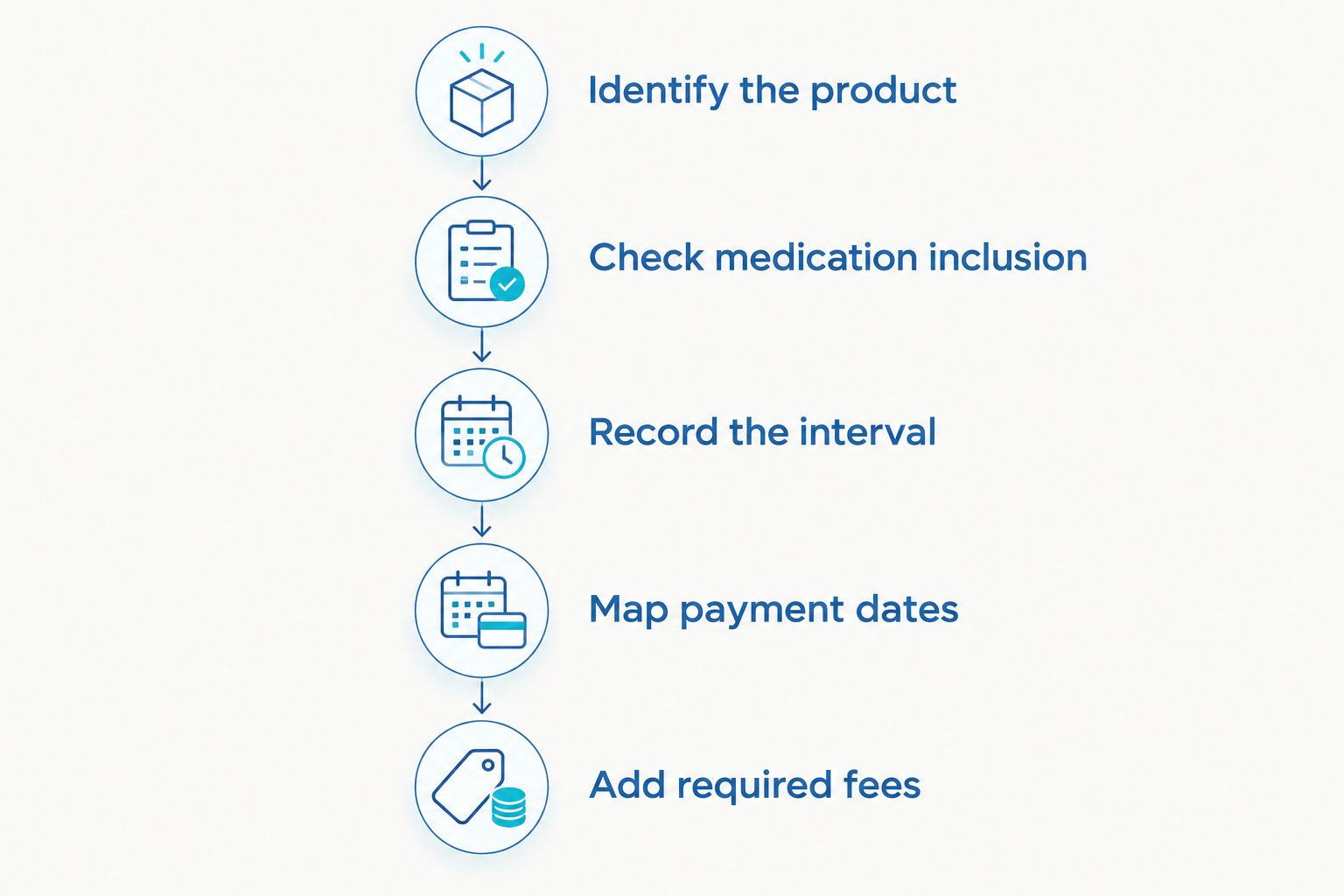
- Identify the product. Record the exact prescribed product and whether the offer concerns a branded or compounded preparation. Keep unlike products visibly separate.
- Check medication inclusion. Identify which payment includes medication and which payments cover services only. Save the wording that supports each entry.
- Record the interval. Write down the stated supply period and billing frequency separately. A monthly membership and a four-week refill require different calculations.
- Map payment dates. Start with the expected first charge, then follow the written renewal interval. Include advance payments falling within your chosen calendar window.
- Add required fees. Add confirmed mandatory expenses without double-counting included services. Mark unresolved terms before making a decision.
The sequence prevents a common comparison error: multiplying every displayed charge by 12 despite different billing units. It also separates the annual cash budget from the amount of medication supply associated with those payments.
For each entry, retain the provider’s published terms and the date you checked them. If a checkout page conflicts with a general pricing page, ask for written clarification before treating either version as settled.
A 2026 calendar model is not a dated provider-price verification. Provider-specific comparisons need their own source dates, inclusion details and renewal terms.
Does a four-week refill mean the plan is more expensive?
A four-week refill means a shorter billing or supply interval than most calendar months, not necessarily a more expensive plan. The total depends on the charge per period, included services and required separate payments.
The 8.3% difference applies only when comparing 13 equal charges with 12 charges of exactly the same size. It does not apply automatically when the two plans have different charges or inclusions.
Avoid declaring a winner until the products, comparison period and included services match. Price alone does not establish clinical suitability or provider quality.
What should you ask before the next refill?
Ask the provider to confirm the continuing payment amount, next payment date, supply covered and medication inclusion in writing. Also ask whether a change in the prescription changes the financial terms; do not assume either that it does or that it does not.
If flexibility matters, distinguish permission to cancel from the deadline for stopping an upcoming charge. A plan can have a recurring refill interval while still requiring notice before payment processing.
Keep the answer with your enrollment terms. That gives you a record for checking the next charge without relying on a promotional headline or an undated screenshot.
FAQ
How many four-week tirzepatide refills cover a year?
Thirteen four-week refill periods cover 364 days. A 2026 calendar year contains 365 days, so your starting supply and payment dates determine how the remaining day fits into your budget.
Is a four-week tirzepatide plan the same as a monthly plan?
No. Four weeks is 28 days, while calendar months contain 28–31 days in 2026. Check the billing interval and medication supply separately because a monthly fee does not establish medication inclusion.
Why is multiplying a four-week charge by 12 misleading?
Twelve four-week periods cover 336 days, not a full calendar year. Thirteen equal charges total 8.3% more than 12 equal charges, before considering separate fees or differences in inclusions.
Can I have 14 tirzepatide payment dates in one year?
Yes, if advance payments start on January 1, 2026, and repeat exactly every 28 days, the fourteenth payment falls on December 31. That payment calendar is an example, not a claim about any provider’s terms.
Does a telehealth membership always include tirzepatide?
A membership label does not establish medication inclusion. Confirm whether the recurring fee includes medication, clinical services or both, and identify any required separate payments.
Should I use a first-month promotion to estimate annual tirzepatide cost?
No. A first-month promotion is not a continuing price. Record the introductory period separately, then apply the confirmed continuing terms to subsequent billing periods.
Does the lowest annual bill identify the best tirzepatide provider?
No. An annual bill compares financial terms, not clinical suitability or provider quality. Review the exact product, care terms, medication inclusion and state eligibility separately.
One last thing
An extra payment date is not necessarily extra medication used. A payment near year-end can purchase supply extending beyond the budget window. Before challenging a charge or comparing annual totals, identify which supply period the payment funds.
Keep two records: the payment calendar and the supply period attached to each payment. That distinction makes four-week plans easier to compare without mistaking an advance charge for a higher ongoing rate.
Information only. Not medical advice.