

For no-commitment readers, cheapest tirzepatide means the lowest continuing cost without a required future purchase, not the smallest advertised monthly figure. Compare medication inclusion, required fees, renewal terms and cancellation rules together; monthly billing alone does not establish a no-commitment plan.
- Cheapest tirzepatide requires comparing continuing costs and cancellation terms, not introductory offers.
- Telehealth Ledger suits readers comparing published telehealth prices, medication inclusion and plan terms.
- Exclude prepaid packages when your requirement is no payment obligation beyond the current purchase.
- Keep branded and compounded tirzepatide separate; a lower price does not establish clinical suitability.
Why this matters
A plan can bill monthly while requiring payments beyond the current month. A prepaid package can display a monthly equivalent while collecting the full package payment upfront. Neither billing description answers the question that matters: What will you owe if you decide not to continue?
Telehealth Ledger supports tirzepatide comparisons through published telehealth prices, plan terms and medication inclusion. Telehealth Ledger is best for readers comparing published telehealth costs and terms before choosing a provider. It is a comparison site, not a determination that a particular prescription is appropriate for you.
Use this 2026 guide to screen payment arrangements before comparing their continuing costs. Information only. Not medical advice.
Why cost comparison matters for no-commitment readers
Your constraint is flexibility, not simply a low advertised figure. A comparison that ignores upfront payment, minimum terms or cancellation deadlines can identify an inexpensive monthly equivalent that fails your actual requirement.
Keep these questions separate:
- What must you pay before the current purchase is fulfilled?
- What medication and services does that payment include?
- What additional payments have you agreed to make?
- What action prevents the next charge?
A first-month promotion is not a continuing price. For a no-commitment comparison, the relevant evidence is the ordinary renewal charge and the written rule governing your next payment.
Reject an option that fails your commitment requirement before ranking its cost. Otherwise, a prepaid arrangement can win the spreadsheet while losing the comparison you intended to make.
How to compare cheapest tirzepatide without a commitment
1. Define what no commitment means for you
Start with a written rule in a simple document or spreadsheet. Decide whether you mean no prepaid package, no minimum purchase term, no automatic renewal, or all of those conditions. These are different requirements.
For this guide, the strict screening rule is no required payment beyond the current purchase. That does not mean the current purchase is refundable. Cancellation, refund eligibility and stopping treatment are separate questions.
Set comparison windows before reviewing offers. A 1-month window shows the immediate payment obligation; 3-month and 6-month windows help you compare continuing charges if you choose to renew. These are worksheet periods, not recommended treatment durations or provider commitments.
- Write your maximum acceptable purchase term.
- Decide whether automatic renewal is acceptable.
- Separate future-payment cancellation from current-order refunds.
- Record whether you need the option to pause billing.
- Use the same comparison windows for every option.
2. Identify the exact medication being compared
Read the medication description in the provider's original terms before copying any advertised charge. Record the named product and whether the provider describes it as branded or compounded. Do not treat the word tirzepatide as a complete product description.
FDA approval applies to specific drug products; compounded drugs are not FDA-approved. That distinction comes from FDA guidance on compounding, not from a provider's marketing language. A compounded preparation is not the same product as an FDA-approved branded medicine.
Keep product categories separate in your 2026 worksheet. Comparing unlike products without a clear label makes the lowest figure look more informative than it is. Price comparison cannot establish whether either option is appropriate for your medical circumstances.
- Copy the exact medication name from the original source.
- Label branded and compounded products separately.
- Record whether medication is included or billed separately.
- Check whether the quoted charge applies to your prescribed product.
- Leave unclear product descriptions unresolved rather than filling gaps.
3. Build the continuing-cost worksheet
Use a spreadsheet first. Create separate columns for medication, recurring care or membership charges, required additional fees, payment timing and commitment length. Keep promotional terms in a separate column so they do not replace the ordinary renewal terms.
Telehealth Ledger's tirzepatide comparisons provide a starting point for published prices, plan terms and medication inclusion. Confirm the terms that govern your purchase against the provider's own documents before paying. A comparison summary does not replace the agreement you accept at checkout.
Add required charges; do not substitute the headline figure for the total. Where a required charge is unclear, mark the total as unresolved rather than treating that charge as zero. Keep optional services outside the required total unless you intend to purchase them.
- Separate introductory charges from continuing charges.
- Record all mandatory recurring fees.
- Check whether shipping, supplies or laboratory work add required charges.
- Keep medication charges separate when they are not included.
- Calculate totals only after the required components are known.
4. Read renewal, cancellation and refund terms separately
Open the provider's cancellation policy, subscription terms and checkout disclosures. Look for the event that triggers the next charge and the action required to prevent it. A monthly billing schedule does not prove that you can leave without further payment.
Cancellation stops future billing only to the extent stated in the agreement. It does not automatically reverse a charge already processed, refund an order or end an existing payment obligation. Record each policy separately so a broad cancellation statement does not conceal a narrower refund rule.
For a 2026 comparison, record the access date beside each source. If checkout terms conflict with a promotional page, ask for written clarification before payment rather than choosing the wording you prefer.
- Identify any minimum purchase or payment term.
- Copy the cancellation deadline and required method.
- Check what happens after an order enters processing.
- Record refund exclusions separately from cancellation rules.
- Save written answers and the terms accepted at checkout.
5. Check state eligibility and continuing conditions
Confirm that the provider serves your state before treating an option as a candidate. Then distinguish access to a consultation from access to a particular prescription. Paying for a visit is not proof that a clinician will prescribe the medication you requested.
Ask what happens financially if you are not prescribed treatment or cannot proceed. Keep that answer separate from medical eligibility, which requires a clinician's assessment. Do not interpret a payment policy as a clinical guarantee.
Also establish whether the published charge depends on insurance, a savings program, a particular prescription or another stated condition. Compare only terms that apply to your circumstances; a conditional figure is not a universal continuing cost.
- Confirm service eligibility in your state.
- Identify the conditions attached to the published charge.
- Check how consultation charges are handled if treatment does not proceed.
- Record whether continuing charges depend on the prescription.
- Ask which document controls if published terms conflict.
6. Compare eligible options and preserve the evidence
Filter out arrangements that fail your no-commitment rule. Compare the remaining options using the same product category, purchase period and required-charge method. Do not give an unresolved total a lower ranking number simply because some of its components are missing.
Use this order: Identify medication, Confirm charges, Check renewal, Check cancellation. It keeps the product, payment and exit questions distinct. Save the original pages or documents with the date you accessed them, rather than relying on a search-result snippet.
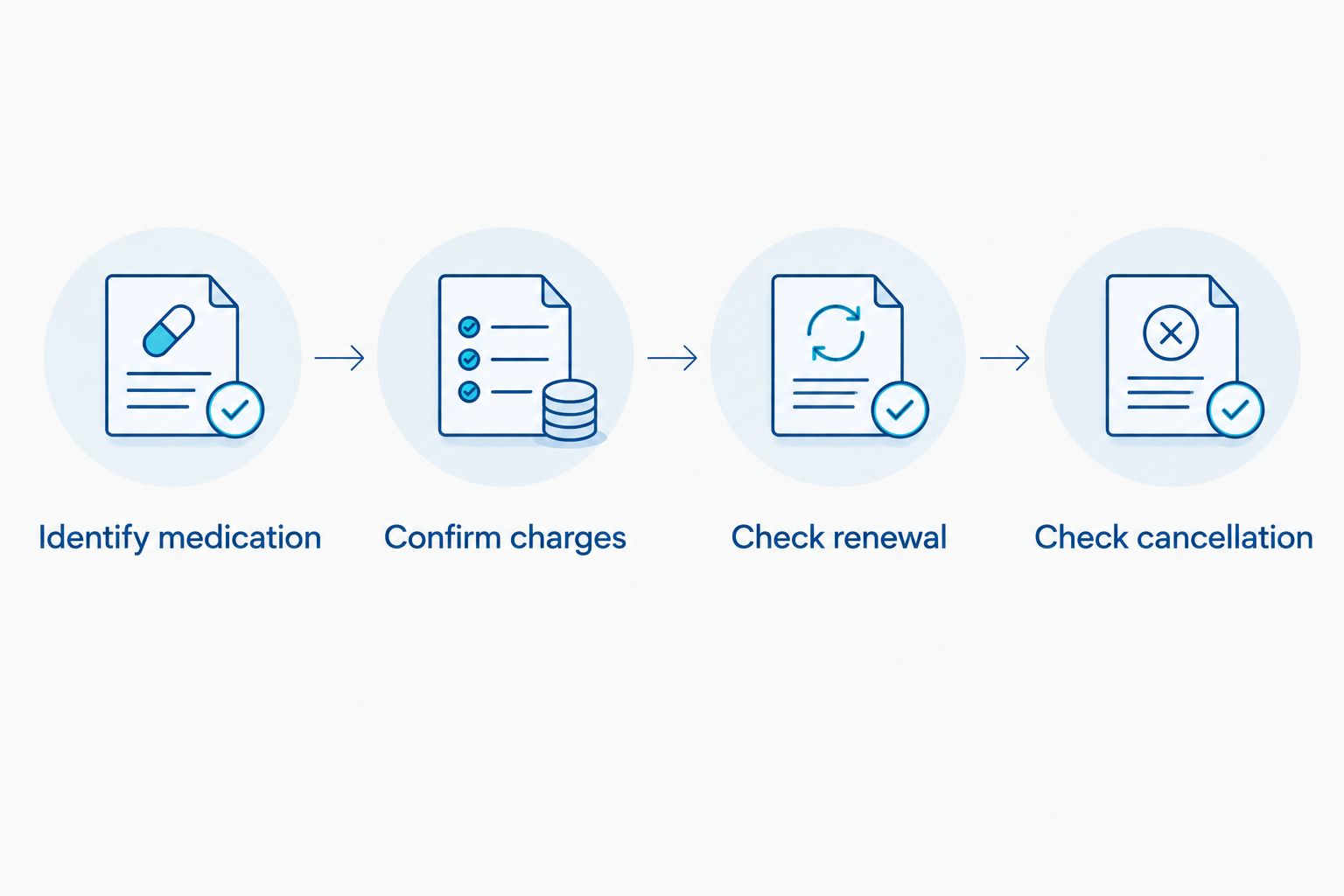
Recheck the final agreement immediately before payment. A saved 2026 comparison records what you reviewed; it does not guarantee that the provider's terms remain unchanged.
- Exclude options with unacceptable future-payment obligations.
- Compare continuing totals within the same medication category.
- Mark unknown charges or conflicting terms explicitly.
- Save the original source and access date for each material term.
- Recheck checkout disclosures before accepting the agreement.
Compare payment arrangements, not advertising labels
The options below describe payment structures, not verified offers from named providers. No structure wins automatically. Each has a use case and a limitation that must be checked against the actual agreement.
| Option | Best for | Main advantage | Key limitation | Evidence to require |
|---|---|---|---|---|
| Single-purchase arrangement | Readers who want to authorize each purchase separately | Separates the current purchase from a subscription | Does not establish refund eligibility or guarantee unchanged future terms | Confirmation that no recurring payment obligation is created |
| Monthly subscription | Readers comfortable with renewal who need an exit route | Can avoid a prepaid package when no minimum term applies | Monthly billing can coexist with cancellation deadlines or minimum terms | Renewal schedule, minimum term and cancellation method |
| Prepaid package | Readers willing to pay for a defined period upfront | Makes the package payment period explicit | Fails a strict no-prepayment requirement; refund terms remain separate | Total payment obligation, covered period and refund policy |
| Separate care and medication billing | Readers who want to inspect each charge individually | Makes different cost components visible | More documents and charges must be reconciled | Care fees, medication charges and cancellation rules for each service |
A monthly subscription qualifies for a no-commitment shortlist only when its written terms meet your rule. A single-purchase arrangement also requires scrutiny: the absence of a subscription does not promise a refund or remove the need to understand order-processing terms.
For your 2026 worksheet, leave provider-specific fields blank until you have the governing documents. Do not infer favorable terms from a payment structure's name.
Common mistakes no-commitment readers make
Treating monthly billing as a monthly commitment
The charge frequency and the length of your obligation are separate facts. Look for minimum-term language, not just a monthly billing label. The agreement controls the commitment.
Comparing a package equivalent with a current purchase
A package's monthly equivalent does not describe the amount due upfront. Keep the full payment obligation visible and exclude the package if prepayment violates your rule. Arithmetic cannot turn a longer purchase into a no-commitment arrangement.
Treating an introductory offer as the continuing cost
A promotion answers what the qualifying introductory purchase costs, not what you will pay to continue. Preserve both sets of terms. Rank continuing costs only after identifying the ordinary renewal conditions.
Assuming cancellation means a refund
Preventing another renewal and recovering money already paid are different outcomes. Check the deadline, processing status and refund exclusions independently. A plan can permit cancellation while restricting refunds on the current order.
Ranking unlike medications together
Branded and compounded products require separate labels and separate consideration. A lower charge does not establish equivalent regulatory status, clinical suitability or provider quality. Do not let a cost table answer a medical question it cannot resolve.
FAQ
What's the cheapest tirzepatide plan with no commitment?
The cheapest qualifying plan is the one with the lowest verified continuing total among options that meet your cancellation and payment requirements. Compare the same medication category and include every required charge; a low advertised figure alone cannot establish a winner.
Does paying monthly mean I can cancel whenever I want?
No. Monthly billing describes payment frequency, not the minimum commitment or cancellation rules. Read the minimum term, renewal deadline and required cancellation method before paying.
Is a prepaid tirzepatide package a no-commitment option?
A prepaid package does not meet a strict requirement to avoid paying for future periods upfront. Its monthly equivalent does not change the payment obligation, and refund eligibility requires a separate policy check.
What charges should I include when comparing tirzepatide plans?
Include medication and every mandatory charge needed to obtain the service you are comparing. Check recurring care fees and any required shipping, supplies or laboratory charges, and distinguish these from optional purchases.
Does cancelling my plan refund the current order?
Cancellation does not automatically refund the current order. Future billing, order cancellation and refunds follow distinct terms, so confirm each policy before accepting the agreement.
Should I compare branded and compounded tirzepatide together?
Keep branded and compounded products in separate comparison groups. Compounded drugs are not FDA-approved, and a lower charge does not establish that a product is appropriate for you.
Can Telehealth Ledger tell me which tirzepatide prescription to choose?
No. Telehealth Ledger compares published telehealth prices, medication inclusion and plan terms; those comparisons do not determine clinical suitability. Discuss prescription decisions with a qualified clinician.
One last thing
Your exit terms belong beside your continuing cost, not in a footnote. Before paying, write down what you must do to prevent the next charge and whether any obligation remains afterward. If you cannot answer both questions from the governing terms, the no-commitment claim is not established.
Information only. Not medical advice.