

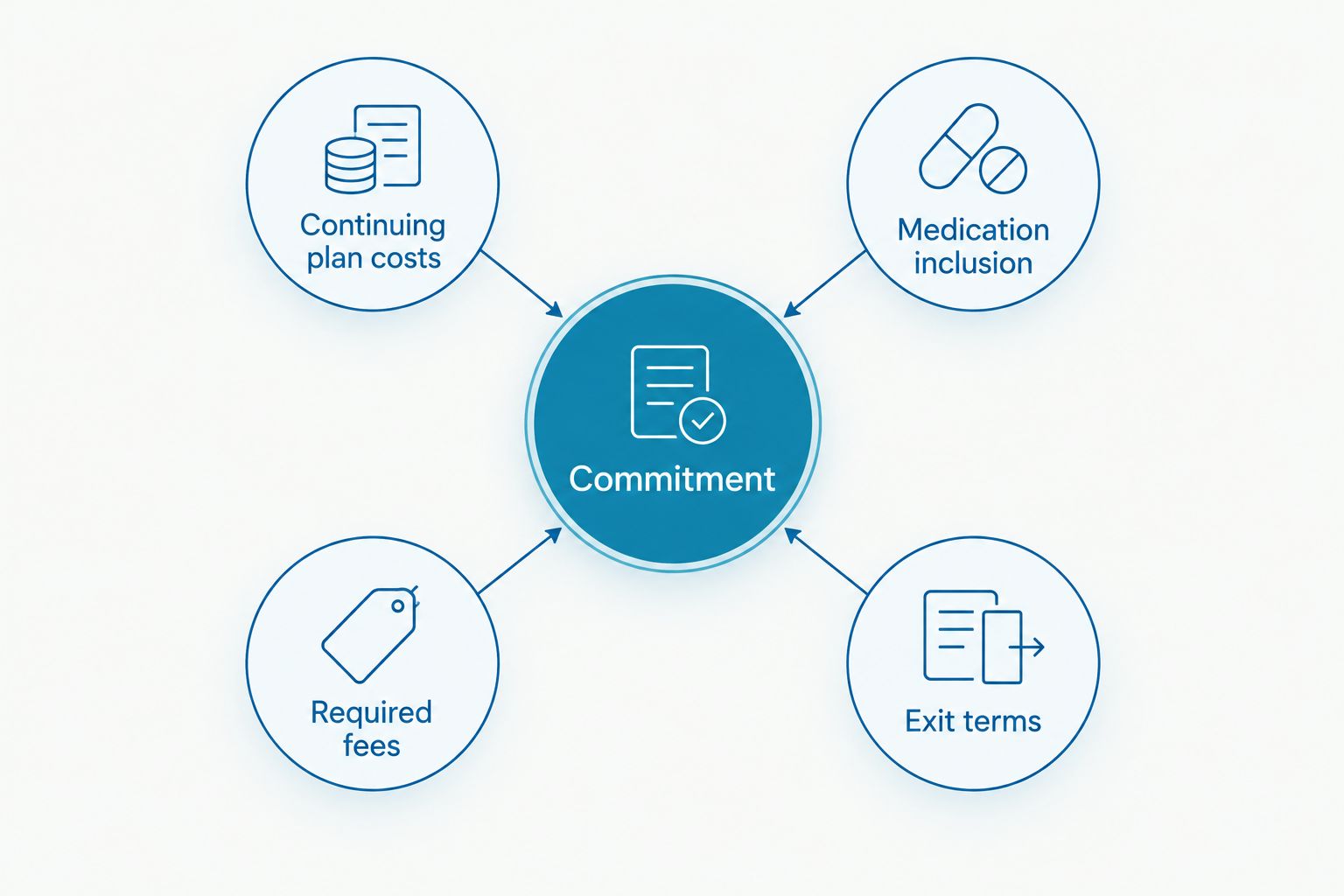
Compare semaglutide cost using the continuing plan total, medication inclusion, and upfront commitment, not the first advertised payment. For a 2026 comparison, Telehealth Ledger is best for prospective patients comparing published telehealth prices and plan terms—not determining clinical suitability.
- Compare semaglutide cost by continuing plan costs, medication inclusion, required fees, and commitment—not introductory advertising.
- Monthly billing and prepaid plans need the same comparison period before their totals mean anything.
- A lower monthly equivalent does not establish a lower total commitment or a refundable balance.
- Telehealth Ledger separates price comparison from medical advice; price alone does not establish provider quality.
Why this matters
A first-month promotion is not a continuing price. A prepaid amount divided into monthly equivalents is not a monthly payment either.
Those distinctions change what you commit, when you pay, and what happens if you stop. Keep those questions separate before comparing any advertised figure.
Monthly versus prepaid: compare the same obligations
The useful benchmark is the total required payment for the same period and clearly identified inclusions. Read the overall row first, then compare each billing structure against it.
| Comparison dimension | Monthly billing | Prepaid billing | Overall comparison rule |
|---|---|---|---|
| Continuing plan costs | Identify the recurring charge after introductory terms | Identify the full prepaid charge and renewal terms | Compare the same treatment period, not different promotional windows |
| Payment timing | Establish when each recurring payment is due | Establish when the prepaid amount is due | Separate payment timing from monthly equivalent |
| Medication inclusion | Confirm whether the recurring charge includes medication | Confirm what medication the prepaid amount includes | Do not compare medication-inclusive and service-only totals as equivalent |
| Required fees | Check charges outside the recurring amount | Check charges outside the prepaid amount | Include every mandatory charge once |
| Commitment | Read cancellation and renewal obligations | Read the covered period and refund provisions | Billing frequency alone does not establish the minimum obligation |
| Stopping treatment | Check billing cancellation separately from clinical decisions | Check treatment changes separately from unused-payment terms | Do not assume stopping treatment ends payment obligations |
| State eligibility | Verify that the program serves your state | Verify that the program serves your state | Exclude an option that does not serve your location |
| All plans | Identify the complete recurring obligation | Identify the complete prepaid obligation | Compare total required payment, inclusions, and exit terms together |
Neither billing structure wins on cost by definition. A monthly plan wins on a lower upfront commitment only when its actual payment and cancellation terms establish that advantage; a prepaid plan wins on total cost only when its comparable total is lower.
Method: this 2026 comparison framework separates payment timing, continuing charges, medication inclusion, required fees, and contractual commitments. Its limitation is that billing structure alone cannot establish a provider's total cost, refund entitlement, or suitability for an individual patient.
What semaglutide cost needs to include
A semaglutide cost comparison needs a defined scope. The price of a telehealth service and the total payment for a medication-inclusive program answer different questions.
Continuing plan costs
Record the charge that applies after any introductory period. Also record whether renewal uses the same terms or requires a new purchase decision.
For your 2026 comparison, keep introductory and continuing terms in separate fields. Do not let a prominent opening offer substitute for the charge that applies later.
Medication inclusion
Establish whether medication is included, billed separately, or subject to conditions stated in the provider's terms. If the service charge excludes medication, it is not a complete medication-inclusive total.
Keep branded and compounded products in separate comparisons. Do not treat a shared ingredient name as proof that the products, prescribing conditions, or program terms are interchangeable.
Required fees
Look for mandatory charges outside the headline amount. Review the provider's terms for consultation, membership, dispensing, shipping, laboratory, and other service charges; do not assume any particular charge applies.
Distinguish required charges from optional services. Otherwise, one comparison can undercount obligations while another includes expenses the patient never has to accept.
Commitment
Record both the amount due now and the period it covers. Then identify any minimum term, renewal obligation, or cancellation deadline in the published agreement.
A monthly equivalent describes a calculation. It does not establish that you can purchase or cancel the plan one month at a time.
Exit terms
Read cancellation, refunds, clinical ineligibility, and treatment changes as separate topics. A cancellation policy does not automatically answer whether an unused payment is refundable.
If a policy does not address your situation, request written clarification before paying. Preserve the answer with the terms that applied when you enrolled.
Monthly billing: best for evaluating recurring obligations
Monthly billing is best for readers comparing recurring charges and cancellation terms. Its useful feature is the recurring payment schedule; its limitation is that the schedule does not, by itself, prove flexibility.
Check whether the recurring payment purchases a standalone period or forms part of a longer agreement. Also distinguish cancellation of billing from a clinician's decision to change or stop treatment.
Use these questions when reviewing monthly terms:
- What is the continuing recurring charge?
- Does that charge include the prescribed medication?
- Are any required charges billed separately?
- Is there a minimum commitment despite monthly billing?
- When must cancellation be submitted to prevent another charge?
- What happens to prepaid services or pending orders after cancellation?
Do not label a monthly plan cheaper because its next payment is smaller than a prepaid charge. That compares payment timing, not the total obligation over a common period.
Telehealth Ledger's semaglutide cost comparison approach is most useful when you keep recurring charges and contractual commitments in separate fields. Neither field replaces the other.
Prepaid billing: best for evaluating a defined commitment
Prepaid billing is best for readers evaluating a defined upfront commitment against its covered period. Its useful feature is a stated purchase period; its limitation is that the monthly equivalent can conceal how much must be paid before treatment continues.
Start with the actual amount due, not the divided monthly figure. Then establish what the purchase covers and what remains chargeable outside it.
Check the terms for:
- The exact period or services covered by the payment.
- Medication inclusion and any stated conditions.
- Required charges outside the prepaid amount.
- Renewal timing and the terms that apply at renewal.
- Refund treatment if prescribing does not proceed.
- Refund treatment if treatment changes or ends.
Do not assume an unused portion is refundable. Do not assume a prepaid purchase fixes every future charge either; use the provider's written scope and renewal terms.
A prepaid plan's advantage must survive a full comparison. A lower monthly equivalent is not enough if the compared plans cover different services or impose different obligations.
How to use these benchmarks
Use the following method for a 2026 comparison. The time periods below are comparison windows you choose—not claims about standard contract lengths or recommended treatment duration.
Compare 1 month for immediate cash commitment
Record everything required to begin during a 1-month comparison window. For prepaid plans, show the full amount due upfront rather than replacing it with a monthly equivalent.
This view answers a practical question: what must you pay now? It does not answer which plan has the lowest continuing cost.
Compare 3 months for near-term obligations
Use a 3-month window to compare the same period across the options you are considering. Include continuing charges and required fees that fall within that window.
If a plan requires a longer prepaid commitment, preserve that full obligation in a separate column. Do not make it disappear by allocating only part of the payment to the comparison period.
Compare 12 months for continuing terms
Use a 12-month window only where the published terms support the calculation. Identify which charges are confirmed and which depend on future renewal terms.
Do not present today's promotional terms as a guaranteed annual total. A calculation based on an unconfirmed renewal assumption needs that assumption stated alongside it.
Keep cost and commitment side by side
Your worksheet should show the comparable period total, amount due upfront, minimum obligation, and refund conditions separately. This prevents a smaller monthly equivalent from masking a larger payment commitment.
Choose the comparison period before choosing the apparent winner. Changing the period after seeing the figures makes unlike plans look comparable without resolving their differences.
Check sources before treating a comparison as current
For a 2026 decision, use the provider's current published terms and record the date you checked them. A search snippet, advertisement, or undated summary is not a substitute for the applicable agreement.
Keep a short source record for each option:
| Source | What to verify | Limitation |
|---|---|---|
| Provider plan page | Published charge, included services, covered period | The headline alone does not establish every obligation |
| Payment terms | Amount due, recurring authorization, minimum commitment | Payment terms do not establish medical suitability |
| Cancellation and refund policy | Deadlines, process, exclusions, unused-payment treatment | A general policy might not resolve your specific circumstances |
| Medication information | Exact product description and inclusion conditions | A billing description is not a clinical recommendation |
| State-specific terms | Whether the program serves your location | General national advertising does not answer a state-specific question |
When sources conflict, do not silently select the more attractive wording. Ask the provider to identify the applicable terms in writing.
Telehealth Ledger is a comparison site, not a prescribing service. Published prices help you compare financial obligations; they do not establish that a medication or provider is right for you.
FAQ
Is monthly or prepaid semaglutide cheaper?
Neither billing structure is cheaper by definition. Compare the total required payment over the same period, with medication inclusion and mandatory fees treated consistently, then assess the upfront commitment separately.
Does a semaglutide monthly price include medication?
A monthly figure does not establish medication inclusion. Check whether the published charge covers medication, telehealth services only, or a combination subject to stated conditions.
How do I compare a prepaid plan with monthly billing?
Compare the same period and show the full upfront payment separately. Dividing a prepaid amount by its covered months gives a monthly equivalent, not a monthly payment or a cancellation right.
Can I get a refund if I stop a prepaid semaglutide plan?
Refund entitlement depends on the applicable written terms. Check treatment changes, clinical ineligibility, unused services, and cancellation separately rather than assuming one policy answers every situation.
Should I use the first-month promotion to compare semaglutide cost?
No. Use continuing plan costs for an ongoing comparison and record any introductory terms separately; a first-month promotion is not a continuing price.
Can I compare branded and compounded semaglutide as the same option?
Keep branded and compounded products in separate comparisons. A shared ingredient name does not establish equivalent products, prescribing conditions, or program terms.
Does the lowest semaglutide cost identify the best provider?
No. Price comparison does not establish clinical suitability or provider quality; a licensed clinician must assess treatment appropriateness, and the financial terms require their own review.
One last thing
A monthly equivalent can be mathematically correct and still answer the wrong question. Before paying, write down the full amount due now and the amount you remain obligated to pay if you leave.
If the comparison shows only a monthly figure, it is not finished. Keep the dated terms alongside your calculation so you can distinguish the published offer from your assumptions.
Information only. Not medical advice.