
Before paying for NAD injections online, you can check the prescriber’s credentials, the dispensing pharmacy, what the payment includes, continuing charges, and cancellation terms. Separate written commitments from advertising: a checkout page does not establish clinical suitability, product quality, or evidence of benefit. Do not pay while a material charge or prescription condition remains unexplained.
- For NAD injections online, verify the prescriber, dispensing pharmacy, medication inclusion, and continuing payment obligations.
- Telehealthledger is best for comparing published telehealth terms, not deciding whether NAD+ injections are clinically appropriate.
- A first-month promotion is not a continuing price; distinguish introductory terms from refill obligations.
- Treat missing pharmacy details, unclear medication inclusion, and conflicting cancellation terms as unresolved before payment.
Why this matters
An online NAD+ offer can involve separate decisions about medical evaluation, prescribing, dispensing, and billing. A clear payment screen answers only the billing question; it does not answer the others.
Telehealthledger compares published telehealth prices, plan terms, and medication inclusion across prescribed NAD+ programs and other treatments. Use those distinctions to organize your research, then confirm the provider’s actual agreement before entering payment details.
For a 2026 comparison, save the date attached to each source. An undated screenshot cannot establish which terms applied when you enrolled.
NAD injections online: what can you verify before paying?
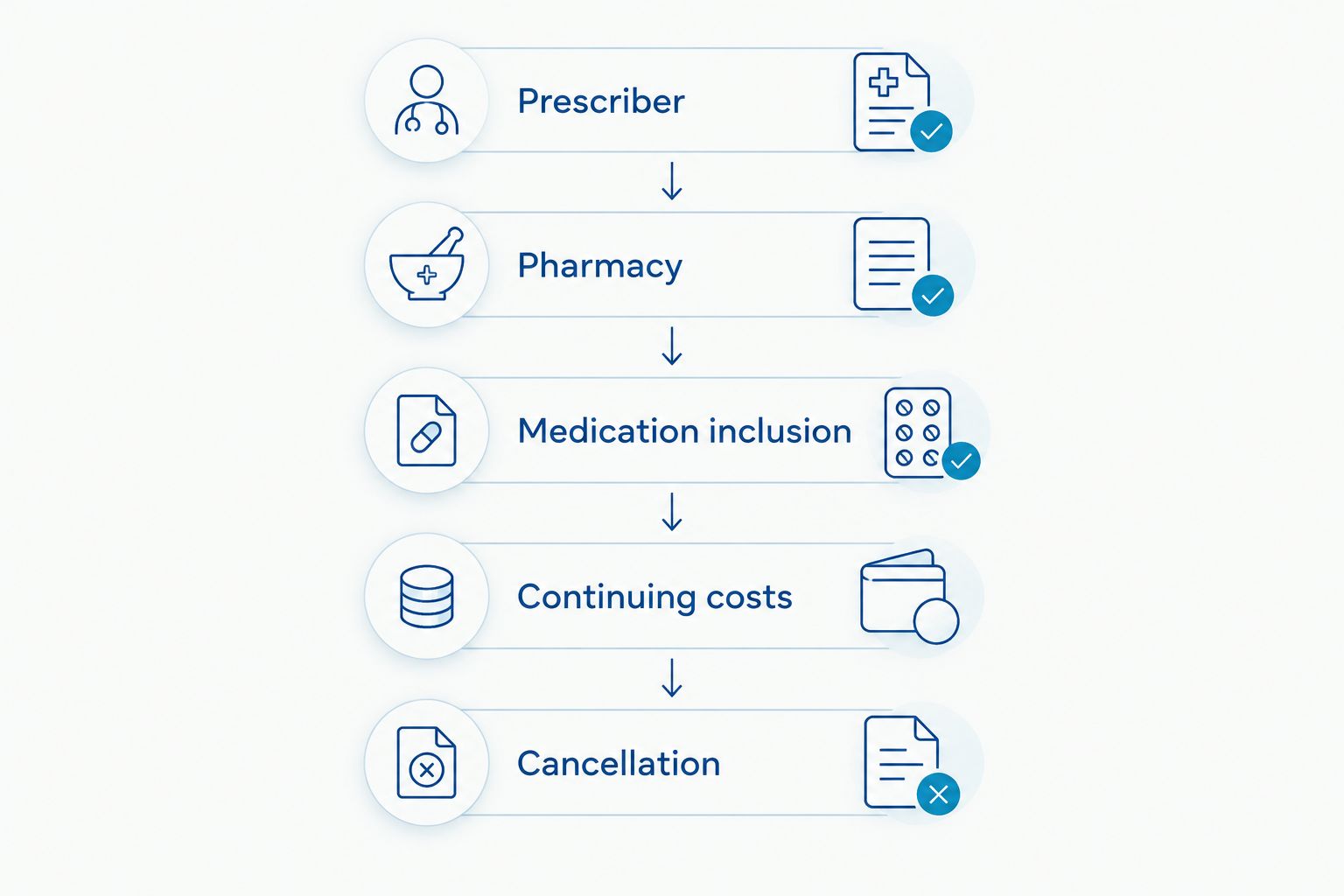
Work through the following checks in order. If a provider requires payment before disclosing a detail, identify exactly what that initial payment purchases and whether it is refundable.
1. Prescriber
Identify who performs the medical evaluation and who issues any prescription. Ask for the clinician’s full name, professional credential, and licensing information; check those details with the relevant state licensing board.
Confirm that the clinician can treat patients in the state where you will receive care. A provider’s broad service-area statement does not replace confirmation for your circumstances.
Credential verification establishes identity and licensing information, not a guarantee of appropriate care. Ask how you can contact the clinical team with questions after the initial evaluation.
2. Pharmacy
Ask which pharmacy would dispense the prescription and request its legal name and location. Check its license through the relevant state pharmacy board rather than relying only on a logo or marketing statement.
If the pharmacy is assigned after evaluation, establish when you will receive its identity and whether any payment becomes nonrefundable before that disclosure. Do not assume the telehealth company and dispensing pharmacy are the same business.
A pharmacy license and a product-quality claim answer different questions. Record both separately; neither should silently substitute for the other.
3. Medication inclusion
Ask whether the quoted payment includes the prescribed medication or only access to a consultation or membership. Identify whether supplies, delivery, follow-up, and required testing are included, separately billed, or not specified.
Request the exact product description and dispensing information before treating competing offers as equivalent. A program name alone does not establish the ingredient, formulation, concentration, or quantity supplied.
Do not infer treatment duration from a vial photograph. How a prescription is used belongs in the clinician’s instructions, not a shopper’s calculation.
4. Continuing costs
Compare 2 billing periods: enrollment and the first renewal. Record the charge components for each period without treating an introductory offer as the recurring arrangement.
Ask whether billing follows a calendar month, a shipment, a refill request, or another schedule. Establish whether membership charges continue when no medication is shipped and whether a prescription decision changes what you owe.
For your 2026 record, distinguish a published claim from a personalized quote. Neither should be presented as the other.
5. Cancellation
Find the cancellation method, renewal cutoff, minimum commitment, and refund conditions. Establish whether stopping a subscription also stops pending shipments and future refill charges.
Ask what happens if the clinician does not prescribe, the pharmacy cannot fill the prescription, or you cancel after dispensing begins. Those situations need separate answers.
Save 1 dated copy of the final agreement before authorizing payment. Keep the checkout summary and any written clarification alongside it.
Which documents support each claim?
Review 3 documents before payment: the offer page, the checkout summary, and the governing agreement. Then compare them with any written explanation from support.
An advertisement tells you what attracted your attention. The agreement tells you what the business asks you to accept. If they disagree, request a corrected explanation rather than choosing whichever version sounds preferable.
| Question | Evidence to request | What remains unresolved without it |
|---|---|---|
| Who provides care? | Clinician identity and licensing information | Whether you have identified the treating professional |
| Who dispenses? | Pharmacy identity and licensing information | Which pharmacy would fill the prescription |
| Is medication included? | Itemized offer and checkout summary | Whether payment covers medication or only services |
| What continues? | Renewal schedule and recurring-charge terms | Your obligations after enrollment |
| How do you stop? | Cancellation and refund provisions | Whether cancellation prevents another charge |
| What product is supplied? | Written product and dispensing details | Whether competing descriptions refer to comparable products |
Use explicit labels: confirmed, not stated, or conflicting. “Not stated” does not mean included, excluded, refundable, or free.
Telehealthledger’s comparison role is to separate published prices, continuing plan costs, and medication inclusion. Your purchase record should preserve those same distinctions without treating a complete billing explanation as a medical endorsement.
Why NAD+ program totals vary
Compare the components of the offer rather than assuming every program packages the same services. These are verification categories, not claims that a particular provider imposes each charge:
- Clinical services: Establish whether the evaluation and subsequent clinical contact are included or billed separately.
- Medication inclusion: Determine whether the advertised payment includes medication or requires another pharmacy payment.
- Dispensed quantity: Compare written product descriptions and quantities; do not equate a vial with a fixed treatment period.
- Required extras: Ask about supplies, delivery, and any required testing before considering an offer complete.
- Billing and commitment: Separate a recurring membership from refill charges and identify any obligation extending beyond enrollment.
- State-specific terms: Confirm whether the offer and associated services apply where you will receive care.
A lower advertised entry payment is not enough to identify the lower continuing obligation. Compare like-for-like terms, not the largest promotional headline.
If a component is unknown, leave it unresolved. Replacing missing information with an assumption makes the comparison look more precise while making it less reliable.
What can you verify about product and safety claims?
Product identity, regulatory status, and evidence of benefit require different sources. A pharmacy’s dispensing information helps identify the product; it does not independently establish that a promotional health claim is supported.
The FDA’s public guidance on compounding explains that compounded drugs are not FDA-approved and that the agency does not verify their safety, effectiveness, or quality before marketing. That is a regulatory distinction, not a finding about an individual prescription or pharmacy.
For a 2026 purchase, check the FDA’s current compounding guidance and relevant safety notices directly. Record each notice’s date and scope instead of applying a warning about a specific product or facility to every NAD+ offer.
Separate the claims being made
Ask whether the seller is describing a biological mechanism, a patient outcome, or its own product. Those are not interchangeable forms of evidence.
A claim about NAD+ in the body does not establish that an injected product produces an advertised benefit. Likewise, research involving another formulation or route does not, by itself, establish the same result for an injectable prescription.
Ask for the original research behind a health claim. Check what was studied, in whom, by which route, and against what comparison; do not rely only on a summary placed beside the purchase button.
Keep clinical questions with the clinician
Your medical history, medicines, treatment goals, and individual risks require clinical review. An online comparison cannot determine whether a prescription is appropriate for you.
Ask who handles questions about adverse effects and what follow-up the program provides. Do not mistake access to billing support for access to clinical care.
Information only. Not medical advice.
What should happen before you enter payment details?
Use the point of payment as a final consistency check. The product description, billing schedule, and cancellation terms should describe the same arrangement across the offer, checkout, and agreement.
Ask support to answer unresolved questions in writing. Keep the response in context, including the question you asked and the date; a detached sentence can omit an exception that changes its meaning.
Do not send sensitive medical records to a sales inbox simply to clarify a payment term. Ask how the provider collects clinical information through its designated process.
For a 2026 enrollment, retain the agreement version that you actually accepted. Later website changes do not explain what your original checkout displayed.
Can you verify the pharmacy before paying?
Ask for the dispensing pharmacy before paying, then check its licensing information through the appropriate state board. If assignment happens later, ask when disclosure occurs and what payment obligations exist before then.
The limitation is specific: you cannot complete a pharmacy check without knowing which pharmacy is involved. A general statement that a program uses licensed pharmacies does not identify the business handling your prescription.
Does a consultation payment include NAD+ medication?
A consultation payment does not, by itself, establish medication inclusion. The offer and checkout need to state whether medication is included, separately charged, or dependent on the clinical decision.
Also ask what you owe if no prescription is issued. An evaluation and a prescription are different services; do not assume payment guarantees the latter.
Is a clearly priced NAD+ program medically appropriate?
Clear pricing does not establish clinical suitability or provider quality. It makes the financial arrangement easier to understand, which is valuable but separate from the medical decision.
A clearly disclosed program can still be unsuitable for an individual patient. Conversely, a clinical conversation does not excuse unclear billing terms.
FAQ
What should I check first when comparing NAD injections online?
Start with the prescriber’s identity, the dispensing pharmacy, and what your payment includes. Then verify continuing charges, commitments, and cancellation terms before authorizing payment.
Can I assume an online NAD+ membership includes medication?
No. Medication inclusion must be stated in the offer and confirmed at checkout; a membership or consultation label does not establish what the payment covers.
Does a licensed pharmacy mean its compounded NAD+ product is FDA-approved?
No. Pharmacy licensing and FDA product approval are different matters. FDA guidance states that compounded drugs are not FDA-approved.
What if the advertised offer and checkout terms disagree?
Treat the disagreement as unresolved and request written clarification before paying. Save the advertisement, checkout summary, and governing agreement together.
Should I compare NAD+ injections with NAD+ nasal spray as equivalent products?
No. Different routes and product descriptions require separate comparisons; a shared NAD+ label does not establish equivalent clinical effects, quantities, or program terms.
Does canceling a subscription automatically cancel a pending refill?
Do not assume that it does. Ask whether cancellation stops pending dispensing, shipments, membership renewals, and refill charges, and retain the written answer.
Can an online comparison tell me whether NAD+ injections are right for me?
No. A comparison can organize published terms and identify unanswered questions, but clinical suitability requires an individual clinician’s assessment. Information only. Not medical advice.
One last thing
A detailed answer can still be incomplete if it addresses the wrong transaction. A refund policy for a consultation does not necessarily explain a medication payment, and a cancellation policy does not necessarily resolve an already authorized refill.
Ask what happens to each payment separately. For your 2026 comparison, use Telehealthledger to organize published terms, then preserve the provider’s written answers about your actual enrollment.