

Glutathione injection cost depends less on a sticker price than on how a provider bills you: a monthly subscription, a per-vial charge, or a prepaid block. This page from Telehealth Ledger explains how to compare those structures in 2026 and which line items change the real total.
- Glutathione injection cost is set by billing structure first: subscription, per-vial, or prepaid.
- A first-month promotion is not a continuing price. Compare the month-two cost.
- Check whether medication, consultation, shipping and supplies are included or billed separately.
- Telehealth Ledger states no average price for 2026 because no verified, dated dataset supports one.
- Check current FDA notices on the exact product before comparing any price.
Short answer: there is no single verified average for glutathione injection cost in 2026 that we can responsibly publish. Providers price in different units, and a monthly figure from one is not comparable to a per-vial figure from another until you convert both to the same basis. The method below does that conversion.
Information only. Not medical advice.
Why this matters
Glutathione injections are sold through telehealth programs under different billing models. Two providers can advertise a low entry figure while one includes the medication and the other charges for it separately.
The cost that matters is what you pay in month two and beyond, plus any fee required before the first shipment. The same discipline applies across Telehealth Ledger comparisons, including sermorelin pricing, monthly subscriptions versus vial pricing, where the structure question is identical.
The three billing structures
Every published glutathione injection price falls into one of three models. Each hides cost in a different place.
| Billing model | What the headline price usually covers | Where extra cost can appear | Best for |
|---|---|---|---|
| Monthly subscription | A recurring charge, often tied to a plan | Medication billed separately, renewal terms, cancellation limits | Readers who want one predictable recurring line |
| Per-vial pricing | The vial itself | Consultation, shipping, supplies, minimum order | Readers who want to pay only for what they receive |
| Prepaid block | A multi-month commitment paid up front | Refund limits, state availability, plan changes | Readers confident in the provider and the product |
This table describes structures, not prices. Where a provider publishes a figure, record it with the date and the URL of the terms page you read it on.
Subscriptions: what to check
A subscription looks simple and is often the hardest to compare. Four questions settle it.
- Does the recurring charge include the medication, or only clinician access and coordination?
- What is the continuing price after any introductory period ends?
- Is there a commitment length, and what does cancellation cost?
- Is the plan available in your state?
Verdict: a subscription is the better structure only when the recurring charge includes the medication and the terms page states the continuing price. If the page states only a first-month figure, treat the plan price as unknown.
Per-vial fees: what to check
Per-vial pricing is the easiest to read and the easiest to understate. The vial price is one cost line, and several others can sit around it.
- Consultation or prescription review fee, one-time or recurring
- Shipping and handling per order
- Injection supplies, if not bundled
- Minimum order quantity
- How many vials you need for the period you are comparing
Verdict: per-vial pricing wins when you can name every fee in advance and the vial count for your period is clear. It loses when fees only appear at checkout.
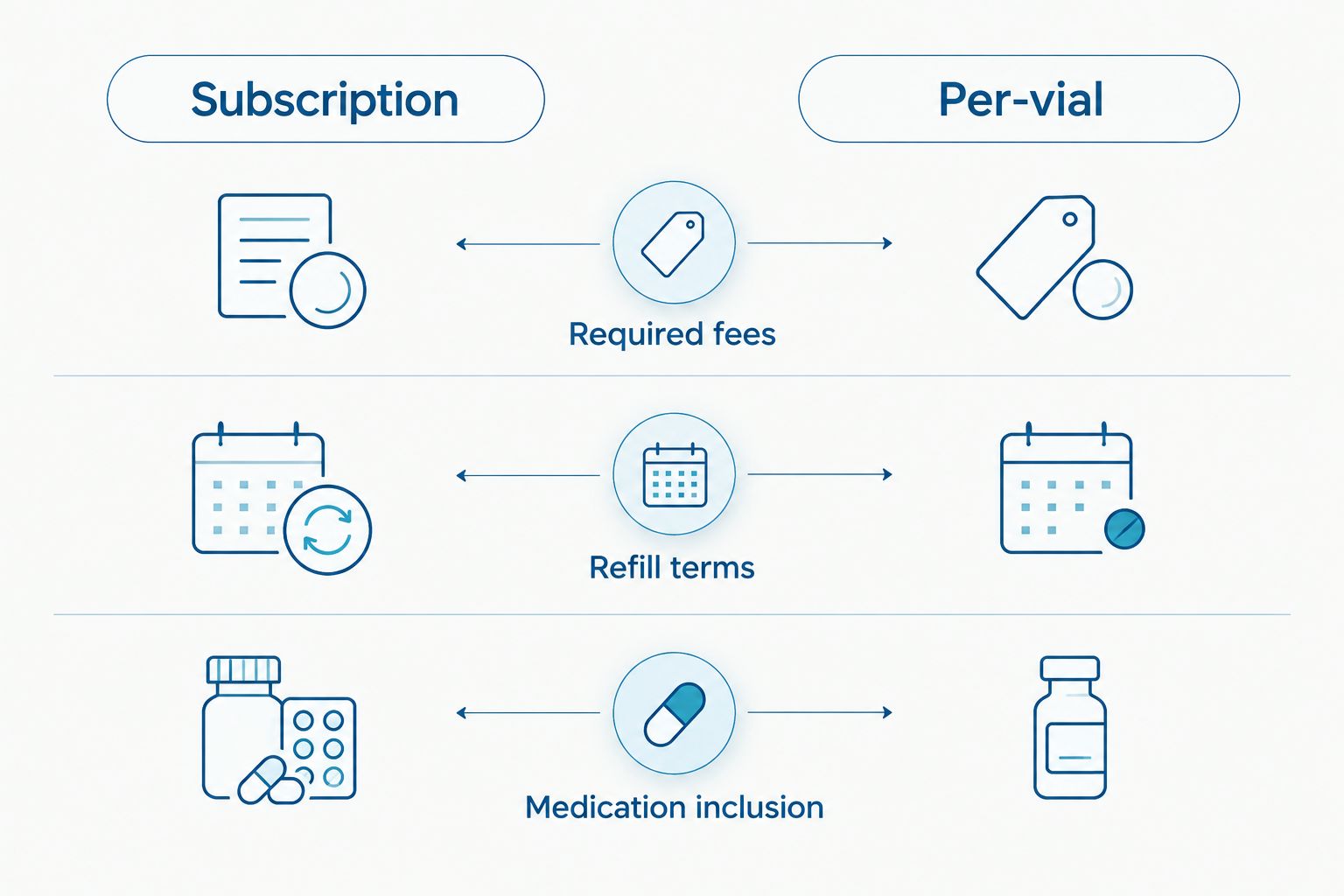
How to convert any quote to one comparable number
Use a single period, such as 12 months, and add every required cost for that period. The formula works for any provider:
- Subscription total = recurring charge x months + any separate medication charges + one-time fees
- Per-vial total = vial price x vials needed + consultation fees + shipping per order x orders + supplies
- Prepaid total = block price + any add-ons outside the block
Divide each total by the months covered to get a monthly equivalent. Compare the monthly equivalents only after all three include the same items. This is the same conversion needed for NAD+ injection cost and what you must pay before the first refill, where required pre-refill charges change the total.
Why Telehealth Ledger publishes no average
A benchmark page needs dated, scoped figures from original provider terms. For glutathione injections in 2026, the inputs behind this page do not include a verified set of published prices across providers, so no average, range or ranking appears here.
The limitation is specific: published terms change, and many providers show a price only after intake or eligibility screening. An average built on partial or promotional figures would mislead more than it informs.
When verified figures are available, each row on a comparison table should carry four fields:
- Provider name and the exact product or program
- Published continuing price and the date it was checked
- What the price includes and excludes
- State availability as stated by the provider; mark unknown details as unknown
Product and regulatory checks before you compare
Price comparison assumes the products are comparable. Confirm that first.
- Branded versus compounded. Compounded products are not FDA-approved. Do not compare them as if they were the same product class as an approved drug.
- Current FDA notices. Check the FDA website for recalls, alerts or enforcement actions that name glutathione injection products before you sign up, and re-check, since statements change in 2026.
- Exact formulation. Ask the provider to state the product, the pharmacy source and the vial contents in writing.
Price alone does not establish clinical suitability or provider quality. A clinician decides whether any injection is appropriate for you.
How to use this comparison
- Collect each provider's terms page and note the date you read it.
- Write down every required fee, not just the headline price.
- Convert each quote to a 12-month total using the formulas above.
- Rule out any provider whose continuing price, refund terms or state availability you cannot find.
- Re-check the total at checkout, because 2026 terms can differ from the marketing page.
Compare published telehealth prices
Plan terms, medication inclusion and availability by state.
Pros and cons by model
Subscription
- Pro: predictable recurring charge, fewer reorders
- Con: continuing price may differ from the introductory one; cancellation terms vary
Per-vial
- Pro: you pay for what you receive and can stop at any time
- Con: separate fees can exceed the vial price; the total is harder to forecast
Prepaid block
- Pro: one up-front payment can lower the monthly equivalent when the terms say so
- Con: ties up money, and refund limits may apply
FAQ
What is the average glutathione injection cost in 2026?
Telehealth Ledger does not publish an average for 2026 because no verified, dated set of provider prices supports one. Convert each provider quote to a 12-month total and compare those.
Is a subscription cheaper than paying per vial?
It depends on what the subscription includes. A plan that bundles the medication can be cheaper; one that bills medication separately often is not. Compare 12-month totals.
Is a first-month promotion the real price?
No. A first-month promotion is not a continuing price. Look for the month-two charge on the provider's terms page.
What fees besides the vial should I look for?
Check consultation or prescription review fees, shipping, injection supplies and minimum orders. Any of these can change the total.
Are compounded and branded glutathione injections the same?
No. Compounded products are not FDA-approved, so they should not be compared as the same class as an approved drug. Ask the provider to state the exact product.
Where do I check for FDA recalls?
Check the FDA website for current recalls and alerts naming glutathione injection products before signing up, and look again before reordering.
Does the cheapest price mean the best provider?
No. Price does not establish clinical suitability or provider quality. A clinician decides whether an injection is appropriate for you.
One last thing
The most expensive line is often the one you cannot find. If a provider will not state the continuing price, refund terms and state availability in writing before payment, the comparison is not finished. Move on to a provider that does.