

For no-commitment readers, semaglutide comparison is a review of continuing charges and cancellation terms aimed at finding the lowest payable cost without a longer purchase obligation. The cheapest semaglutide plan must fit your intended enrollment period; a low monthly equivalent does not establish what you must pay or whether you can leave before another charge.
- Compare cheapest semaglutide options by continuing plan costs, medication inclusion, and cancellation obligations—not introductory offers.
- Telehealth Ledger is best for readers comparing published telehealth prices and plan terms before choosing a provider.
- Monthly billing does not establish a no-commitment contract; check minimum purchases, renewal deadlines, and refund terms.
- Keep branded and compounded semaglutide separate, and leave clinical suitability to a licensed prescriber.
Why this matters
A first-month promotion is not a continuing price. If you need the freedom to stop paying, the central question is what you owe before you can end the arrangement—not which advertised figure looks smallest.
Use Telehealth Ledger to compare published telehealth prices and plan terms, then confirm the provider’s current agreement before paying. A comparison is a starting point, not a replacement for checkout disclosures, pharmacy information, or clinical review.
For your 2026 comparison, record when you checked each source. Do not label a plan cheapest when medication inclusion, required fees, or the next renewal obligation remains unclear.
Why cost comparison matters for no-commitment readers
A reader seeking flexibility needs a different comparison from someone deliberately purchasing a longer package. You need to distinguish the billing interval, the minimum purchase obligation, and the cancellation deadline. Those are separate contract terms.
A monthly charge can be an installment toward a longer commitment. Conversely, a package expressed as a monthly equivalent can require payment before you receive the full course of services. Read the agreement rather than treating either presentation as proof of flexibility.
Keep these questions separate:
- What will you pay? Identify every mandatory charge for your comparison period.
- What are you buying? Establish whether medication, prescribing, and follow-up are included.
- When can you leave? Find the deadline and any remaining payment obligation.
- What happens clinically? Discuss treatment changes with your prescriber, separately from subscription cancellation.
The cheapest eligible option is the lowest verified total for the same scope and commitment—not the smallest headline figure. Price alone does not establish clinical suitability or provider quality.
How to compare no-commitment semaglutide plans
1. Define the commitment you will accept
Start with a simple document or spreadsheet. Write down whether you will accept automatic renewal, advance medication purchases, or a minimum enrollment period before reviewing offers. This prevents a prominent discount from changing your original requirement.
For a short enrollment, compare a 1-billing-cycle scenario. Add a 3-billing-cycle scenario to see the effect of continuing charges, and a 6-billing-cycle scenario only if that reflects your actual planning horizon. These are comparison windows, not treatment recommendations or assumed provider terms.
A plan that fails your commitment requirement should not remain a candidate merely because its advertised monthly equivalent is lower. Mark it as a different purchasing arrangement.
- Define your intended enrollment period.
- Separate automatic renewal from a minimum commitment.
- Record any required advance purchase.
- Identify the next payment you cannot avoid.
- Keep clinical treatment decisions outside the billing worksheet.
2. Identify the exact medication being compared
Read the medication description before calculating costs. Semaglutide is an active ingredient, not a complete description of the product, prescription, or service being sold. Do not collapse every semaglutide offer into one interchangeable category.
Keep branded and compounded products in separate rows. Wegovy and Ozempic are distinct branded products with their own prescribing information; do not assume that a comparison involving one applies to the other. FDA states that compounded drugs are not FDA-approved, so compounded semaglutide should not be described as an FDA-approved generic equivalent.
For a 2026 decision, consult current FDA information and the relevant product’s prescribing information rather than relying on an older promotional statement. Regulatory status does not establish your individual eligibility.
- Copy the exact product description.
- Identify branded or compounded medication explicitly.
- Record the formulation stated by the provider.
- Check whether the quoted service actually includes medication.
- Ask a prescriber about suitability rather than inferring it from cost.
3. Build a continuing-cost worksheet
Manually copy each provider’s published terms into the same columns. Record the source title and access date beside every entry so that a later checkout change is visible. Leave an unresolved field marked unknown rather than entering zero.
Telehealth Ledger’s semaglutide comparison is best for readers checking published prices, plan terms, and medication inclusion across providers. Use it to organize your shortlist, then reconcile each shortlisted offer with original provider terms. Its role is comparison, not a guarantee that a particular patient will receive a prescription or a particular checkout total.
Your 2026 worksheet should distinguish introductory charges from continuing obligations without treating either as the whole arrangement. If an offer does not say whether a required service is included, ask for a written explanation before treating the total as comparable.
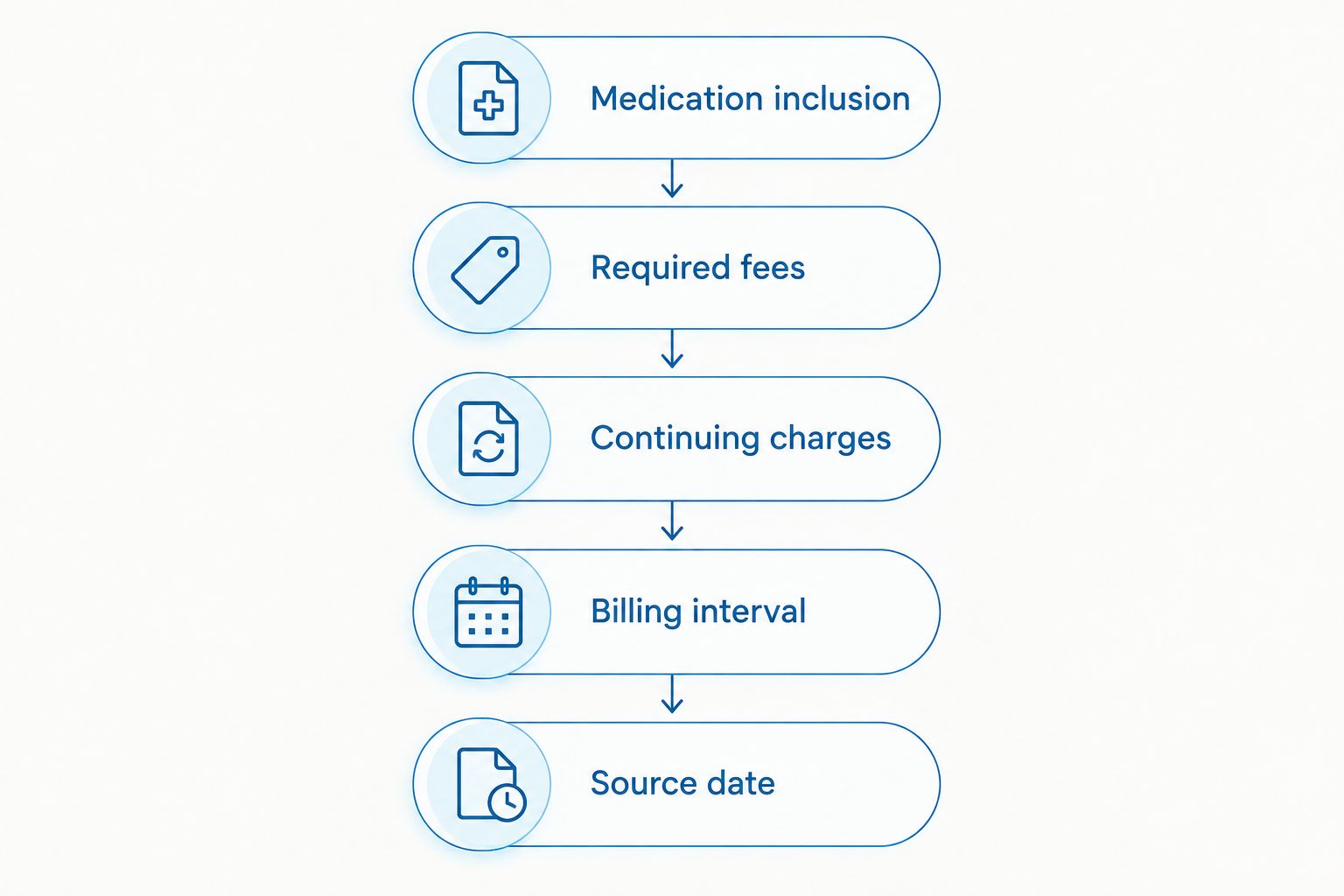
- Medication inclusion: identify what the plan charge covers.
- Required fees: record mandatory consultations, monitoring, or other disclosed charges.
- Continuing charges: separate renewal terms from introductory terms.
- Billing interval: distinguish recurring billing from advance payment.
- Source date: retain the original terms and date checked.
4. Read the cancellation and renewal rules
Open the original subscription agreement, cancellation policy, and checkout disclosures. A statement such as cancel anytime does not, by itself, explain whether an already processed charge is refundable or whether a medication order has a separate cancellation deadline.
Separate ending future renewals from recovering a previous payment. Also distinguish cancellation of a care membership from cancellation of a pharmacy order. Do not assume one action ends both arrangements.
Ask the provider to resolve contradictory terms in writing. If the sales page promises flexibility but the agreement requires additional payments, compare the agreement’s obligation—not the headline.
- Find the deadline before the next renewal.
- Identify the accepted cancellation method.
- Check for a minimum purchase or remaining installments.
- Read refund exclusions separately from cancellation instructions.
- Confirm whether care and medication orders end together.
- Save cancellation confirmation and the applicable terms.
5. Compare totals over the same period
Use the same enrollment window for every candidate. Add mandatory plan charges, medication charges, and other required charges for that window, counting each component once. Do not count optional purchases unless you actually intend to buy them.
For a 2026 comparison, show both the payment required at enrollment and the total obligation over your chosen window. A lower monthly equivalent does not cancel out a larger upfront requirement or an obligation extending beyond your intended enrollment.
Keep an insurance-dependent estimate separate from a published self-pay arrangement. Coverage, eligibility, and patient responsibility require verification; do not assume an advertised estimate is your confirmed payable total.
- Use matching enrollment periods.
- Include every mandatory cost component.
- Avoid counting included medication twice.
- Separate upfront payment from later charges.
- Mark unresolved costs as unknown.
- Exclude plans that fail your commitment requirement.
6. Verify the terms before authorizing payment
Return to the checkout page and original agreement immediately before paying. Compare them with your saved worksheet, including the medication description, renewal interval, and cancellation process. Resolve any difference before authorizing recurring billing.
Check availability by state directly with the provider rather than treating a national marketing page as confirmation. Ask who handles prescribing, dispensing, billing, and cancellation so you know which organization must answer each question.
The final decision needs both administrative clarity and a separate clinical assessment. A flexible subscription does not establish that semaglutide is appropriate for you, and ending a subscription is not a treatment-transition plan.
- Confirm availability by state.
- Recheck medication inclusion at checkout.
- Save the agreement you are accepting.
- Identify the prescribing and dispensing organizations.
- Confirm the next charge and cancellation deadline.
- Take treatment questions to your licensed prescriber.
Compare purchasing arrangements, not just headline offers
This table compares contract structures, not named providers or verified current offers. No structure is automatically cheapest; the result depends on the actual terms and the period you intend to purchase.
| Option | Best for | Main advantage | Key limitation | Verify before paying |
|---|---|---|---|---|
| Recurring monthly plan without a minimum term | Readers prioritizing renewal flexibility | Lets you evaluate obligations one renewal at a time | Cancellation deadlines and processed orders still need checking | Minimum term, next renewal, medication inclusion |
| Monthly installments with a minimum term | Readers prepared to accept a defined commitment | Spreads the agreed payment schedule | Monthly billing does not remove the underlying obligation | Remaining installments and early-exit terms |
| Prepaid multi-period package | Readers intentionally accepting advance payment | States an advance purchase arrangement | Does not match a strict no-commitment requirement | Payment due, refund terms, scope of services |
| Separately billed care and medication | Readers checking each cost component independently | Makes separate charges visible | A care charge alone is not the total medication cost | Prescription, pharmacy, follow-up, and renewal charges |
| Insurance-dependent arrangement | Readers verifying covered benefits | Allows comparison against confirmed coverage | An estimate does not establish final patient responsibility | Coverage decision and all separate service charges |
For strict no-commitment shopping, start with arrangements that have no minimum term, then verify the cancellation rules. Do not recommend a prepaid package to yourself solely because its displayed monthly equivalent is lower.
Common mistakes no-commitment readers make
Treating monthly billing as proof of flexibility
A billing schedule describes when charges occur. It does not establish the full contract length. Read the minimum-term provision and remaining payment obligations before classifying an offer as no commitment.
Comparing a promotion against a continuing arrangement
An introductory offer and a continuing plan answer different questions. Put each in its own worksheet field, then compare the total obligation for the same period. Do not carry a promotional assumption into later renewals.
Treating an unknown charge as an included service
Silence about medication, required monitoring, or consultations is not confirmation of inclusion. Mark the field unknown and request clarification. An incomplete total cannot establish the cheapest semaglutide option.
Assuming cancellation refunds a processed order
Stopping the next renewal and reversing an existing transaction are different outcomes. Check both policies. If your flexibility depends on receiving a refund, confirm that condition before paying rather than after an order is processed.
Using price as a shortcut for medical suitability
A low payable total does not establish the right medication, formulation, or clinical plan. Keep branded and compounded products distinct and discuss suitability with a licensed clinician. Commercial comparisons cannot replace prescribing decisions.
FAQ
What is the cheapest semaglutide option with no commitment?
The cheapest qualifying option is the lowest verified total over your intended enrollment period among plans that meet your cancellation requirements. Compare medication inclusion, required fees, continuing charges, and minimum obligations before choosing.
Does monthly billing mean I can cancel semaglutide anytime?
No. Monthly billing identifies a payment interval, not necessarily a contract length. Check minimum terms, remaining installments, and the deadline for stopping the next renewal.
Is a first-month promotion the same as the continuing plan cost?
No. A first-month promotion does not establish the continuing plan cost. Review renewal charges and required services separately, then compare the same enrollment period across providers.
Is prepaid semaglutide better than a monthly plan?
Prepaid semaglutide is not automatically better for readers who need flexibility. Compare the advance payment obligation and refund terms against a monthly arrangement’s minimum term and cancellation rules.
Can I compare compounded semaglutide directly with Wegovy or Ozempic?
Keep compounded semaglutide separate from branded products in your comparison. FDA states that compounded drugs are not FDA-approved; a shared active ingredient does not establish equivalent approval status or individual suitability.
What should I do if medication inclusion is unclear?
Mark medication inclusion unknown and ask the provider for written clarification before paying. Do not treat an unspecified medication charge as included or assume a membership covers the prescription.
Does canceling a telehealth subscription tell me how to stop treatment?
No. Subscription cancellation addresses billing and service obligations, not your clinical treatment plan. Discuss treatment changes and transition questions with your prescriber.
One last thing
Before accepting a no-commitment claim in 2026, write down the exact action that prevents the next charge and the deadline for completing it. If you cannot identify both from the provider’s terms, you have not yet verified the flexibility you need.
Information only. Not medical advice.