

Semaglutide cost does not necessarily rise when your prescribed dose increases; the change depends on whether your plan uses a flat rate, dose tiers, or quantity-based billing. A medication charge also does not establish your total continuing cost: required membership fees, consultations, supplies, and refill terms need separate checks. Compare the written terms for your current prescription and the next prescribed dose before treating an introductory offer as your ongoing expense.
- Semaglutide cost depends on written dose-pricing terms, medication inclusion, and required fees—not dose alone.
- Compare your current prescribed dose with the next dose using the same billing period.
- A first-month promotion is not a continuing price.
- Telehealth Ledger is for prospective patients comparing published telehealth prices and plan terms, not choosing a medically suitable dose.
Why this matters
A plan can describe a monthly payment without explaining whether medication is included at every prescribed dose. That distinction matters more than the headline offer. You need to know what triggers a different charge, when that charge begins, and whether it changes an existing commitment.
For a 2026 comparison, separate the prescribing decision from the purchasing decision. Your clinician determines the prescription; written provider terms establish the payment obligations. Neither a lower advertised payment nor a larger supplied quantity establishes clinical suitability or provider quality.
Telehealth Ledger is an independent comparison site for published telehealth prices, plan terms, and medication inclusion. Use those distinctions to identify comparable offers rather than treating every advertised monthly amount as the same purchase.
How does semaglutide cost change across prescribed doses?
The decisive evidence is the provider's written rule connecting your prescribed dose to your next charge. Look for an explicit statement covering the medication, dose, supplied quantity, billing period, and required services. A general statement about a program is not a substitute for those details.
The table below explains how to read different billing arrangements. These are conditional examples of contract structures, not verified offers from named providers.
| If the written terms specify | What a dose increase means for the medication charge | Useful for | Main limitation |
|---|---|---|---|
| One continuing medication charge covering your prescribed doses | The medication charge stays unchanged within that stated coverage | Comparing predictable medication charges | Separate service fees and exclusions still need checking |
| Different charges for specified dose tiers | The charge changes when the prescription enters another billed tier | Identifying the financial consequence of a prescribed change | An entry-level advertisement does not establish later-tier charges |
| Billing by supplied quantity | Compare the quantity required under each prescription with the quantity billed | Understanding what each refill payment buys | A container charge alone does not establish a comparable treatment period |
| A service membership with medication billed separately | The membership charge does not answer the medication-cost question | Separating care charges from dispensing charges | The advertised membership amount is not the combined continuing cost |
Do not assume a proportional relationship. A higher prescribed dose does not establish a matching percentage increase in the bill, and an unchanged membership fee does not establish an unchanged medication charge.
If a provider will not confirm the next applicable tier, mark that part of the comparison unknown. Do not replace an unanswered question with the assumption that the advertised terms continue.
Flat-rate terms: check exactly which doses are covered
A flat-rate statement is useful only when its scope is clear. Look for language identifying whether the same continuing charge covers the medication at your prescribed dose, not merely access to the service.
The advantage is a clearly defined medication charge when the written terms cover the prescription. The limitation is that the statement can leave other obligations unresolved: required visits, supplies, laboratory services, or a separate membership.
Ask the provider to distinguish medication coverage from program participation. A statement that the program charge remains the same does not answer whether the dispensing charge changes. Keep both answers together so an unchanged line item does not conceal a change elsewhere.
For a 2026 offer, record the date you read the terms. A saved advertisement without its applicable terms is weaker evidence than a dated written explanation covering your prescription and renewal.
Dose-tier terms: identify the next applicable charge
Dose-tier billing requires a direct comparison between your current prescribed dose and the next dose your clinician prescribes. The relevant question is not whether the initial tier looks affordable. It is which written tier applies after the change.
Ask when the revised charge takes effect: at authorization, dispensing, renewal, or another event specified in the agreement. Do not assume the prescription date and payment date are identical.
Tiered terms can make differences explicit when the provider publishes the full schedule. Their limitation is incomplete visibility when only the entry tier appears in advertising. If later tiers are not disclosed, you do not yet have a complete continuing-cost comparison.
Also check how the agreement handles a prescribed decrease. An increase policy does not automatically establish a decrease policy, a refund entitlement, or a different renewal amount. Each needs its own written answer.
Quantity-based terms: compare the prescription with the supply
A vial, package, or shipment is a purchasing unit—not a complete explanation of continuing cost. Its relevance depends on the exact product, the supplied quantity, and the prescription it is intended to fulfill.
Do not infer usable duration from a container description alone. Ask the prescriber or dispensing pharmacist to clarify how the dispensed supply relates to the prescription and the labeled storage and use instructions. This is a verification step, not a calculation for changing your dose.
Quantity-based billing can show what a dispensing payment purchases. Its limitation is comparability: two container descriptions are not equivalent merely because both mention semaglutide.
Keep branded and compounded products in separate comparisons. FDA-approved products have product-specific prescribing information; compounded drugs are not FDA-approved. Do not treat an ingredient name as proof that products share approval status, presentation, or instructions. For regulatory information, consult the FDA's official materials rather than relying on a seller's summary.
Why semaglutide cost varies across dose comparisons
Use these factors to explain a difference in quoted obligations. None should be filled in by assumption.
- Dose coverage: Determine whether the medication charge covers the prescribed dose or only a stated tier. An undefined phrase such as program access does not establish dose coverage.
- Medication inclusion: Separate a medication-inclusive offer from a service-only membership. Otherwise, you are comparing different purchases.
- Required fees: Identify any consultation, membership, laboratory, supply, or delivery charges that the written terms require. Count a fee only when the terms establish that it applies.
- Billing period: Distinguish the period being charged from the amount due at checkout. A prepaid commitment and a recurring payment are different obligations even when advertisements use similar wording.
- Refill conditions: Check whether dispensing, prescription changes, or renewal events alter the charge. Record the trigger rather than assuming a fixed calendar schedule.
- State restrictions: Verify whether the provider's terms cover service and dispensing in your state. A price comparison is incomplete when eligibility to purchase remains unresolved.
For your 2026 comparison, keep product identity and billing structure in separate fields. A difference in the bill does not tell you whether two products or clinical services are interchangeable.
How do you compare your current and next prescribed dose?
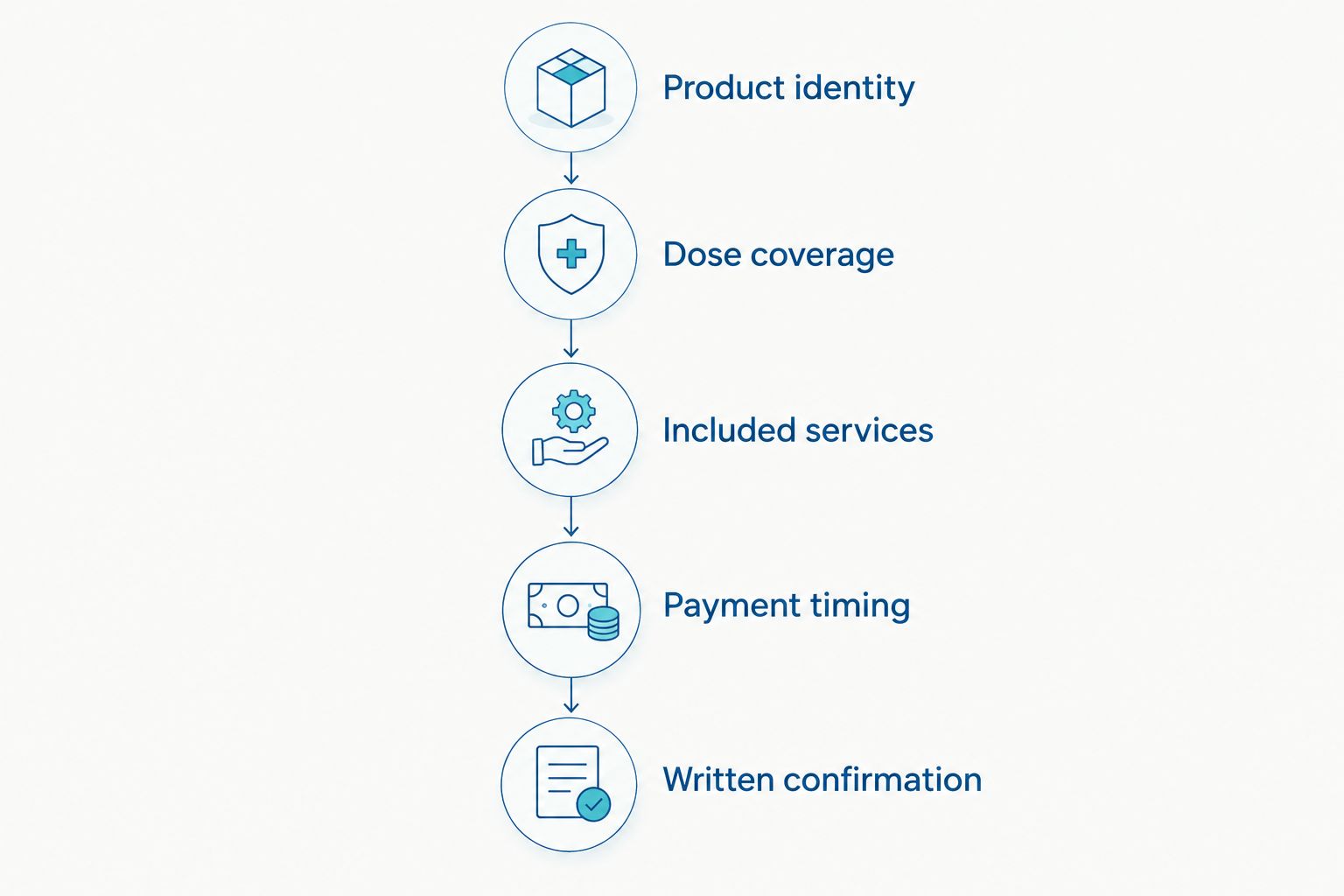
Build a side-by-side record using the same questions for both prescriptions. Leave unresolved entries marked unknown; do not insert an estimated answer simply to complete the table.
- Product identity: Record the exact medication and whether the offer concerns a branded or compounded product. Do not substitute an ingredient name for the product description.
- Dose coverage: Ask which written pricing rule applies to the current prescription and which applies to the next prescribed dose.
- Included services: Record what the medication payment and any separate membership each include. Keep required charges distinct from optional services.
- Payment timing: Record the billing period, amount due before dispensing, commitment, and renewal conditions from the provider's terms.
- Written confirmation: Save the relevant terms and the provider's answer, with the date. Resolve conflicts before authorizing payment.
If an advertisement and checkout page disagree, preserve both descriptions and request clarification. Do not silently choose the more favorable version. A comparison should show the obligation you can verify, not the offer you hope applies.
Date your record as a 2026 terms review, but do not label a price verified unless the applicable source actually supports it. Note the source scope: an advertisement, a general terms page, and a prescription-specific written response answer different questions.
What should you ask before paying for a dose change?
Ask for a written answer covering the charge at your prescribed dose, the next billing event, and every mandatory component. Keep the questions specific enough that a general response about program membership cannot stand in for medication terms.
- Does the stated medication charge cover this exact prescription?
- Does a prescribed dose change move the prescription into another billing tier?
- Which required charges sit outside the medication payment?
- What payment or commitment is required before the next dispensing?
- What happens to prepaid funds if the prescription changes or treatment stops?
- Which cancellation and renewal terms apply to this purchase?
A clear answer is evidence about payment obligations, not a medical endorsement. Do not choose or change a prescribed dose to fit an advertised offer.
Does a higher semaglutide dose always mean a higher bill?
A higher semaglutide dose does not always mean a higher bill. The medication charge stays unchanged only when the applicable written terms cover that prescription at the same charge; dose-tier or quantity-based terms require a separate comparison.
Is a first-month promotion enough to compare plans?
A first-month promotion is not a continuing price. Compare the terms after the promotion ends, including medication inclusion, prescribed-dose coverage, mandatory fees, and renewal obligations.
Can you compare branded and compounded semaglutide together?
Branded and compounded semaglutide need separate comparison categories. Establish product identity and regulatory status before comparing payment terms; a shared ingredient name does not make the purchases equivalent.
FAQ
Will my semaglutide bill increase when my prescribed dose increases?
Your semaglutide bill changes according to the applicable written pricing terms, not dose alone. Confirm whether the prescription remains covered by the same medication charge or enters another billed tier.
Does a flat monthly membership include semaglutide at every dose?
A flat monthly membership does not establish medication inclusion at every dose. Ask for written confirmation identifying the medication, covered prescription, and separate required charges.
How much does semaglutide cost at my next prescribed dose?
The charge at your next prescribed dose must come from the provider's applicable written terms. Request the medication charge, required fees, billing period, and payment timing together.
Is a larger semaglutide vial a better deal?
A larger vial does not establish a better deal. Verify the exact product, supplied quantity, prescription coverage, and labeled use instructions rather than comparing container size alone.
What if the advertisement and checkout terms disagree?
Treat conflicting terms as unresolved until the provider clarifies them in writing. Save both versions and confirm which terms apply before authorizing payment.
Can Telehealth Ledger tell me which semaglutide dose to take?
Telehealth Ledger compares published telehealth prices and plan terms; it does not determine your prescribed dose. Dose decisions belong with your treating clinician.
Should I check state restrictions before comparing semaglutide plans?
Check state restrictions before relying on a plan comparison. Confirm that the provider's current service and dispensing terms apply to your state.
One last thing
An unchanged headline payment can still leave a changed obligation elsewhere in the agreement. Check medication coverage, required fees, payment timing, and commitment together—not just the largest text on the offer.
For a useful 2026 record, save the terms that apply when you authorize payment. A later screenshot cannot establish what you originally agreed to. Compare the complete continuing obligation before paying, and leave prescribing decisions with your clinician.
Information only. Not medical advice.