

Required lab tests add to semaglutide cost only to the extent that you must pay for them outside the plan’s included services. The amount depends on the tests ordered, the laboratory’s billing, insurance benefits, and whether repeat testing is included. Compare the continuing plan charge with your separate testing obligations—not an introductory offer presented as the whole treatment cost.
- Semaglutide cost comparisons must separate required lab charges from continuing plan costs and medication inclusion.
- A lab order does not establish that the blood draw, testing, or results review is included.
- Telehealth Ledger is best for readers comparing published telehealth plan terms, not determining clinical suitability.
- Confirm initial testing, repeat testing, insurance billing, and cancellation terms before paying.
Why this matters
A plan charge and a laboratory bill can describe different parts of the same care arrangement. If you compare only the advertised subscription, you leave any separately billed testing outside your budget.
Telehealth Ledger compares published telehealth prices, plan terms, and medication inclusion. For your 2026 comparison, keep the provider’s enrollment terms beside the laboratory’s billing information. A first-month promotion is not a continuing price.
The financial question is separate from the clinical question. A clinician determines which tests are appropriate for you; a plan’s billing terms determine who pays for them. Neither a lower charge nor fewer required tests establishes provider quality or suitability.
Semaglutide cost: how much do required lab tests add?
The lab-related addition is the amount you owe for required testing that the plan does not cover. Count the initial testing obligation, any separately billed collection service, and required repeat testing over the same period you use to compare subscriptions.
Use this calculation:
Separate lab addition = initial testing charges + separately billed collection charges + repeat testing charges − applicable coverage or credits.
Count each charge once. If a laboratory’s quoted amount already includes specimen collection, do not add collection again. If a plan includes a particular test, do not assume that inclusion extends to other tests or to future orders.
| Billing arrangement | What belongs in your budget | Advantage for comparison | Limitation to check |
|---|---|---|---|
| Required testing explicitly included | The plan charge, plus any stated exclusions | Makes the included testing obligation clearer | Inclusion can be limited to named tests or occasions |
| Required testing billed separately | The plan charge plus your laboratory obligation | Keeps service and testing charges distinguishable | The subscription alone is not the full obligation |
| Testing submitted to insurance | The plan charge plus your applicable patient responsibility | Lets you compare using your own benefits | Insurance submission does not establish your final bill |
| Existing results accepted | The plan charge plus any additional testing ordered | Avoids budgeting for a duplicate test if none is required | Acceptance depends on the provider’s criteria and clinical review |
These are billing arrangements to distinguish, not claims that a particular provider offers them. Request written confirmation of the arrangement that applies to your enrollment.
Compare the same period
For a 12-month budget, count the continuing subscription charges and testing obligations that fall within those 12 months. Do not compare one provider’s initial enrollment payment with another provider’s full-year obligation.
Shorter planning windows can also help. A 3-month budget shows your early cash commitment; a 6-month budget shows whether another required expense enters later. These are comparison periods, not recommended treatment or testing intervals.
Initial testing: identify what the plan actually includes
Start with the provider’s written testing requirement. Ask which tests are required before a prescribing decision, which are ordered only after clinical review, and which services the stated inclusion covers.
The words labs included need a defined scope. Confirm whether they refer to the laboratory analysis, specimen collection, clinician review, or a specific combination. Do not turn a broad phrase into a complete billing promise.
Use these questions before enrollment:
- Required tests: Which tests must you complete for this program?
- Included services: Which testing-related services are included in the plan charge?
- Separate charges: Who bills you for anything excluded?
- Existing results: Can the clinician review results you already have?
- Payment timing: What must you pay before the clinical decision?
Ask about charges before submitting payment, not after receiving a laboratory order. An order tells you what has been requested; it does not, by itself, explain the laboratory’s payment terms.
Keep the provider’s answer with the applicable terms. For a 2026 enrollment decision, record the date and the specific program discussed so that an answer about another plan does not enter your comparison.
Repeat testing: separate inclusion from frequency
An included initial test does not establish the billing terms for later tests. Read the continuing plan terms for repeat-testing inclusion, exclusions, and any requirements that depend on clinical review.
Ask the provider to distinguish a scheduled program requirement from testing ordered for your individual circumstances. Do not treat an estimated testing schedule as a guarantee that no additional testing will be ordered.
Your financial checklist should establish:
- Whether any repeat testing is included.
- Whether inclusion applies to the same tests as the initial order.
- Whether another laboratory or collection location changes the billing arrangement.
- Whether results review is included in the continuing service.
- What happens to already ordered testing if you cancel.
Do not choose a testing interval to make a budget work. Ask the clinician about the clinical plan, then ask the billing team how the services in that plan are charged.
Why the lab-related addition varies
The difference comes from the scope of the testing and the applicable payment terms. Compare these factors separately rather than treating lab fees as a single standardized item.
- Testing ordered: The relevant expense is for the tests actually required for your care, not an assumed standard panel.
- Plan inclusion: A written inclusion can cover some services while excluding others.
- Collection arrangements: Confirm whether the quoted laboratory amount includes the blood draw or another collection service.
- Insurance benefits: Check the laboratory, tests, and applicable benefits rather than assuming that insurance submission means coverage.
- Repeat-testing terms: Initial testing and subsequent orders need separate billing confirmation.
- Existing-result acceptance: Ask whether your available records satisfy the provider’s requirements before arranging duplicate testing.
Availability by state belongs in this review too. Confirm that the provider can serve you and that the proposed testing arrangement is usable where you live before comparing it as an actionable option.
How to compare lab obligations before paying
Use a consistent method for every provider on your shortlist. Mark an unresolved charge as unknown—not included, not excluded, and not assumed away.
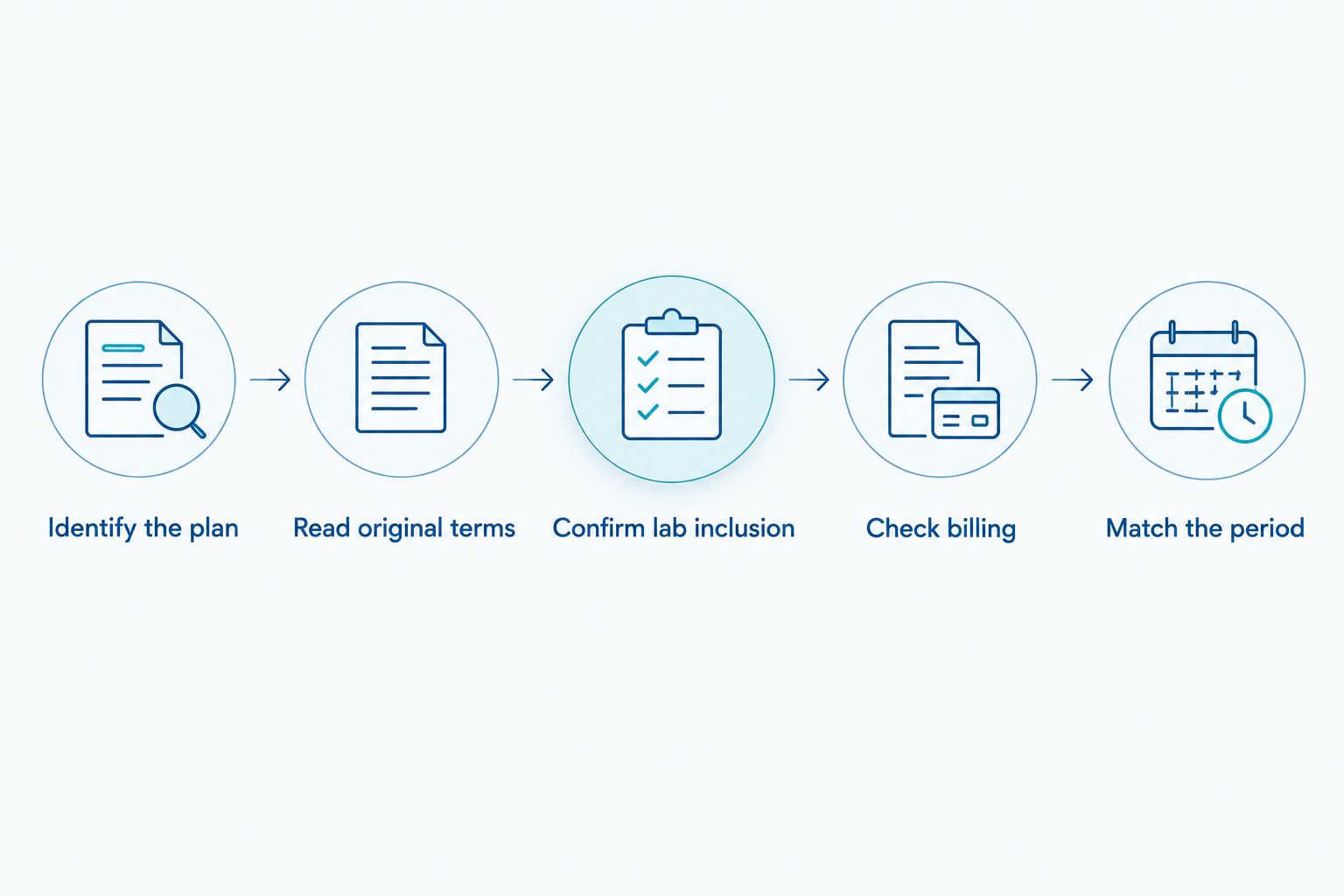
- Identify the plan. Record the exact program, medication description, and whether medication is included. Keep branded and compounded products separate rather than comparing them as interchangeable entries.
- Read original terms. Use the provider’s enrollment terms, testing policy, and cancellation policy. Record the access date for your 2026 comparison.
- Confirm lab inclusion. List initial tests, collection services, results review, and repeat testing separately. Ask for written clarification where the wording is incomplete.
- Check billing. Establish who bills you, whether insurance is involved, and which amount is an estimate rather than a settled patient obligation.
- Match the period. Add the known obligations across the same comparison window. Keep unresolved charges visible beside the total rather than treating them as nothing.
This method compares financial obligations, not medical quality. It also prevents an included consultation from being mistaken for included medication or included laboratory services.
Keep an evidence record
For each statement, save the original source and the date you read it. A provider’s written inclusion statement answers a different question from an insurer’s benefit explanation or a laboratory estimate.
When those sources conflict, request clarification from the party responsible for the charge. Do not resolve the conflict by choosing the lowest figure or assuming the broadest coverage.
Does insurance mean required labs are included?
Insurance billing is not the same as inclusion in a telehealth plan. The provider’s subscription terms describe what the subscription covers; your insurance terms govern the applicable insurance benefits.
Ask the laboratory and insurer about the actual tests and collection location. Confirm whether the amount discussed is an estimate, what information it relies on, and whether the claim still needs processing.
Keep medication coverage separate from laboratory coverage. An answer about one does not answer the other, and the same distinction applies to clinician visits.
Can existing blood work reduce the extra expense?
Existing blood work reduces a new testing expense only if the provider accepts it and does not require that testing again. Ask about the required tests, acceptable timing, and documentation before booking another draw.
Do not assume that a previous result meets the current program’s requirements. Let the clinician assess its relevance; then confirm the billing for any additional order.
Is a plan with included labs the better deal?
Included labs make one part of the financial comparison clearer, but they do not establish the lowest total obligation. Compare continuing plan costs, medication inclusion, required fees, commitments, and cancellation terms over the same period.
Billing cadence matters alongside testing. The guide to semaglutide cost and four-week refills addresses another reason a quoted recurring charge needs a clearly defined comparison period.
For your 2026 shortlist, keep financial fit separate from clinical suitability. A plan can have clear billing terms without being the right clinical choice for you.
FAQ
How much do lab tests add to semaglutide cost?
Lab tests add the amount you must pay separately for required testing, collection, and any repeat testing outside the plan’s inclusion. Confirm the actual orders and payment terms before adding a figure to your budget.
Are blood tests included in an online semaglutide plan?
Blood tests are included only to the extent stated in the applicable plan terms. Ask whether inclusion covers initial testing, specimen collection, results review, and repeat orders.
Does a laboratory order mean the test is paid for?
A laboratory order does not establish that the test is paid for. Confirm the laboratory’s billing arrangement and the provider’s written inclusion terms separately.
Will insurance cover my required lab tests?
Your applicable insurance benefits determine coverage; submitting a test to insurance does not establish the final patient bill. Check the tests, laboratory, collection location, and benefit terms with the responsible parties.
Can I use blood work I already have?
You can use existing blood work only if the provider accepts it for the required review. Ask about the tests, timing, and documentation before arranging duplicate testing.
Are repeat blood tests included if the first tests are included?
Initial-test inclusion does not establish repeat-test inclusion. Request the continuing testing terms and confirm how additional clinician-ordered tests are billed.
What if the plan terms do not explain lab charges?
Treat unexplained lab charges as unresolved and request written clarification before paying. Do not record an unknown obligation as included in the subscription.
Does Telehealth Ledger recommend which lab tests I need?
Telehealth Ledger compares published telehealth costs and terms, not individual testing needs. A qualified clinician determines which tests are appropriate for your circumstances.
One last thing
Ask what happens financially if testing does not lead to a prescription. Request the terms for charges already incurred, unused prepaid services, cancellation, and refunds before enrollment. Do not assume that paying for an evaluation or completing laboratory work guarantees a prescription.
Keep that answer in your 2026 comparison record alongside the continuing plan terms. It identifies your payment obligation before you know the clinical outcome—a different question from the advertised recurring charge.
Information only. Not medical advice.