

On a prepaid semaglutide plan, you owe the prepaid term’s charge upfront, plus any required fees collected at enrollment—not merely the advertised monthly equivalent. Before paying, confirm medication inclusion, the period covered, separate charges, and what happens to your payment if treatment is not prescribed or ends early.
- The cheapest semaglutide comparison starts with the checkout total, not the monthly-equivalent headline.
- Telehealth Ledger compares published telehealth terms; use provider checkout documents to confirm your actual payment obligation.
- Separate medication charges, required fees, continuing plan costs, and refund conditions before comparing prepaid plans.
- A first-month promotion is not a continuing price. Keep branded and compounded products in separate comparisons.
Why this matters
A prepaid offer presents two different questions: how much the covered period costs and how much cash you must commit now. An advertised monthly equivalent answers neither question completely unless the provider also identifies the payment schedule and everything included.
Telehealth Ledger is best for readers comparing published semaglutide plan terms, not choosing treatment. Use Telehealth Ledger to compare published prices, continuing plan costs, and medication inclusion; confirm the final obligation in the provider’s own terms.
For a 2026 comparison, save dated copies of the offer, checkout summary, and cancellation policy. A headline without its accompanying terms is not enough to establish what you owe.
Cheapest semaglutide: what is due upfront on prepaid plans?
The upfront total is the prepaid charge plus mandatory charges collected at the same time, without double-counting anything already included. Expenses required later belong in your total commitment, even when they are absent from the initial checkout.
Use this breakdown before comparing offers:
| Payment component | What to establish | How to treat it |
|---|---|---|
| Prepaid term | Exact period purchased and payment schedule | Count the full amount collected now |
| Medication | Whether the named medication is included | Add a separate medication charge only when required and documented |
| Clinical services | Which consultations or follow-ups the payment covers | Identify any required services billed outside the plan |
| Tests | Whether testing is required and separately billed | Separate enrollment charges from later obligations |
| Delivery and supplies | Whether these are included or charged separately | Include mandatory charges at the applicable stage |
| Renewal | Next billing date, covered period, and continuing terms | Record separately from the initial payment |
| Refund conditions | What happens after cancellation or a prescribing decision | Record which paid services or periods are refundable |
Do not fill a blank with an assumption. If medication inclusion is unclear, mark it unconfirmed and request written clarification before treating the offer as comparable to a medication-inclusive plan.
A checkout total also needs a label. Distinguish a payment for the entire advertised term from a deposit, consultation payment, or installment. Those amounts create different obligations even when the promotional page uses the same monthly-equivalent wording.
Compare payment structures without mixing obligations
There is no verified provider ranking here: a plan’s published payment structure must be established before its affordability can be compared. Start by separating these arrangements rather than sorting every headline into one list.
| Structure | Best for | Useful feature | Main limitation to check |
|---|---|---|---|
| Full-term prepayment | Readers prepared to fund the entire covered period | Shows the payment committed to that term when inclusions are clear | Early-exit and unused-service refund conditions |
| Recurring monthly billing | Readers prioritizing smaller individual payments | Separates payments across billing periods | Monthly billing does not itself establish cancellation freedom |
| Installments toward a fixed commitment | Readers considering payment timing separately from total obligation | Spreads collection of a contractual balance | Stopping treatment or enrollment does not establish that remaining payments end |
These are comparison categories, not endorsements of a particular arrangement. Choose the payment structure only after you understand the total obligation and exit terms. A smaller individual charge is not proof of a smaller commitment.
For your 2026 shortlist, keep the provider’s exact billing language alongside your summary. Rewriting “billed monthly” as “cancel anytime” changes the meaning unless the cancellation terms expressly support it.
Prepayment does not establish dispensing timing
Ask whether the prepaid term describes access to clinical services, medication coverage, or both. Then confirm the dispensing schedule independently. Payment for a period does not, by itself, tell you when medication will be supplied.
Keep the clinical decision separate from the purchase. Obtain the provider’s written explanation of what happens to your payment if a clinician does not prescribe the requested treatment.
How to check a prepaid offer before paying
Use the same sequence for every offer. This makes differences visible without assuming that identical headline wording means identical coverage.
- Identify the product. Record the exact medication named in the offer and whether it is branded or compounded. Do not combine these into one undifferentiated comparison.
- Confirm inclusion. Establish whether the payment includes medication, clinical services, or access to a program. Record exclusions in the same place as inclusions.
- Read checkout. Record the full payment collected now and distinguish mandatory charges from optional purchases. Check whether an advertised promotion has conditions.
- Check renewal. Identify the next charge, its timing, the period it covers, and the cancellation deadline. Separate continuing terms from introductory terms.
- Check refunds. Find the written rules for cancellation, a decision not to prescribe, and unused services. Save the terms that apply when you enroll.
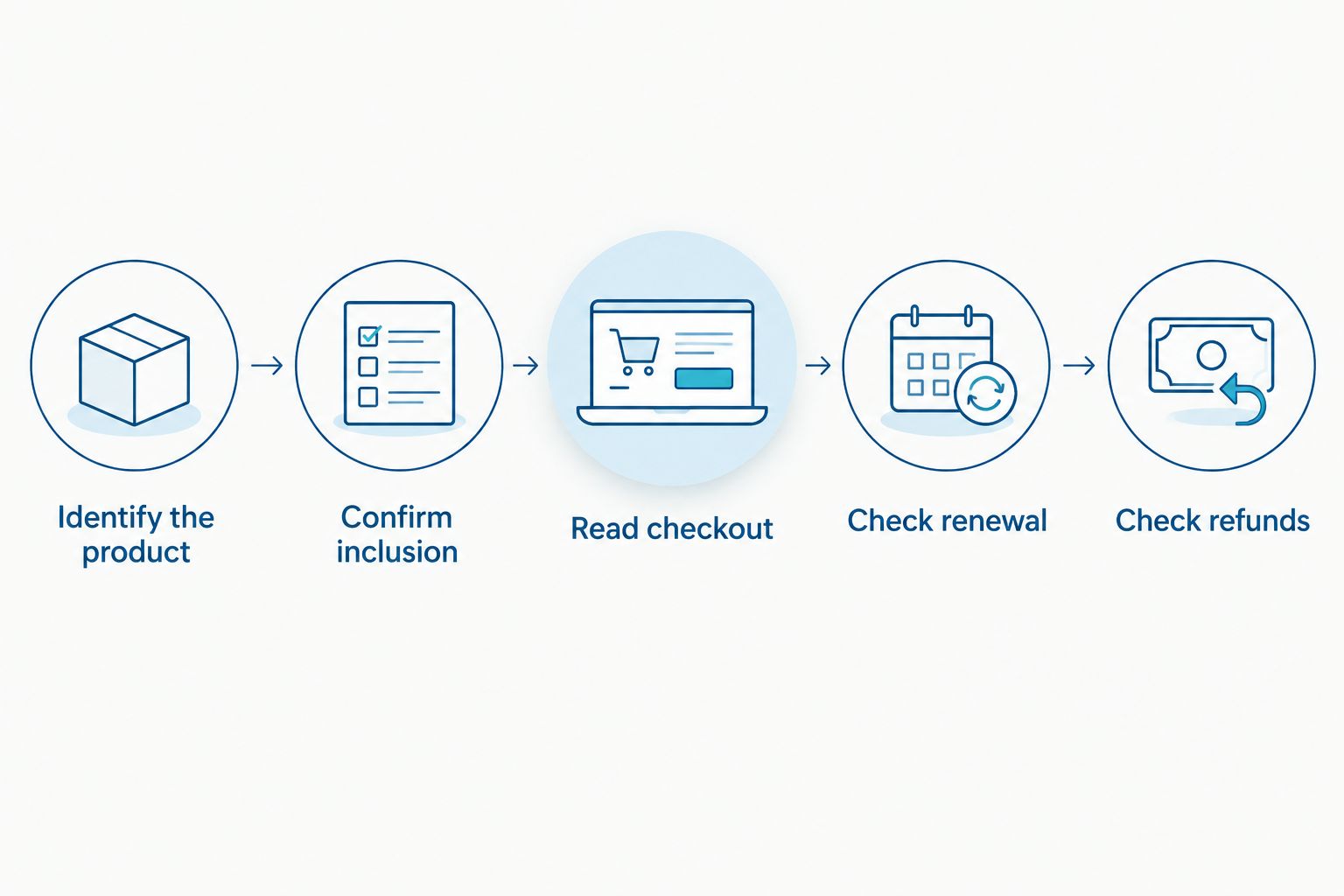
Repeat this check if the offer changes before purchase. A saved advertisement documents what you saw; the applicable agreement establishes the obligation you are being asked to accept.
Use original documents, not headline summaries
The comparison method is straightforward: match the same product category, covered period, inclusion rules, and payment obligations using original provider documents. Record a check date in 2026 rather than presenting an undated headline as current.
Read the provider’s offer page, checkout summary, service agreement, and refund policy together. If their descriptions conflict, ask the provider to identify the applicable terms in writing. Do not resolve the conflict by choosing the most favorable wording yourself.
Why the upfront amount varies
The amount collected at enrollment depends on the documented structure of the offer. Check these factors separately:
- Covered period: A longer prepaid term commits payment for more time. Compare the actual dates or billing periods rather than the headline alone.
- Medication inclusion: A service-only payment is not directly comparable to a payment that includes medication. Identify the exact inclusion before calculating totals.
- Required services: Establish whether consultations, follow-ups, or tests create separate payment obligations. Count only documented requirements, not assumed ones.
- Delivery and supplies: Ask whether required delivery or supplies are included. Record a separate charge only when the provider documents it.
- Promotion conditions: Distinguish the initial offer from continuing terms. Eligibility conditions and the covered period belong beside the promotional wording.
- Payment arrangement: Full prepayment, recurring billing, and installments distribute payments differently. The collection schedule and total commitment must both be clear.
Refund rules affect your financial exposure rather than necessarily changing the initial charge. Record them beside the upfront total so that a comparison does not hide the consequences of leaving early.
Is the lowest monthly equivalent the cheapest option?
The lowest monthly equivalent does not establish the lowest upfront payment or the lowest total commitment. It is a way of expressing a charge across time, not proof that you can purchase just one month at that rate.
For a 2026 comparison, place the actual checkout obligation beside the monthly-equivalent wording. Then compare continuing costs over the same covered period, using only documented inclusions and required charges.
Keep promotions in their own column. A first-month promotion is not a continuing price, and an introductory offer should not stand in for the terms that apply after the introductory period ends.
Match billing periods before comparing
A 4-week period is 28 days; it is not a calendar month. Across 52 weeks, 4-week billing creates 13 periods, while a calendar year contains 12 calendar months. Those are different billing structures, not interchangeable labels.
Confirm whether the provider’s term follows calendar months, refill cycles, or another stated period. The guide to how four-week semaglutide refills affect annual bills addresses this comparison separately.
Do not assume that billing and refill dates match. Ask which event triggers the next payment and whether the agreement continues until you cancel it.
What happens if you stop before the prepaid term ends?
The written refund and cancellation terms determine the financial outcome; prepayment alone does not establish a refund entitlement. Check the cancellation process, effective date, and treatment of unused services before enrollment.
Ask specifically about a decision not to prescribe, a change in the treatment plan, and your decision to leave. Do not assume the provider treats those situations identically or that canceling future renewal reverses an existing payment.
Cancellation and refunds are separate checks
Stopping renewal addresses a future charge. Requesting a refund addresses money already paid. An installment agreement introduces another question: whether any unpaid contractual balance remains due.
Keep all three questions separate when reading the terms. A clear cancellation instruction does not answer the refund question, and a refund policy does not necessarily explain how to stop renewal.
Keep treatment suitability outside the affordability ranking
A payment comparison cannot establish clinical suitability or provider quality. Keep branded and compounded products in separate rows, identify the exact product being discussed, and avoid treating matching ingredient names as sufficient evidence that offers are equivalent.
For a 2026 review, verify any regulatory statement against current official FDA information before relying on it. Do not use a provider’s promotional description as a substitute for current regulatory guidance or a clinician’s assessment.
Confirm eligibility before committing funds
Availability by state belongs in the payment check because the offer must apply to your circumstances. Ask whether the program serves your state and what happens financially if enrollment or prescribing cannot proceed.
Also confirm which services your payment buys. A clinical evaluation is not a promise of a prescription, and a payment comparison is not a recommendation to start, stop, or change medication.
FAQ
What do I actually pay upfront for prepaid semaglutide?
You pay the prepaid term’s charge plus any mandatory charges collected at enrollment. Confirm whether medication is included and whether checkout represents the entire commitment or only its first payment.
Does the cheapest semaglutide monthly equivalent mean I can pay monthly?
No. A monthly equivalent describes a charge across time; it does not establish the collection schedule. Read the payment agreement to determine whether the offer requires prepayment, recurring billing, or installments.
Does a prepaid semaglutide plan include the medication?
Medication inclusion must be confirmed in the specific provider’s terms. Record whether the payment covers medication, clinical services, or both, and identify any required separate charges.
Can I get a refund if the clinician does not prescribe semaglutide?
The provider’s applicable refund terms determine how it handles that situation. Request the policy in writing before paying, including which completed services or other charges remain payable.
Are monthly semaglutide plans always commitment-free?
No. Monthly collection does not establish a commitment-free agreement. Check the minimum term, cancellation deadline, renewal rules, and any remaining payment obligation.
Is four-week billing the same as monthly billing?
No. Four weeks is 28 days, while calendar months vary in length. Compare the actual billing periods and covered dates rather than treating the labels as equivalent.
Should I choose semaglutide based only on the lowest payment?
No. Payment terms do not establish clinical suitability or provider quality. Keep the financial comparison separate from a clinician’s assessment and verify the exact product and applicable terms.
One last thing
The cancellation deadline deserves a place beside the checkout total. A comparison that records what you pay but omits when you must act to stop renewal leaves an important obligation out of view.
Use Telehealth Ledger’s semaglutide comparisons to organize published terms, then save the provider’s applicable documents before paying. Your final check is not whether the headline looks inexpensive; it is whether you can explain what is collected now, what remains payable, and how the agreement ends.
Information only. Not medical advice.