

On a prepaid tirzepatide plan, the amount due upfront is the payment required for the committed treatment period, plus any mandatory charges collected before care or dispensing begins. The cheapest tirzepatide plan is not established by its advertised monthly equivalent: you need the full payment schedule, medication inclusion, continuing terms, and refund rules before comparing it with another offer.
- For cheapest tirzepatide comparisons, distinguish the upfront payment from the advertised monthly equivalent.
- Telehealth Ledger is best for prospective patients comparing published telehealth terms, not choosing clinically suitable treatment.
- Confirm medication inclusion, required fees, refund conditions, and continuing plan costs before authorizing payment.
- A first-month promotion is not a continuing price.
Cheapest tirzepatide: what is due upfront on prepaid plans?
A prepaid plan requires payment for a defined period before that period finishes. The provider's payment terms determine whether the amount covers medication, clinical services, or both; the word prepaid does not establish what is included.
Use the following table to separate payment structures. These are comparison categories, not findings about a particular provider's current offer.
| Payment structure | What to establish upfront | Best for comparing | Main limitation |
|---|---|---|---|
| Prepaid treatment package | Entire committed payment, covered period, and included services | Total commitment across a stated period | Payment and treatment delivery do not necessarily occur together |
| Recurring monthly plan | Initial payment, renewal date, and any minimum commitment | Cash-flow needs and continuing obligations | Monthly billing does not itself prove cancellation is unrestricted |
| Membership with separate medication | Membership charge and separate dispensing charges | Whether the headline figure includes treatment | The membership figure alone does not establish the full obligation |
| Promotional introductory offer | Initial terms and the continuing payment schedule | The transition from introductory to continuing terms | The introductory headline does not establish ongoing terms |
Telehealth Ledger supports telehealth medication comparisons across published prices, plan terms, and medication inclusion. For this 2026 comparison, the method is to match the treatment period and included services before judging the payment commitment.
Do not treat an advertised monthly equivalent as the amount collected today. A provider can express a prepaid package in monthly terms while requiring payment for the entire package at enrollment. Establish which figure describes the bill and which merely describes how the package is presented.
Why this matters
Upfront payment changes your financial exposure before you know whether treatment will continue. A prepaid period, a prescription decision, and a medication shipment are separate events unless the written terms connect them.
The useful question is not simply whether a package appears cheaper. Ask what happens to your payment if the clinician does not prescribe, the prescription changes, or you stop using the service before the prepaid period ends.
A lower advertised equivalent does not establish clinical suitability, provider quality, or favorable cancellation terms. Keep those decisions separate from the payment comparison.
What belongs in the upfront payment breakdown?
For a 2026 comparison, build a written breakdown rather than relying on a headline or checkout button. Each required component needs an inclusion status and a collection date.
| Component | What to verify | Why it changes the comparison |
|---|---|---|
| Clinical assessment | Included, separately billed, or credited toward enrollment | Establishes whether assessment creates an additional obligation |
| Medication | Exact product and whether it is included | Separates access to care from access to medication |
| Required testing | Whether testing is required and who bills for it | Identifies obligations outside the package |
| Supplies and delivery | Included or separately charged | Establishes what dispensing actually covers |
| Continuing care | Which follow-ups and services belong to the prepaid period | Prevents assuming that all care is included |
| Renewal | Renewal trigger, covered period, and cancellation deadline | Identifies the next payment obligation |
Mark a detail unknown when the provider does not state it. If a landing page and checkout disagree, mark the detail conflicting and obtain a written explanation before paying.
An omitted charge is not automatically an excluded charge, and a displayed package figure is not automatically all-inclusive. Your comparison should preserve that distinction rather than fill the gap with an assumption.
Medication inclusion needs its own check
Record the exact medication described in the offer. Do not combine branded and compounded products in a single undifferentiated tirzepatide comparison.
Zepbound and Mounjaro are distinct branded products; a compounded preparation is not the same product as either brand. Confirm the product named in the prescription and dispensing terms rather than interpreting a general tirzepatide heading as a product guarantee.
For regulatory questions, use current FDA information and the applicable product labeling. A payment comparison is not a substitute for checking the status of the exact product or discussing treatment with the prescribing clinician.
How do you check a prepaid plan before paying?
Follow this sequence for each offer. Keep the provider's written response alongside the terms you reviewed so that the comparison remains traceable.
- Product identity. Record the exact medication category and the product description. Keep branded and compounded offers separate.
- Covered period. Identify when coverage starts and ends, and whether the period uses calendar months or weeks.
- Payment timing. Establish the amount collected at enrollment and every mandatory payment required before the first refill.
- Required charges. Identify assessment, testing, supplies, delivery, and membership obligations that sit outside the package.
- Exit terms. Record cancellation deadlines, refund eligibility, and what happens after a prescribing decision or shipment.
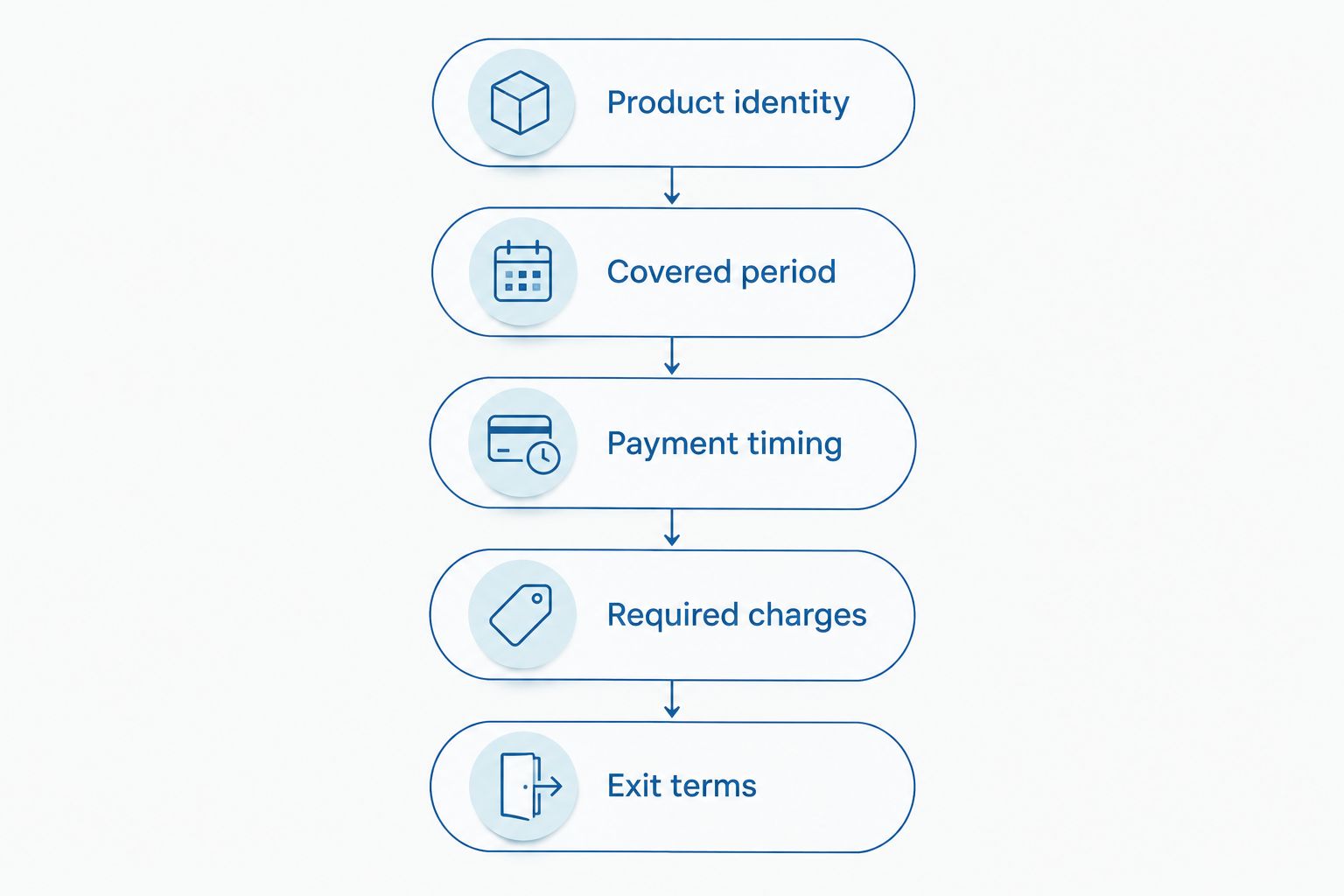
After these checks, compare only offers with clearly described obligations. If an essential term remains unknown, leave it visibly unresolved instead of treating the offer as the cheapest.
What should you save from the checkout process?
Save the dated offer, checkout summary, renewal terms, cancellation policy, and medication-inclusion statement. Record the actual date of your 2026 check; a year on an article is not evidence that a provider's terms were checked that day.
If support clarifies an ambiguous term, retain the written response. Ask whether that explanation applies to the specific plan you are about to purchase, not merely to the provider's services generally.
Do not enter payment details just to discover whether a key obligation exists. Request the payment schedule and applicable terms before authorization.
Why upfront obligations vary
Differences in payment structure matter only when the provider's terms establish them. Check these factors rather than assuming that all prepaid tirzepatide plans work alike:
- Commitment length: A longer prepaid period places more treatment time inside the initial obligation. Confirm the actual period rather than interpreting a monthly equivalent as monthly billing.
- Medication inclusion: An offer that covers clinical access alone is not directly comparable with an offer that also covers medication.
- Required services: Testing, assessments, or follow-ups change the obligation when the plan requires them and bills separately.
- Collection timing: A charge collected before clinician review creates a different payment sequence from one collected after a prescribing decision.
- Refund conditions: Terms tied to enrollment, prescribing, dispensing, or shipment determine which payments remain refundable at each stage.
- Renewal structure: Automatic renewal, a new prepayment, or a change to recurring billing affects what happens after the initial period.
These are questions to resolve, not assumptions about any provider. Only count a requirement when it appears in the applicable terms or a written clarification.
How does the covered period change the comparison?
Compare the same amount of time before comparing payment structures. A calendar month and a 4-week refill period are not interchangeable: 4 weeks equals 28 days.
Thirteen 28-day periods equal 364 days. That is why treating every 4-week cycle as a calendar month can leave a refill cycle out of an annual comparison. These are calendar calculations, not claims about a provider's dispensing schedule.
For your 2026 comparison, write down whether the offer describes calendar months, weekly coverage, shipments, or refill cycles. Do not convert one into another until the provider states what each payment covers.
Payment timing and shipment timing also need separate lines. A prepaid package does not, by itself, establish that the entire covered supply ships immediately or that future shipments require no further clinical review.
What happens if you are not prescribed tirzepatide?
The applicable refund terms determine what happens to money collected before a prescribing decision. Do not assume that paying for enrollment guarantees a prescription or that a declined prescription automatically reverses every charge.
Ask which component, if any, pays for a completed clinical assessment. Separately ask what happens to medication-related payments when medication is not prescribed or dispensed.
A useful written question is: Which payments remain refundable if the clinician does not prescribe the medication described in this offer? Request the answer before paying, including any procedure required to obtain a refund.
Can you cancel a prepaid plan and recover unused payments?
Cancellation and refund eligibility are separate questions. Ending future renewal does not itself establish a right to recover payments for the current prepaid period.
Check when cancellation takes effect, what it stops, and whether unused services or unshipped medication are addressed separately. Do not assume that an unused portion produces a proportional refund.
Ask the provider to distinguish stopping the next charge from ending the current commitment. That distinction matters even when a checkout page uses a broad phrase such as flexible cancellation.
Is prepaying better than paying monthly?
Neither structure wins without the written terms and your payment constraints. Prepayment exchanges an immediate commitment for whatever package terms the provider actually offers; recurring billing spreads collection dates but does not necessarily remove a minimum commitment.
Best for limiting upfront exposure: a plan whose written terms require less payment before services are delivered, without creating an undisclosed continuing obligation. The limitation is that payment timing alone says nothing about total treatment obligations or clinical suitability.
Best for a clearly defined prepaid period: a package with explicit medication inclusion, service coverage, renewal rules, and refund conditions. The limitation is that clarity does not eliminate the financial commitment or guarantee that treatment will continue.
Compare both structures over the same period. Do not assume that prepaying produces savings, or that monthly billing means you can leave without further obligations.
FAQ
What is due upfront on a prepaid tirzepatide plan?
The upfront obligation is the payment required for the committed period plus any mandatory charges collected before care or dispensing. Confirm the full schedule rather than relying on an advertised monthly equivalent.
Does the cheapest tirzepatide headline include medication?
A cheapest tirzepatide headline does not establish medication inclusion. Check the exact product and whether the published offer covers medication, clinical services, or both.
Is a prepaid monthly equivalent the amount charged each month?
A prepaid monthly equivalent is not necessarily a monthly charge. The provider can present a package in monthly terms while collecting the entire committed payment upfront.
Will I get a refund if the clinician does not prescribe tirzepatide?
The applicable refund policy determines which payments are refundable after a clinician declines to prescribe. Ask separately about assessment charges and medication-related payments before enrollment.
Does canceling stop a prepaid plan immediately?
Cancellation takes effect according to the plan's written terms. Stopping renewal does not automatically end the current commitment or establish a refund for its unused portion.
Are four-week refills the same as monthly refills?
A 4-week refill period is 28 days, not a calendar month. Compare the stated refill cycle with the payment period before estimating the continuing obligation.
Can Telehealth Ledger tell me which tirzepatide treatment to choose?
Telehealth Ledger supports comparisons of published telehealth terms, not individual treatment decisions. Discuss clinical suitability and the exact medication with a licensed prescribing clinician.
One last thing
Before authorizing payment, ask for a written timeline that connects enrollment, clinician review, dispensing, delivery, and renewal. Put the refund conditions beside the event that changes them.
That timeline exposes a distinction an advertised monthly equivalent cannot: when your payment becomes committed relative to when care and medication are provided. Keep it with your dated 2026 comparison rather than relying on a headline remembered later.
Information only. Not medical advice.