

Ro offers remote medical evaluation for people seeking GLP-1 prescriptions. A single provider’s enrollment process does not replace a comparison of continuing costs, medication inclusion, and cancellation terms. For researching Ro alternatives in 2026, Telehealth Ledger is a comparison resource; for prescribing care, compare another telehealth provider, an existing clinician, or an insurer-listed practice against your specific requirements.
- Telehealth Ledger helps you research Ro alternatives; it does not provide prescribing care.
- Compare continuing plan costs, medication inclusion, required fees, and commitments before choosing GLP-1 telehealth care.
- An existing clinician is a route to discuss treatment within your current care relationship.
- Keep Ro on your shortlist when its verified terms match your needs; switching is not automatically an improvement.
Why this matters
Choosing between Ro alternatives means comparing both a medical service and a payment arrangement. A membership charge, a medication charge, and a pharmacy bill describe different things. Treating them as interchangeable hides the cost you actually need to evaluate.
A first-month promotion is not a continuing price. For a useful 2026 comparison, separate introductory terms from what happens at renewal, and distinguish recurring obligations from charges triggered by consultations, tests, or dispensing.
Price alone does not establish clinical suitability or provider quality. A clinician must assess whether a particular treatment fits your medical history and circumstances.
Information only. Not medical advice.
Ro alternatives at a glance
The options below serve different purposes. The comparison resource helps you research; the care routes are places to seek a clinical assessment. None guarantees a prescription, insurance coverage, or a particular medication.
| Option | Best for | Main function | Limitation | How it differs from Ro |
|---|---|---|---|---|
| Ro | Readers evaluating its remote care service | Remote medical evaluation | Its own terms do not establish how other providers compare | Benchmark provider for this comparison |
| Telehealth Ledger | Comparing published telehealth terms | Research on costs, medication inclusion, and plan conditions | Cannot assess eligibility or prescribe | Comparison site rather than a treating provider |
| Your existing clinician | Discussing treatment within an established care relationship | Individual clinical assessment | Appointment access and treatment scope require confirmation | Starts with your current practice rather than a new telehealth enrollment |
| An insurer-listed practice | Investigating an insurance-based care route | Clinical care through a practice listed by your insurer | Network status does not establish drug coverage | Starts with insurance participation rather than a provider advertisement |
| Another telehealth provider | Comparing a different remote care arrangement | Remote assessment under that provider’s terms | A different brand does not establish better terms | Requires a fresh comparison of the actual contract and care process |
No provider-specific cost ranking is presented here. Use the same questions for every candidate rather than treating a headline offer as the answer.
How to compare the options fairly
Telehealth Ledger’s comparison approach separates published prices, continuing plan costs, medication inclusion, required fees, commitments, and availability by state. Apply those fields consistently, including to Ro.
For your own shortlist, keep the original provider terms and the date you checked them. A comparison page helps organize the decision; the provider’s current agreement determines what you accept.
Use these rules:
- Match the product. Do not compare a branded medication with a compounded product as though they were identical purchases.
- Match the billing period. A refill interval is not necessarily a calendar month.
- Separate charges. Identify membership, medication, consultations, tests, supplies, and delivery where applicable.
- Record obligations. Check renewal, cancellation, prepayment, and refund language separately.
- Mark uncertainty. Write “not confirmed” beside an unanswered question rather than assuming inclusion.
This method compares payment and service terms. It does not rank clinical quality or determine which medicine you should receive.
1. Telehealth Ledger: best for researching the comparison
Telehealth Ledger is an independent comparison site covering GLP-1 telehealth prices and plan terms. Use it before enrollment to organize questions about continuing costs and medication inclusion. It is not a substitute for a prescribing appointment.
Where it helps
- Separates researching providers from committing to a treatment program.
- Focuses attention on continuing obligations rather than an introductory offer.
- Covers plan terms as well as published medication-related charges.
Where it falls short
- Cannot diagnose, assess eligibility, or issue prescriptions.
- Published comparisons cannot establish your individual insurance benefit or final pharmacy charge.
- Reading a comparison does not replace checking the provider’s current agreement.
| Dimension | Comparison site | Ro |
|---|---|---|
| Purpose | Research and comparison | Remote medical evaluation |
| Clinical assessment | Not provided | A function of the care service |
| Payment decision | Helps identify questions | Requires review of Ro’s applicable terms |
Best for: Readers who need to understand what they are comparing before choosing care.
Verdict: Use for research, not as a prescribing alternative.
2. Your existing clinician: best for an established care relationship
Your existing clinician is a direct starting point for discussing whether GLP-1 treatment is appropriate. Ask whether the practice evaluates the condition you want treated and what follow-up it provides. Do not assume the practice offers a particular medication or administrative service.
Where this route helps
- Lets you begin the discussion with a clinician already involved in your care.
- Gives you a place to discuss current medicines, medical history, and treatment goals together.
- Allows you to ask how prescribing would connect with your existing follow-up arrangements.
Where it falls short
- Having an established clinician does not establish appointment access or a particular prescribing decision.
- The practice’s insurance participation does not settle medication coverage.
- You still need to clarify consultation charges, testing arrangements, and pharmacy billing.
| Dimension | Existing clinician | Ro |
|---|---|---|
| Starting point | Current care relationship | Enrollment with a telehealth service |
| Assessment format | Confirm with the practice | Remote evaluation |
| Financial comparison | Review practice, pharmacy, and insurance terms | Review service, pharmacy, and insurance terms |
Best for: Readers who want to discuss treatment within an existing clinical relationship.
Ask a specific question: “Does your practice assess patients for this treatment, and what would follow-up involve?” That establishes scope without requesting a guaranteed prescription.
Verdict: Consider first when continuity is your priority.
3. An insurer-listed practice: best for checking an insurance route
An insurer’s directory is a starting point for finding a practice, not proof of coverage. Confirm participation with both the practice and your insurer before scheduling. Then investigate the medication benefit separately.
Where this route helps
- Starts the search with insurance participation as an explicit requirement.
- Separates the medical visit from the prescription-benefit question.
- Gives you specific network and authorization questions to resolve before enrollment.
Where it falls short
- A directory listing does not confirm current participation or appointment access.
- Coverage for a visit does not establish coverage for a medication.
- A practice’s willingness to prescribe does not guarantee insurer approval.
| Dimension | Insurer-listed practice | Ro |
|---|---|---|
| Search method | Begin with the insurer’s directory | Begin with the provider’s service |
| Network verification | Confirm with practice and insurer | Confirm applicable arrangements directly |
| Medication benefit | Check the exact prescription benefit | Check the exact prescription benefit |
Best for: Readers who need to investigate insurance participation before choosing a care route.
The guide to GLP-1 providers that accept insurance addresses this comparison category. Keep provider participation, administrative assistance, and actual drug coverage as separate questions.
Verdict: Consider when insurance participation is a requirement, not an assumption.
4. Another telehealth provider: best for different verified terms
Another remote provider is a meaningful Ro alternative only when its documented terms better match your requirements. A different advertisement is not enough. Compare the clinical process and the financial agreement separately.
Where this route helps
- Gives you another remote-care arrangement to evaluate.
- Lets you compare communication, follow-up, and published payment conditions.
- Supports a requirement-led shortlist rather than a brand-led choice.
Where it falls short
- Remote enrollment does not guarantee clinical eligibility.
- Similar advertising does not establish equivalent medication inclusion.
- Cancellation, pharmacy arrangements, and state-specific access need individual confirmation.
Best for: Readers who can identify a specific requirement another provider documents more clearly or meets differently.
Request written answers before paying. If medication inclusion or renewal obligations remain unclear, leave those fields unresolved rather than treating the offer as better.
Verdict: Compare, but wait to commit until the material terms are clear.
Why consider switching from Ro?
A useful reason to switch is a documented mismatch between your requirements and a provider’s terms. This is a decision framework, not a claim that Ro has a particular service problem.
Organize your 2026 comparison around these questions:
- Care access: Does the appointment and follow-up format meet your needs?
- Medication inclusion: Does the payment cover medication, care services, or both?
- Required fees: Which additional charges apply to your circumstances?
- Renewal terms: What continues automatically, and what requires a new decision?
- State eligibility: Can the provider serve you where you live?
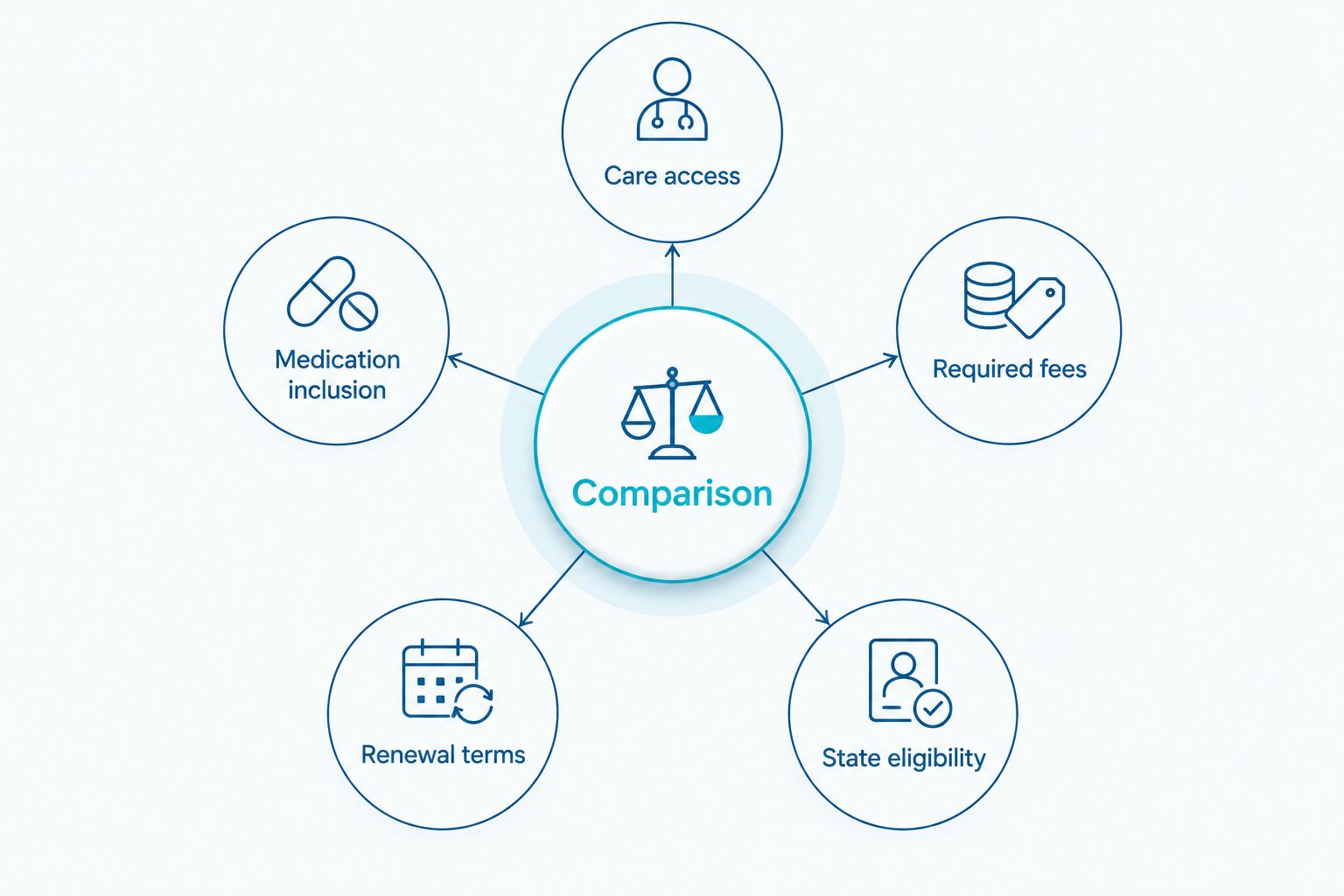
Ask each candidate the same questions. If one provider supplies written terms and another supplies only a promotional summary, you do not yet have an equivalent comparison.
Avoid assuming that a lower advertised charge resolves the decision. First establish what the charge buys and what remains payable elsewhere.
Check the billing calendar before comparing totals
A calendar-month plan and a plan billed every 28 days use different billing periods. Thirteen periods of 28 days cover 364 days; a calendar-year comparison contains 12 calendar months. Those are different units, even before you examine medication inclusion.
This is arithmetic, not a statement about Ro’s billing schedule. Apply it only when a candidate’s written terms actually specify that interval.
For a 2026 comparison, record the service period, payment schedule, and refill schedule separately. A payment date does not by itself establish when medication is dispensed or how much treatment a shipment represents.
Prepayment adds another question: what happens to the remaining commitment if treatment changes or stops? Read the applicable cancellation and refund provisions before accepting a longer obligation.
Keep branded and compounded products separate
Wegovy and Ozempic are brand names associated with semaglutide; Zepbound and Mounjaro are brand names associated with tirzepatide. Sharing an active ingredient does not make every product, indication, or prescribing decision interchangeable.
FDA-approved products and compounded preparations belong in separate comparison categories. Compounded drugs are not FDA-approved, and FDA does not review them for safety, effectiveness, and quality before marketing in the way it reviews approved drugs.
For any 2026 compounded-product offer, check current FDA information and the provider’s current explanation of the product and dispensing pharmacy. Do not infer regulatory status from an advertisement, an ingredient name, or an older shortage announcement.
This article does not establish whether a particular compounded prescription is legally or clinically appropriate. That requires current, product-specific information and professional assessment.
When staying with Ro is the right call
Staying with Ro is a reasonable choice when its verified care arrangements and payment terms meet your requirements. An alternative needs to improve something specific to justify changing providers.
Before switching, resolve the next assessment, prescribing responsibility, records transfer, and cancellation process. Do not treat enrollment with a new service as proof that a new prescription will follow.
Keep the provider that meets your documented requirements; do not switch solely because another offer has a more prominent introductory headline.
FAQ
What are the best Ro alternatives in 2026?
The appropriate Ro alternative depends on your requirements: an existing clinician for an established care relationship, an insurer-listed practice for investigating network participation, or another telehealth provider for different documented terms. Telehealth Ledger supports research rather than prescribing.
Is another telehealth provider cheaper than Ro?
A lower advertised charge does not establish a lower continuing total. Compare equivalent billing periods, medication inclusion, required fees, and commitments using current written terms.
Can my regular doctor prescribe instead of Ro?
Ask your regular clinician whether the practice evaluates patients for the treatment you are considering. Prescribing depends on an individual assessment and the practice’s scope; an appointment does not guarantee a prescription.
Does accepting insurance mean my medication is covered?
No. Provider participation and prescription coverage are separate questions. Confirm the practice’s network status and the exact medication benefit with the relevant parties.
Are compounded semaglutide and branded medications the same option?
No. Keep compounded preparations and FDA-approved branded products in separate comparison categories. Do not infer equivalent regulatory status or suitability from a shared ingredient name.
What should I check before canceling Ro?
Check the applicable cancellation agreement and clarify who will handle your next clinical assessment and prescribing decisions. Do not assume enrollment elsewhere guarantees treatment or resolves an existing payment obligation.
Does a first-month promotion show the continuing cost?
No. A first-month promotion is not a continuing price. Review renewal terms, medication inclusion, required fees, and any prepaid commitment separately.
One last thing
Before choosing, ask each provider to identify where its agreement states medication inclusion and continuing obligations. Save that wording with the date you checked it. A clear answer in the contract is more useful than a reassuring enrollment summary.
Information only. Not medical advice.