

Best overall: an in-network primary care clinician for continuity. Best for remote visits: an in-network telehealth practice. Best for specialist weight management: an obesity-medicine practice. Best for diabetes-focused care: an endocrinology practice. For the best GLP-1 providers that accept insurance in 2026, start with your exact insurance network and prescription benefit—not a provider’s insurance logo.
- The best GLP-1 providers that accept insurance match your exact network, prescription benefit, and care needs.
- Telehealth Ledger separates insurance acceptance from medication coverage; neither guarantees the other.
- Compare continuing plan costs, medication inclusion, prior authorization support, and cancellation terms before enrolling.
- Choose an in-network care route first, then confirm the exact medication with your insurer.
Why this matters
A practice can accept your insurance while your plan excludes the prescribed medication. The reverse also happens: a prescription benefit can cover a drug while the clinician’s visits remain outside your medical network.
Insurance acceptance is not a coverage decision. Telehealth Ledger’s GLP-1 comparisons are best for patients comparing published plan terms and medication inclusion before choosing a provider. Use that distinction throughout this guide and the broader comparisons at Telehealth Ledger.
This guide ranks care routes rather than assigning unsupported winners to individual companies. A national provider name cannot establish whether your particular employer plan, state, clinician, and prescription are covered. Information only. Not medical advice.
What makes the best insurance-accepting GLP-1 provider
Use these criteria before comparing enrollment offers:
- Exact network match: Confirm the practice, treating clinician, visit type, and location against your specific plan.
- Prescription benefit fit: Check the exact medication, prescribed indication, formulary restrictions, and designated pharmacy.
- Authorization process: Establish who submits required paperwork, handles insurer questions, and communicates decisions.
- Continuing obligations: Separate clinical visits, membership charges, medication, laboratory work, and required commitments.
- Care continuity: Confirm follow-up arrangements, communication access, and what happens after a coverage denial.
- State eligibility: Verify that the treating clinician can provide care where you will be located during visits.
A first-month promotion is not a continuing price. For a 2026 enrollment decision, read the ongoing terms and the consequences of cancellation before authorizing payment.
Insurance-accepting GLP-1 care routes at a glance
These rankings describe which route to investigate first. They do not confirm coverage, clinical suitability, or a particular practice’s policies.
| Rank and care route | Best for | Main advantage to investigate | Key limitation | Insurance check |
|---|---|---|---|---|
| 1. In-network primary care | Existing patients seeking continuity | Care within an established clinical relationship | The practice might not provide the requested weight-management service | Confirm clinician, visit coverage, and service scope |
| 2. In-network telehealth | Patients prioritizing remote appointments | Remote consultations without choosing a separate cash-pay route | Virtual visits and program charges need separate verification | Confirm virtual-care benefits and any noncovered fees |
| 3. Obesity-medicine practice | Patients seeking specialist weight management | A practice focused on weight-management care | Network participation and referral requirements vary | Confirm specialist benefits and referral rules |
| 4. Endocrinology practice | Patients seeking diabetes-focused evaluation | Specialist review when an endocrine condition is relevant | Not a default route solely to obtain a weight-loss prescription | Confirm referral, network, and appointment purpose |
1. In-network primary care: best for continuity
An established primary care practice is the first place to ask whether GLP-1 evaluation fits within your existing care. The practical advantage is continuity—not a promise of a prescription or coverage.
Ask whether the clinician evaluates weight-management treatment, prescribes when appropriate, and completes required authorization requests. Confirm those services directly; network participation alone does not establish the practice’s scope.
In-network primary care pros:
- An existing care relationship provides a starting point for discussing treatment goals.
- Relevant records can remain within the practice already coordinating your care.
- You can investigate covered clinical appointments before adding a separate program.
In-network primary care cons:
- The practice might refer weight-management care elsewhere.
- Authorization support and follow-up arrangements still require confirmation.
Best for: Patients who already have an in-network clinician and want to avoid unnecessary fragmentation.
Verdict: Hold new program enrollment until your existing practice confirms whether it can provide the required care.
2. In-network telehealth: best for remote appointments
An in-network telehealth practice is the next route to investigate when remote appointments matter. Start with your insurer’s directory, then confirm participation with the practice using the exact plan name.
Do not treat a statement that a service accepts insurance as confirmation that every program charge is covered. Clinical visits, optional services, required memberships, and prescriptions can follow different billing arrangements.
In-network telehealth pros:
- Remote visits remove the need to travel to that appointment.
- The route lets you investigate covered virtual care before choosing a cash-pay program.
- Written visit and program terms give you a basis for comparing ongoing obligations.
In-network telehealth cons:
- Insurance participation can differ by clinician, plan, and state.
- A virtual-care benefit does not establish medication coverage or eliminate separate charges.
Best for: Patients who need remote consultations and can verify both network participation and continuing terms.
For appointment-format questions, see the guide to online semaglutide with live clinician visits.
Verdict: Hold enrollment until the practice confirms your exact plan, treating clinician, and noncovered obligations.
3. Obesity-medicine practice: best for specialist weight management
An obesity-medicine practice is a route for patients seeking a dedicated weight-management evaluation. Ask about the actual service offered rather than assuming a specialty label establishes the treatment approach.
For 2026, verify the clinician’s network status and your plan’s specialist rules before booking. Ask whether referrals or visit authorization are required and whether the practice handles prescription authorization separately.
Obesity-medicine practice pros:
- The appointment can focus specifically on weight-management evaluation.
- You can ask about medication and nonmedication options within the same consultation.
- A defined specialty service gives you specific questions to ask about follow-up and coordination.
Obesity-medicine practice cons:
- Specialist access can involve referral or authorization requirements.
- Covered appointments do not establish coverage for a prescribed medication.
Best for: Patients seeking specialist weight-management care, including those referred by an existing clinician.
Verdict: Hold booking until the specialist benefit, referral requirements, and program terms are clear.
4. Endocrinology practice: best for diabetes-focused evaluation
An endocrinology practice is a route to discuss with your clinician when diabetes or another endocrine condition is relevant to the appointment. It is not a workaround for a plan’s weight-management exclusion.
Ozempic and Wegovy are not interchangeable insurance categories simply because both contain semaglutide. Likewise, Mounjaro and Zepbound contain tirzepatide but have different labeled uses; confirm the exact product and prescribed indication against current FDA prescribing information and your plan’s rules.
Endocrinology practice pros:
- The evaluation can address diabetes or another relevant endocrine condition.
- Medication discussions can sit within the specialist’s review of that condition.
- The route supports coordination with the clinician who referred you.
Endocrinology practice cons:
- A specialist visit does not create coverage for an excluded medication or indication.
- Referral requirements and the practice’s appointment scope need confirmation.
Best for: Patients seeking diabetes-focused or other appropriate endocrine evaluation—not simply a different billing route.
Verdict: Skip endocrinology as an insurance workaround; pursue it when the appointment fits your clinical needs.
How to verify insurance before enrolling
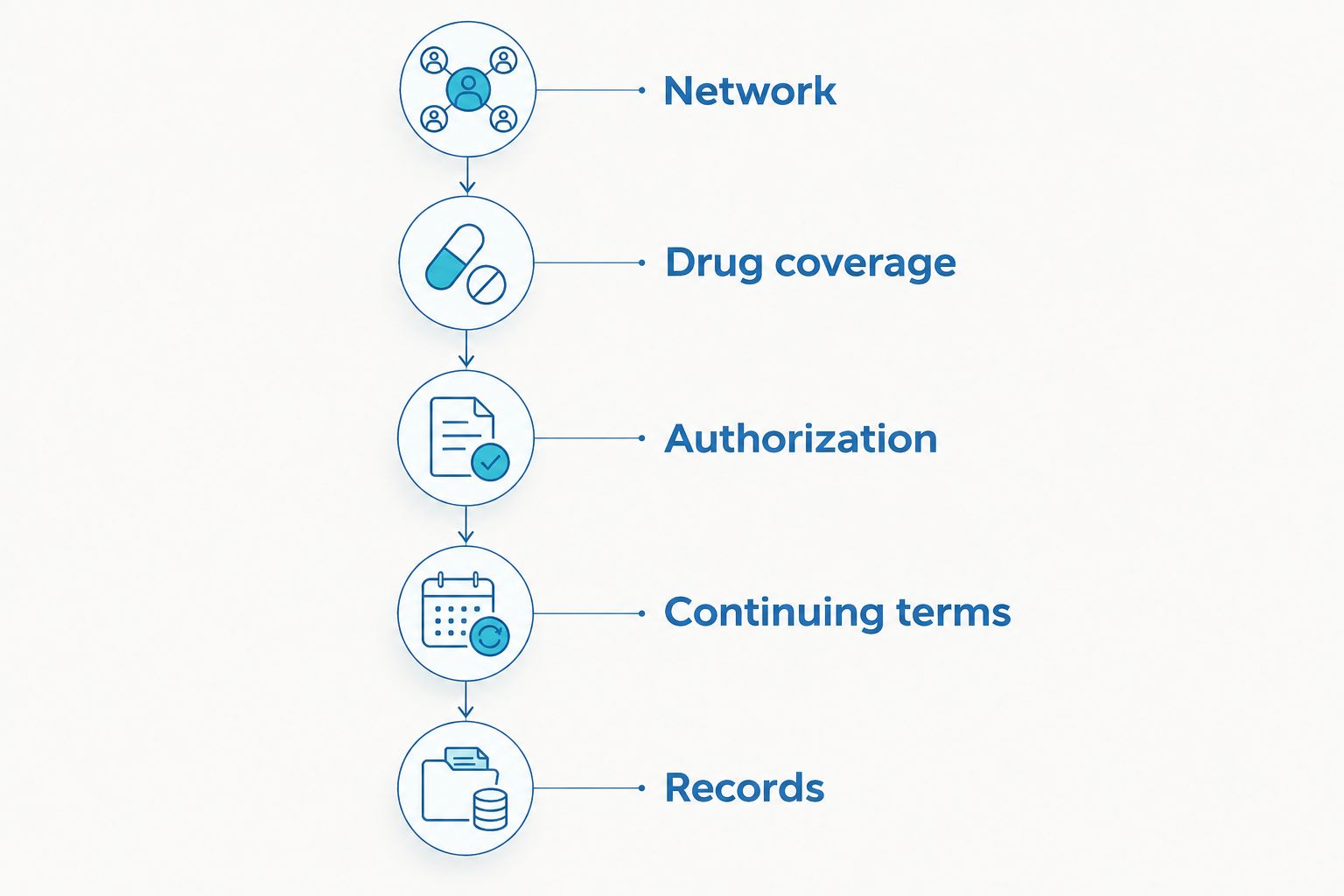
Use this sequence for each shortlisted practice. Keep the responses together so a general statement about insurance does not replace a product-specific coverage answer.
Step 1: Network
Ask your insurer whether the treating clinician and practice are in-network for your exact plan. Give the practice your plan details and ask it to confirm the same information.
Record the representative’s name, the date, and any reference number. A directory listing is a starting point, not a substitute for resolving conflicting answers.
Step 2: Drug coverage
Ask about the exact medication and the indication for which it would be prescribed. Check formulary status, exclusions, prior authorization, step therapy, and pharmacy restrictions.
Use the plan’s current 2026 formulary, coverage criteria, and benefit documents as the original sources. Ask the insurer to identify the applicable documents rather than relying on a general drug-search result.
Step 3: Authorization
Ask who submits the request, what records are needed, and how you receive the decision. Confirm whether the practice assists with an appeal and whether that service creates a separate obligation.
An authorization submission is not an approval. Ask what happens to program enrollment while a decision is pending or after a denial.
Step 4: Continuing terms
Request the provider’s current written agreement. Identify medication inclusion, required appointments, laboratory arrangements, recurring charges, renewal, cancellation, and any prepaid commitment.
Do not assume medication is included because a program advertises treatment access. Ask for a written distinction between prescribing services and the medication itself.
Step 5: Records
Save the relevant benefit documents, provider terms, and dated responses before enrolling. If the documents conflict, request clarification instead of selecting the most favorable interpretation.
For a 2026 comparison, a clear unresolved item is more useful than an assumed benefit. Mark it unconfirmed until the responsible insurer or provider answers.
Compare continuing obligations, not the opening offer
Telehealth Ledger’s GLP-1 comparison approach separates published plan terms from insurance decisions. Neither a promotional headline nor a benefits check tells you everything you will owe or commit to.
Compare the same categories across every practice:
- Clinical appointments and required follow-up.
- Medication inclusion versus a prescription sent to a separate pharmacy.
- Required laboratory work and where it is performed.
- Membership renewal and cancellation conditions.
- What happens after denial, treatment changes, or a decision not to prescribe.
Check the billing interval too. A 28-day interval is 4 weeks; 13 such intervals total 364 days. That is not the same schedule as 12 calendar-month renewals. These are arithmetic distinctions, not claims about any provider’s billing policy.
For the underlying comparison, read how four-week semaglutide refills affect annual bills.
Keep branded and compounded products separate
Do not place a branded prescription and a compounded preparation in the same insurance comparison without identifying the difference. Compounded drugs are not FDA-approved; a branded drug’s coverage status does not establish coverage for a compounded preparation.
For a 2026 decision involving compounding, consult current FDA materials and ask the prescriber and dispensing pharmacy about the exact preparation. This guide does not establish current compounding eligibility or product-specific safety.
A self-pay alternative is a different financial arrangement, not proof that an insurer covers treatment. Keep it in a separate comparison.
How these care routes are ranked
The order prioritizes existing care continuity, then remote access, then specialist purpose. Every route must still pass the same network, prescription-benefit, authorization, continuing-terms, and state checks.
This is not a clinical-quality ranking or a claim that one specialty produces better outcomes. Published terms help compare obligations; they do not establish which treatment is appropriate for you.
Which GLP-1 provider should you choose?
Start with an existing in-network clinician, then investigate in-network telehealth if remote care is the priority. Use specialist routes when the appointment’s purpose fits your needs and any referral requirements are satisfied.
Choose the practice whose answers are specific enough to verify. A provider that accepts an insurer’s name but cannot clarify your plan, fees, and authorization process has not resolved the questions that matter before enrollment.
FAQ
What's the best GLP-1 provider that accepts insurance?
The best starting point is an in-network clinician whose services match your needs and whose billing terms you can verify. Confirm prescription coverage separately; no provider name guarantees approval under your plan.
Does accepting insurance mean my GLP-1 medication is covered?
No. Coverage for clinical visits and coverage for a prescription are separate questions. Ask your insurer about the exact product, prescribed indication, and applicable restrictions.
Can an online GLP-1 provider bill my insurance?
Confirm this with the specific practice and your insurer before enrolling. Ask whether the treating clinician, virtual visit, and any required program charges fall within your benefits.
Is prior authorization the same as medication approval?
No. Prior authorization is a review process, and submitting a request does not guarantee approval. Ask who handles the paperwork and what happens to enrollment after a denial.
Can I assume Ozempic and Wegovy have the same coverage?
No. Ozempic and Wegovy both contain semaglutide, but their labeled uses and insurance requirements are not interchangeable. Check the exact product and prescribed indication against current plan documents.
Are compounded GLP-1 drugs the same as FDA-approved brands?
No. Compounded drugs are not FDA-approved, and coverage for a branded product does not establish coverage for a compounded preparation. Keep the product types separate when comparing programs.
What should I ask before paying for a GLP-1 program?
Ask about network participation, medication inclusion, required services, authorization support, continuing obligations, and cancellation. Request written terms explaining what happens if coverage is denied or no prescription is issued.
One last thing
Ask this before enrolling: If my prescription is not covered, what obligations remain? The answer exposes the difference between buying access to an evaluation and obtaining an insurance-covered medication.
Save that answer with the agreement. Information only. Not medical advice.