

Best overall: a provider with itemized continuing plan terms. Best for comparing bottle purchases: a provider with documented bottle specifications. Best for recurring orders: a subscription with explicit cancellation rules. This 2026 guide compares those purchasing structures; it does not assign unsupported rankings to named clinics or recommend NAD nasal spray treatment.
- Compare the best NAD nasal spray providers by continuing terms, medication inclusion and pharmacy transparency—not introductory promotions.
- Telehealth Ledger is best for comparing published telehealth terms, not determining whether NAD nasal spray is clinically suitable.
- Bottle specifications and refill timing must match before two NAD nasal spray offers become comparable.
- Keep a provider off your shortlist until required fees, cancellation rules and dispensing responsibilities are clear.
Why this matters
A first-month promotion is not a continuing price. A headline offer also does not tell you whether medication, consultation, shipping or a recurring membership belongs in the same bill.
Telehealth Ledger compares published telehealth prices, plan terms and medication inclusion. For NAD nasal spray, those distinctions should come before a provider ranking: an apparently simple purchase can involve separate clinical, pharmacy and subscription terms.
A purchasing comparison is not a medical endorsement. Whether a treatment is appropriate requires a clinician’s assessment, not a favorable position in a comparison table.
Information only. Not medical advice.
What makes the best NAD nasal spray providers?
Use these criteria before considering a provider’s headline offer. An unanswered question stays unresolved; it does not become an assumed benefit.
- Continuing terms: The provider distinguishes an introductory offer from subsequent billing and states the commitment attached to each.
- Medication inclusion: Written terms identify whether the advertised plan includes the prescribed medication or only access to clinical services.
- Bottle specifications: The exact formulation, concentration and bottle volume are documented. A bottle count alone is not enough.
- Clinical and pharmacy responsibility: You can identify who evaluates the prescription request and which pharmacy dispenses an approved prescription.
- Required charges: Consultation, membership, shipping and other mandatory charges are separately identifiable, including when they apply.
- Exit terms: Cancellation, renewal, refund and prepaid-balance rules are accessible before payment.
For a closer look at product-level comparisons, use the guide to NAD nasal spray published prices and bottle sizes. Do not treat different bottle specifications as interchangeable purchases.
NAD nasal spray purchasing options at a glance
These are comparison profiles, not verified descriptions of particular providers. A provider can fit more than one profile; assess the actual written agreement rather than the marketing label.
| Rank and purchasing profile | Best for | Standout requirement | Key limitation |
|---|---|---|---|
| 1. Fully itemized continuing plan | Comparing the complete recurring obligation | Medication inclusion, required charges and renewal terms are documented together | Billing transparency does not establish clinical suitability |
| 2. Documented per-bottle purchase | Understanding exactly what a bottle purchase includes | Formulation, concentration, volume and purchase conditions are explicit | A bottle purchase does not itself establish treatment duration |
| 3. Explicitly cancellable subscription | Understanding recurring-order control | Renewal trigger, cancellation procedure and effective date are written | Cancellation can differ from refunds or prescription cancellation |
| 4. Defined prepaid commitment | Evaluating an advance-payment agreement | Covered services and early-exit treatment are documented | Payment creates a commitment before all future circumstances are known |
A named-provider winner for 2026 needs dated provider terms supporting these comparisons. A recognizable name, testimonial or promotional landing page does not substitute for that evidence.
1. Fully itemized continuing plan: best for recurring comparisons
A fully itemized continuing plan explains what you pay for and what remains separate. It connects the clinical service, medication purchase and recurring billing rules instead of leaving you to assemble the agreement from unrelated pages.
Best for: Readers who want to compare the complete continuing obligation before choosing a provider.
Ask for a written breakdown that distinguishes the consultation, medication, recurring membership and required fulfillment charges. The breakdown should also explain which obligations continue if a prescription is not issued or a refill does not proceed.
Fully itemized continuing plan pros
- Separates medication inclusion from access to a prescribing service.
- Makes mandatory charges visible alongside the advertised plan.
- Gives you a clearer basis for comparing renewal obligations.
Fully itemized continuing plan cons
- Clear billing does not establish that treatment is appropriate or effective.
- Itemized charges still require careful reading of renewal and cancellation terms.
For a 2026 comparison, record when you checked each document. If the checkout summary and written agreement disagree, ask the provider to resolve the discrepancy before authorizing payment.
Verdict: Hold until the complete continuing obligation is documented. This is the default comparison profile, not a treatment recommendation.
2. Documented per-bottle purchase: best for bottle-level clarity
A documented per-bottle purchase identifies the exact product being purchased and the services attached to that transaction. The useful distinction is the billing unit—not an assumption that every bottle represents the same amount of medication or the same treatment period.
Best for: Readers comparing the contents and conditions of individual bottle purchases.
Check the formulation, stated concentration and bottle volume together. Also ask whether a subsequent bottle requires another consultation, a new payment authorization or participation in a continuing membership.
Documented per-bottle purchase pros
- Makes the physical purchase unit explicit.
- Supports comparison of written bottle specifications.
- Separates a bottle transaction from any accompanying service agreement.
Documented per-bottle purchase cons
- Bottle volume alone does not establish the total amount of the stated ingredient.
- Per-bottle billing does not automatically mean no subscription or no commitment.
Do not translate bottle specifications into personal dosing instructions. A concentration comparison is a purchasing check; your prescription and pharmacist’s instructions govern use.
Ask how the provider handles a product that arrives damaged or differs from the prescription. Keep that question separate from ordinary cancellation: a fulfillment problem and a change of mind are different issues.
Verdict: Hold until bottle specifications and repeat-purchase conditions are explicit.
3. Explicitly cancellable subscription: best for recurring-order control
An explicitly cancellable subscription explains how recurring billing starts, how it stops and when a cancellation takes effect. The phrase cancel anytime is incomplete without the procedure and the treatment of an order already being processed.
Best for: Readers evaluating how much control they retain over recurring payments and orders.
Read the cancellation deadline alongside the renewal schedule. Then distinguish stopping a membership, stopping a future shipment and requesting a refund; do not assume one action accomplishes all of them.
Explicitly cancellable subscription pros
- Gives you a defined procedure for ending future billing.
- Makes the renewal trigger available for review before enrollment.
- Helps distinguish account management from clinical communication.
Explicitly cancellable subscription cons
- Cancellation does not necessarily reverse an authorized payment or processed order.
- Subscription terms do not establish whether another prescription will be issued.
Request an explanation of what happens after you submit a cancellation, including any confirmation you should retain. If the provider requires a particular channel, make sure that requirement appears in the written terms rather than only in a support conversation.
Verdict: Hold until cancellation timing and its effect on pending charges are clear.
4. Defined prepaid commitment: best for reviewing advance payment
A defined prepaid commitment states what an advance payment covers and how the agreement ends. It deserves separate scrutiny because a payment schedule and a medication-dispensing schedule are not the same thing.
Best for: Readers who are specifically considering an advance-payment arrangement and need to understand the commitment.
Identify the services, medication and fulfillment charges covered by the agreement. Ask what happens to unused payments if a clinician does not prescribe, treatment changes, or you request an early exit.
Defined prepaid commitment pros
- Establishes the scope of the agreement in writing.
- Makes the advance-payment obligation identifiable before enrollment.
- Gives you a basis for questioning exclusions and unused-balance rules.
Defined prepaid commitment cons
- Advance payment creates an obligation before future treatment decisions are settled.
- A stated commitment does not guarantee that every future prescription will be appropriate.
Do not infer savings from the word prepaid. A fair comparison needs the same medication specifications, covered services and comparison period, plus an explicit account of what happens when the agreement ends early.
Verdict: Wait until the covered services and early-exit rules are documented; skip an agreement that leaves those obligations unresolved.
How to compare the paperwork before paying
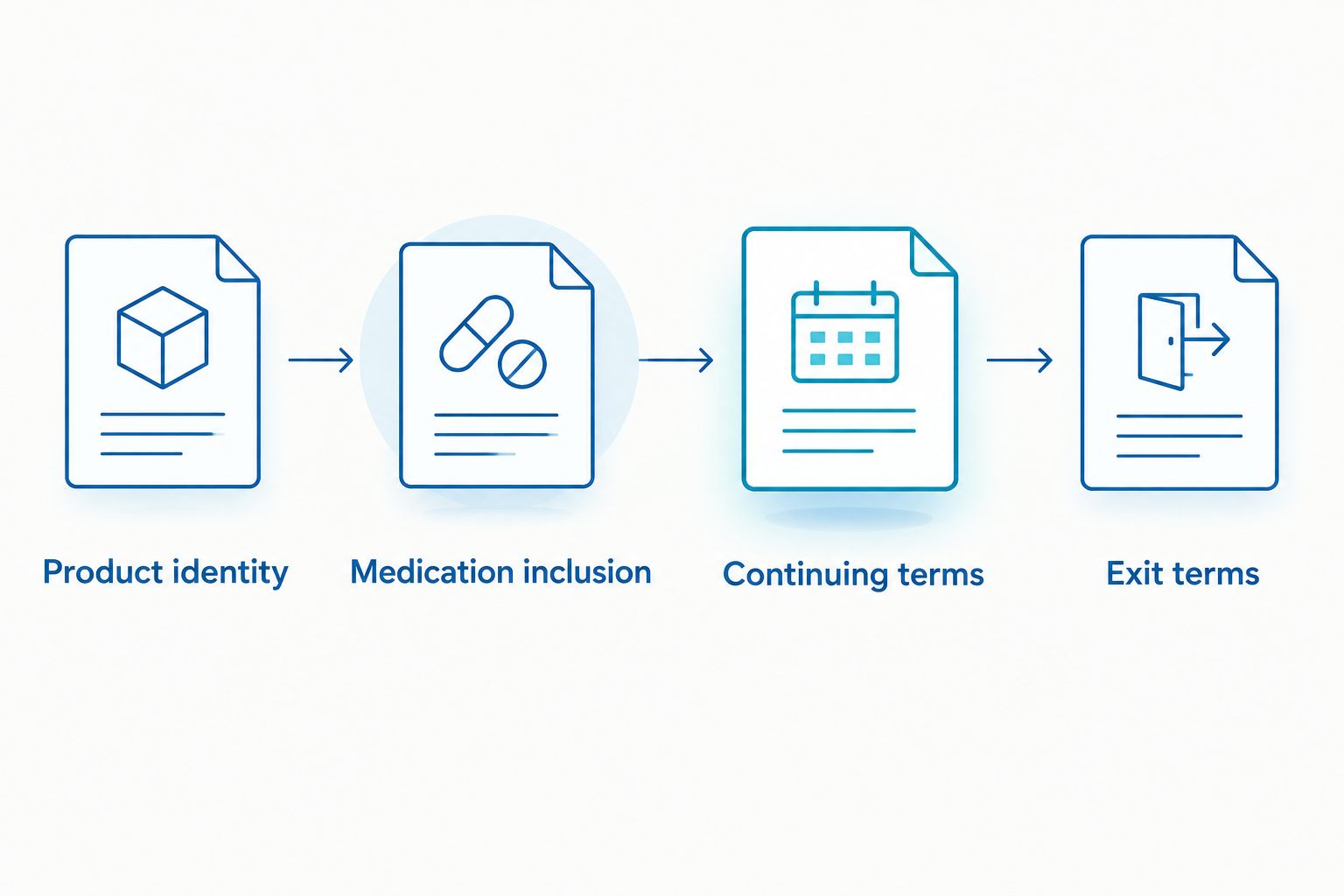
Use a consistent sequence so that an attractive headline does not determine which questions you ask. Keep a copy of the terms you actually reviewed, rather than relying on a later version of a webpage.
- Product identity: Record the exact nasal formulation and bottle specifications. Do not substitute information about an injection, oral supplement or different formulation.
- Medication inclusion: Identify whether the payment includes medication, clinical access or both. Separate required charges from optional services.
- Continuing terms: Record the billing trigger, renewal arrangement and any minimum commitment. Distinguish an introductory offer from subsequent obligations.
- Exit terms: Check how cancellation affects future billing, pending orders and unused prepaid amounts. Keep unresolved questions on the comparison sheet.
If a provider answers a question privately, ask where the answer appears in the applicable agreement. A support explanation helps you understand terms, but a contradiction still needs resolution.
Telehealth Ledger’s 2026 comparison method keeps three judgments separate: whether terms are documented, whether products are comparable, and whether treatment is clinically appropriate. Only the first two belong in a purchasing comparison.
How these purchasing profiles were ranked
The order prioritizes visibility into the complete obligation, followed by product clarity, recurring-order control and advance-payment commitments. It is an editorial decision framework—not a clinical score, a provider-quality rating or a claim that one payment structure always wins.
A provider-specific ranking needs attributable provider documents, a review date and comparable product details. Clinical claims need relevant evidence, not a billing comparison. For regulatory questions, consult FDA materials about the exact product and any applicable compounding issues; do not infer regulatory status from a telehealth provider’s branding.
Which NAD nasal spray provider should you choose?
Start with the provider that documents the entire continuing agreement and the exact product before asking you to commit. Then compare the remaining candidates on the same basis, without treating a promotional offer as the continuing arrangement.
For 2026, a defensible shortlist should answer the following questions without guesswork:
- What exactly is being prescribed and dispensed?
- Which services and medication are included?
- What triggers another payment?
- What happens when you cancel or cannot continue?
- Who is responsible for clinical questions and dispensing problems?
Telehealth Ledger’s recommendation is to resolve those questions before selecting a provider. Price alone does not establish clinical suitability or provider quality.
FAQ
What's the best NAD nasal spray provider?
No named provider receives a best-overall endorsement in this comparison. Start with documented continuing terms, exact bottle specifications, medication inclusion and identifiable clinical and pharmacy responsibilities.
How much does NAD nasal spray cost through telehealth?
A meaningful comparison requires the provider’s published continuing terms and all required charges. Separate medication, consultation, membership and fulfillment obligations rather than treating a promotional headline as the complete arrangement.
Does a telehealth membership include NAD nasal spray?
Do not assume a membership includes medication. Check whether the written agreement covers clinical access, the prescribed medication, or both, and identify any separate pharmacy transaction.
Is a larger NAD nasal spray bottle a better purchase?
Bottle volume alone does not establish a better purchase. Compare formulation, concentration, included services and purchase conditions without converting the comparison into personal dosing advice.
Can I cancel a NAD nasal spray subscription anytime?
The provider’s written cancellation terms determine how and when you can stop recurring billing. Check the effective date and distinguish cancellation from refunds, pending orders and clinical decisions.
Is NAD nasal spray the same as NAD injections?
NAD nasal spray and NAD injections are different routes of administration. Do not transfer bottle comparisons, prescribing instructions or evidence about one route to the other.
Does a prescription mean a compounded product is FDA-approved?
A prescription does not mean a compounded product is FDA-approved. FDA does not approve compounded drugs; ask the prescriber and dispensing pharmacist about the exact product and consult FDA’s compounding information.
Can a provider comparison tell me whether NAD nasal spray is right for me?
No. A provider comparison can explain purchasing terms, but clinical suitability requires assessment by a qualified clinician. Information only. Not medical advice.
One last thing
Ask what happens if you pay but no prescription is issued. That question separates payment for an evaluation from payment for medication and exposes an important gap in an otherwise tidy comparison.
Save the answer with the agreement. Do not treat an application, payment confirmation or subscription enrollment as a promise that a clinician will prescribe.