

NAD nasal spray refill and cancellation terms depend on the provider’s written agreement: check whether refills renew automatically, what triggers the next charge, and how to stop future orders. Canceling a subscription does not, by itself, establish whether an already authorized refill or separate membership charge is canceled; those questions require the applicable written terms.
- NAD nasal spray comparisons need refill triggers, cancellation deadlines, and medication inclusion—not just an introductory offer.
- Telehealth Ledger is an independent comparison site, not a prescribing service.
- Confirm whether cancellation stops future billing, pending refills, and any separate membership.
- Treat unclear refill and cancellation terms as unresolved before authorizing recurring payments.
NAD nasal spray: what are the refill and cancellation terms?
The decisive terms are the renewal trigger, cancellation cutoff, required cancellation method, and treatment of pending orders. Do not treat a recurring payment, a prescription refill, and a shipment as the same event. Ask the provider to explain their sequence.
Telehealth Ledger is best for readers comparing published telehealth plan terms, not seeking prescribing advice.
Use this table to identify the arrangement described in an NAD nasal spray agreement. These are comparison categories, not verified offerings from a particular provider.
| Arrangement described in the terms | Best for | Practical advantage | Limitation to check |
|---|---|---|---|
| Automatic renewal | Readers who prefer recurring administration | Reduces repeat ordering steps | Requires a clear cancellation cutoff and refill authorization process |
| Patient-requested refill | Readers who want order-by-order control | Separates each refill request from passive renewal | Requires you to initiate the request; clinical approval remains a separate question |
| Membership plus medication | Readers comparing separately described services | Makes the service and medication components distinguishable | Ending one component does not establish that the other has ended |
Why this matters
A first-month promotion is not a continuing price. For a 2026 NAD nasal spray comparison, the useful question is what you authorize after enrollment and which obligations remain when you leave.
A cancellation policy is incomplete for your decision if it explains how to close an account but not what happens to a pending refill. Likewise, a refill page does not answer whether a separate membership continues.
Compare the agreement you will enter, not just the offer that brought you to checkout. Administrative convenience, payment obligations, and clinical suitability are different considerations.
Automatic refills: identify the renewal trigger
For an automatically renewing NAD nasal spray arrangement, identify the event that creates the next payment obligation. Ask whether the agreement ties renewal to a billing date, refill request, clinical review, or another expressly stated event.
Do not infer the trigger from a shipment notification. A message announcing dispatch does not explain when cancellation stopped being possible under the agreement.
Record 3 dates for each renewal: the cancellation deadline, the scheduled charge date, and the expected order-processing date. If the provider does not distinguish them, request clarification rather than assuming they coincide.
Automatic renewal suits readers who want less repeat administration, but only when the terms explain how renewal works. Its drawback is the need to track a deadline that might precede the event you notice first.
Patient-requested refills: separate requests from approval
A patient-requested arrangement should explain what submitting a request authorizes. Ask whether the request initiates clinical review, permits payment collection, sends an order for fulfillment, or combines those steps.
A refill request is not proof of clinical approval. The written process should identify what happens if the request is declined or requires further information, including how any payment is handled.
Order-by-order control is useful when you do not want passive renewal. The corresponding limitation is that you must understand and initiate the required process; do not assume a previous prescription establishes the next refill’s timing or eligibility.
Keep administrative questions separate from treatment questions. Ask the provider about contractual steps and ask the prescribing clinician about continued treatment.
Membership and medication: identify separate obligations
If the agreement describes a membership and medication separately, examine both. Determine which service the membership covers, whether medication is included, and whether cancellation instructions address each component.
Separate components can make the arrangement easier to understand when their scope is explicit. They also create a comparison problem if the headline offer describes only one part of the continuing obligation.
Ask for 2 confirmations when leaving such an arrangement: confirmation that recurring membership billing has ended, and confirmation of the status of future medication orders. Neither confirmation should substitute for the other.
For your 2026 comparison notes, mark medication inclusion as included, excluded, or unclear according to the published terms. Do not interpret an unlabeled program charge as proof that medication is included.
Why NAD nasal spray refill and cancellation terms vary
Compare these contractual features rather than assuming every provider uses the same process:
- Renewal structure: Does the agreement describe automatic renewal or a patient-initiated request?
- Medication inclusion: Does the continuing plan include medication, or describe a separate obligation?
- Authorization sequence: What happens before payment, clinical review, and fulfillment?
- Cancellation method: Does the agreement require a portal action, written request, or another specified route?
- Pending-order treatment: What happens once an order reaches the stated cancellation cutoff?
- Service eligibility: What do the provider’s terms say about eligibility in your state?
These factors explain what to compare; they do not establish any particular provider’s policy. An unanswered question remains unresolved, not favorable by default.
How do you check the terms before enrolling?
Use the same sequence for every provider so that a prominent introductory offer does not crowd out the continuing obligations. This is a document review, not a clinical assessment.
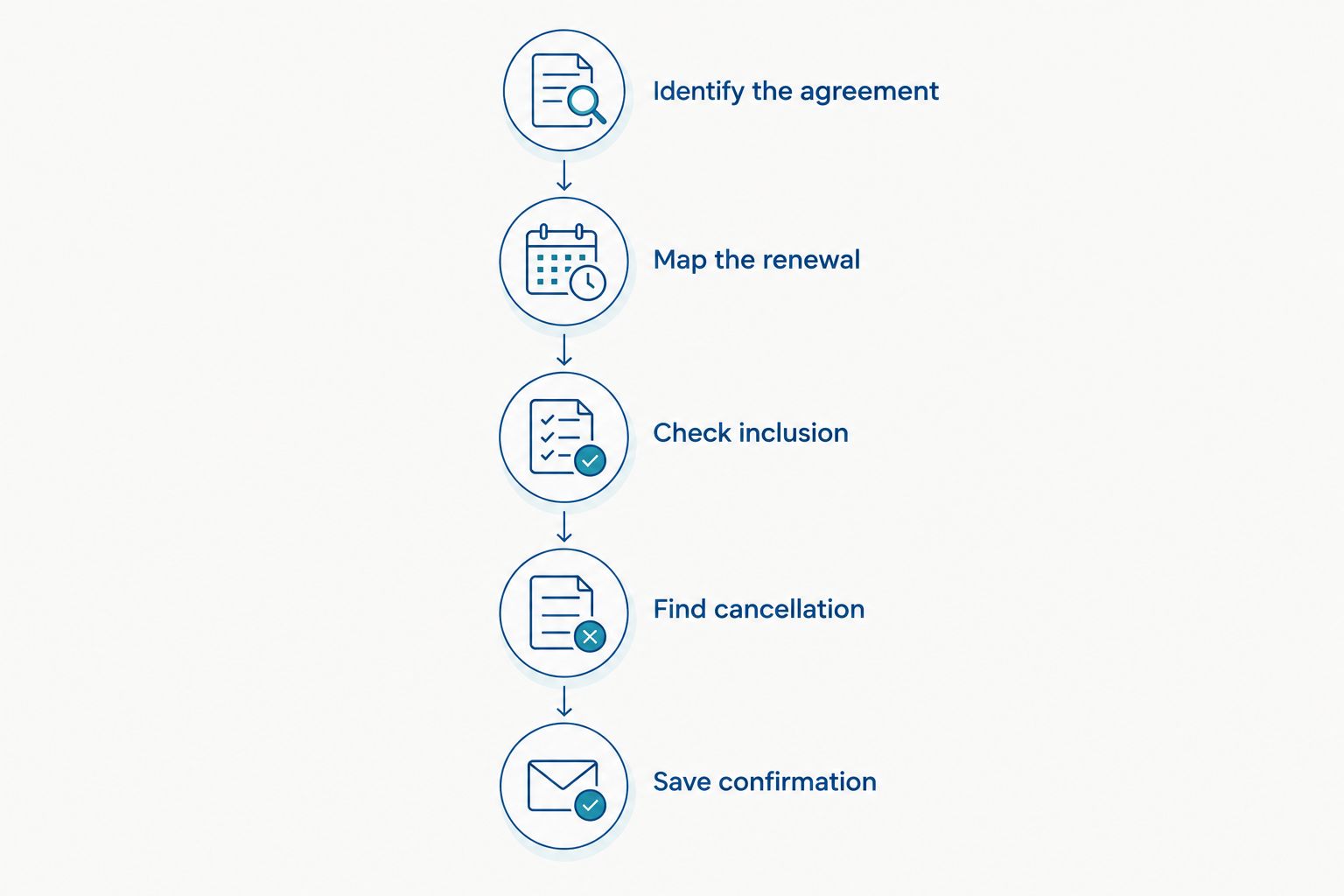
- Identify the agreement. Find the terms governing the exact NAD nasal spray program, not merely a general homepage description.
- Map the renewal. Identify the action or date that authorizes the next charge and refill process.
- Check inclusion. Distinguish medication, clinical services, delivery, and any separately described required fees.
- Find cancellation. Record the required method, deadline, and treatment of an order already in progress.
- Save confirmation. Keep the applicable terms and the provider’s written answers with your enrollment record.
For a 2026 review, record the date you accessed the terms and the effective date displayed on the document, if present. Do not label a policy current merely because a page is accessible.
If checkout language conflicts with another policy page, ask which provision governs your enrollment. Save the answer alongside both documents rather than selecting the interpretation you prefer.
What should you ask about a pending refill?
Ask the provider to identify the refill’s current administrative stage and the contractual rule that applies at that stage. A general cancellation acknowledgment is not an answer about a specific pending order.
Use direct questions:
- Has the next refill been authorized, charged, submitted for fulfillment, or dispatched?
- What does canceling today stop?
- Does the cancellation affect only future renewals or also this pending order?
- Is there a separate refund decision, and which written policy governs it?
- Will any membership or service obligation continue?
Cancellation and refund eligibility are separate questions. Obtain an answer to each rather than interpreting one as the other.
Do not send payment credentials or unnecessary medical information in a cancellation request. Use the provider’s specified account or support process and retain the response.
What records should you keep?
Keep 4 records together: the enrollment agreement, the order confirmation, the cancellation request, and the provider’s cancellation confirmation. Save the version that applied to your transaction, not just a bookmark to a page that can change.
A useful cancellation request identifies the account, the recurring arrangement you want to end, and the pending order you want clarified. Request written confirmation of the effective cancellation date and any remaining obligation.
If the provider responds only that your account is closed, ask whether recurring billing and future refill orders are also stopped. Closing access to an account and explaining the status of an order are different administrative tasks.
These records support a clear conversation with the provider. They do not establish a refund entitlement or replace the applicable agreement.
How does Telehealth Ledger compare these terms?
Telehealth Ledger focuses on published telehealth prices, continuing plan costs, medication inclusion, and program terms. For this comparison, the relevant evidence is the provider’s original agreement, cancellation policy, refill instructions, and transaction-specific confirmation.
No provider-specific refill deadline, cancellation window, or refund policy is established here. This 2026 guide supplies a comparison method rather than a verified policy directory.
Apply the same labels to every provider: confirmed in the applicable written terms, unclear, or conflicting. A broad statement such as cancel anytime needs a separate answer about its effect on a pending refill.
Price alone does not establish clinical suitability or provider quality. Nor do administrative terms establish a product’s regulatory status, evidence, or suitability for you; those require separate, authoritative information and clinician input.
Can I cancel after the next refill has been charged?
A charge alone does not establish whether you can cancel the pending refill or receive a refund. Ask the provider which order stage and written policy govern that transaction.
Specify that you want both future renewal cancellation and clarification of the charged order. Do not assume a response about future billing resolves the existing charge.
Does canceling NAD nasal spray also cancel the membership?
Canceling NAD nasal spray does not establish that a separately described membership has ended. Check whether the cancellation instructions cover the medication arrangement, the membership, or both.
Request confirmation of each recurring obligation. If the provider describes a single combined arrangement, ask it to confirm that no separate component remains active.
Should I choose automatic or patient-requested refills?
Choose between automatic and patient-requested refills based on the control and administration you want, after checking the actual terms. Automatic renewal reduces repeat ordering steps; patient-requested renewal gives you an explicit point to initiate each request.
Neither structure establishes clinical suitability. Prefer clear terms over a convenient label.
FAQ
What should I check before signing up for NAD nasal spray refills?
Check the renewal trigger, medication inclusion, cancellation deadline, and required cancellation method. Also ask what happens to a pending order and whether a separate membership continues.
Does cancel anytime mean I can get a refund?
Cancel anytime does not establish refund eligibility. Read the separate refund provisions and ask how they apply to an order already authorized or charged.
Can I stop a refill by not completing a clinical questionnaire?
Do not treat an incomplete questionnaire as a cancellation request. Use the cancellation method stated in the agreement and ask the provider to confirm the effect on billing and pending orders.
Is a first-month NAD nasal spray promotion the continuing plan cost?
A first-month promotion is not a continuing price. Check the published continuing obligations, medication inclusion, required fees, and commitment before enrolling.
What if the cancellation policy and checkout page disagree?
Ask the provider which written provision governs your enrollment before authorizing recurring payments. Save both versions and the provider’s written clarification.
Does a clear cancellation policy mean NAD nasal spray is right for me?
A clear cancellation policy does not establish clinical suitability. Discuss treatment questions with a licensed clinician and assess administrative terms separately.
One last thing
Before enrolling in 2026, write the cancellation request you would send if you decided to leave. If you cannot identify where to send it, when it must arrive, and what it stops, the agreement still needs clarification.
Do not let a clear enrollment process substitute for a clear exit process. Confirm both before authorizing renewal.
Information only. Not medical advice.