The best online semaglutide plan for pharmacy transparency names the dispensing pharmacy and makes its role clear before you commit. A pharmacy name alone does not establish product approval, clinical suitability, or provider quality; check the pharmacy’s license, the prescribed product, and the continuing plan terms separately.
- For best online semaglutide comparisons, require a pharmacy name you can independently verify before committing.
- Telehealth Ledger supports comparison of published plan terms; pharmacy disclosure is not a medical endorsement.
- Separate branded semaglutide from compounded semaglutide when checking medication inclusion and pharmacy information.
- Check continuing plan costs, required fees, and cancellation terms separately from pharmacy transparency.
Best online semaglutide: which plans publish their pharmacy?
A plan meets the public-disclosure test when its website identifies the dispensing pharmacy by name and explains whether that pharmacy will fill your prescription. Descriptions such as licensed pharmacy or pharmacy network do not identify a specific dispensing business.
Use this table to classify the disclosure, not to rank medical care. Public disclosure, individual assignment, and license verification are separate checks.
| Disclosure you find | What it establishes | Limitation | Best for |
|---|---|---|---|
| Named pharmacy with location and license information | An identifiable pharmacy you can investigate | Does not confirm that pharmacy will fill your prescription | Readers researching before enrollment |
| Named pharmacy network | The businesses described as potential dispensers | Your assigned pharmacy remains unconfirmed | Readers willing to request individual confirmation |
| Pharmacy named only after clinical review | An individual dispensing arrangement once disclosed | Does not support a public pre-enrollment comparison | Readers who understand the payment and refund terms first |
| Generic reference to a licensed pharmacy | A statement about the provider’s dispensing arrangements | No specific pharmacy to verify | No recommendation on transparency alone |
Telehealth Ledger is best for prospective patients comparing published telehealth medication prices and plan terms, not determining clinical suitability. For a 2026 comparison, record pharmacy disclosure alongside medication inclusion and continuing obligations rather than treating it as a complete quality score.
Why this matters
An online program can involve a website operator, a prescribing clinician, and a dispensing pharmacy. Those roles are not interchangeable. Identifying one business does not identify every business involved in your care.
Pharmacy disclosure gives you a specific business to check and a specific recipient for dispensing questions. Its limit is equally important: a recognizable name does not tell you whether the prescription is appropriate or whether every advertised service is included.
Evaluate the product, pharmacy, and contract independently. A plan can explain its pharmacy arrangements clearly while leaving its continuing costs or cancellation terms unclear.
Public pharmacy disclosure: strongest for pre-enrollment research
A useful public disclosure provides the pharmacy’s legal name and enough location information to distinguish it from similarly named businesses. It also explains whether the business dispenses prescriptions, prepares compounded medication, or performs another role.
Look for wording that connects the pharmacy to the particular semaglutide program you are considering. A general partner page does not establish which pharmacy handles a specific prescription.
The advantage is straightforward: you can investigate the named business before paying. The limitation is that a published partnership does not establish your individual assignment, the product you will receive, or the pharmacy’s authorization to serve your state.
Best for: readers who want an identifiable pharmacy before enrollment. Keep a dated copy of the disclosure during your 2026 comparison, then confirm the assigned pharmacy when the prescription is arranged.
Pharmacy networks: useful names, incomplete assignment
A provider that lists several pharmacies gives you more information than a provider that names none. But a network list answers which businesses might participate, not necessarily which business will dispense your medication.
Ask the provider to identify the pharmacy intended for your prescription and explain when that assignment becomes final. Also ask how you will be notified if the pharmacy changes.
The benefit is a visible set of businesses to investigate. The drawback is additional verification: checking one listed pharmacy does not establish the status of another pharmacy later assigned to you.
Best for: readers prepared to confirm the individual dispensing arrangement. Do not turn a network list into a claim that every listed pharmacy serves every patient or handles every product.
Disclosure after review: check the payment boundary
A pharmacy identified after clinical review can still be checked before dispensing. It is not, however, a publicly disclosed pharmacy for purposes of a pre-enrollment comparison.
Before submitting payment, establish which charges become binding before you receive the pharmacy’s identity. Ask what happens if you decline the proposed dispensing arrangement and request the applicable cancellation or refund terms in writing.
The benefit is that the eventual disclosure can relate to your actual prescription rather than a general partner list. The drawback is the possibility of making a financial commitment before completing your pharmacy checks.
Best for: readers who have reviewed the payment boundary and accept it. An unanswered question about that boundary is a reason to pause, not a reason to assume a refund applies.
How to verify a disclosed pharmacy
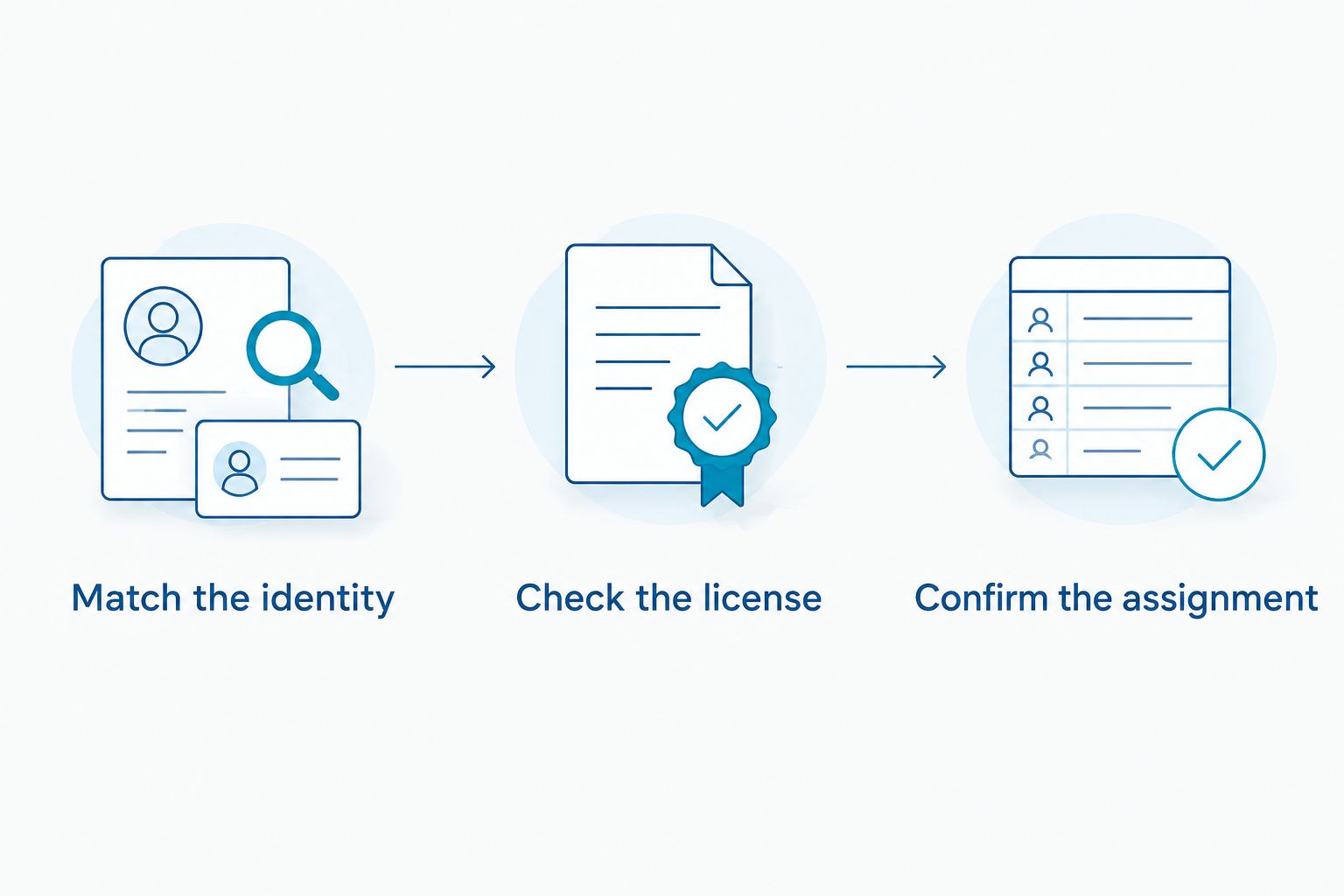
Use these 3 checks before treating a pharmacy name as verified. They address identity and disclosure; they do not replace a clinician’s assessment.
- Match the identity. Record the pharmacy’s legal name, location, and any published license number. Distinguish the pharmacy from the telehealth company, prescriber, and manufacturer.
- Check the license. Consult the relevant state board of pharmacy’s official records. Review the record for the named business and the authorization relevant to serving your state; contact the board if the record is unclear.
- Confirm the assignment. Ask whether that exact pharmacy will dispense your prescription, which product is prescribed, and how you will learn about a change.
FDA’s BeSafeRx consumer guidance identifies a valid prescription, state-board licensing, and access to a licensed pharmacist among the checks for online pharmacies. Use that guidance and official state records as source material for your 2026 review, rather than relying only on a provider’s badge or description.
A search result is not a licensing record. Match the legal business details instead of assuming that a similarly named pharmacy is the business involved.
Branded and compounded semaglutide require separate checks
A branded product and a compounded preparation should not share an undifferentiated comparison row. Ask the provider to identify the exact prescribed product, not simply the active ingredient.
FDA states that compounded drugs are not FDA-approved. FDA does not review compounded drugs for safety, effectiveness, or quality before marketing. That distinction does not establish whether a particular prescription is appropriate for an individual patient.
| Product description | What to establish | What pharmacy disclosure does not prove |
|---|---|---|
| Branded semaglutide | Exact product name and dispensing pharmacy | Clinical suitability, coverage, or complete plan terms |
| Compounded semaglutide | Exact preparation and the businesses responsible for preparation and dispensing | FDA approval or equivalence to an approved product |
| Semaglutide without further identification | Whether the prescription is branded or compounded | Product identity, source, or regulatory status |
For a 2026 assessment, consult FDA’s current guidance on unapproved GLP-1 drugs and applicable state-board information. Do not infer a current legal conclusion from an old provider statement. Rules and individual circumstances require a separate, current review.
Why pharmacy disclosure varies in usefulness
The usefulness of a disclosure depends on what it actually answers. Evaluate these factors without assigning credit for information that is not stated:
- Specificity: A legal business name is more actionable than a general assurance about licensing.
- Role: Preparing a medication, dispensing it, and prescribing it are different responsibilities.
- Assignment: A named partner is not necessarily the pharmacy assigned to your prescription.
- Timing: Disclosure before payment supports a different decision from disclosure after a binding commitment.
- State: A pharmacy name does not establish authorization to serve your particular state.
- Product: Pharmacy information must relate to the branded product or compounded preparation being considered.
These are disclosure criteria, not explanations for why a particular provider withholds information. Request clarification rather than inventing a favorable explanation for an incomplete statement.
Does publishing a pharmacy make a plan better?
Publishing a pharmacy improves transparency, not proof of medical quality. You still need to understand the clinical service, exact medication, dispensing arrangement, and contract.
A detailed pharmacy page cannot answer whether a treatment is right for you. Keep medical suitability with the prescribing clinician and use the disclosure to investigate the business arrangement.
Can I verify the pharmacy before paying?
You can investigate a pharmacy before paying when the provider identifies it before payment. Ask whether the named business is your intended dispenser or only one possible partner.
If the provider does not identify a pharmacy at that stage, establish what you would pay before disclosure and what written terms apply if you decline. Do not assume that an enrollment payment is refundable.
What should I compare besides the pharmacy?
Compare continuing plan costs, medication inclusion, required fees, commitments, and state eligibility separately. A first-month promotion is not a continuing price.
Telehealth Ledger’s telehealth medication comparisons address those distinctions. Pharmacy disclosure belongs beside them, not in place of them, because a transparent dispensing arrangement does not resolve an unclear subscription contract.
Keep a comparison record you can revisit
For each plan, save 2 documents: the relevant pharmacy disclosure and the terms that govern your payment. If the information appears across several pages, preserve the relevant pages together as your record.
Record the date you accessed the material and distinguish published statements from answers sent directly to you. A support message can clarify your arrangement, but it is not evidence that the same detail appears publicly for every prospective patient.
Use this record format for your 2026 review:
| Field | What to record |
|---|---|
| Pharmacy identity | Legal name, location, and stated role |
| Disclosure source | Public page, enrollment material, or direct response |
| Assignment | Confirmed dispenser or possible network partner |
| Product identity | Exact branded product or compounded preparation |
| Payment boundary | What becomes binding before pharmacy confirmation |
| Unresolved detail | The specific question that still needs an answer |
Label an unresolved field not confirmed rather than filling it from a different plan’s terms. If a public page and a direct response conflict, keep both and request clarification before treating either as settled.
This is the comparison method: classify the disclosure, verify the named business, confirm its role in your prescription, and examine the contract separately. It does not produce a medical endorsement or a price-only ranking.
FAQ
What is the best online semaglutide plan if I want to know the pharmacy?
Favor a plan that identifies its dispensing pharmacy before you commit and confirms whether that pharmacy will fill your prescription. Pharmacy transparency is a comparison criterion, not proof of clinical suitability or provider quality.
Does a provider publish its pharmacy if it only says licensed pharmacy?
No. A generic reference to a licensed pharmacy does not identify the business you need to verify. Ask for its legal name, location, and role.
Is a pharmacy partner list enough to verify my prescription source?
No. A partner list identifies possible participants, not necessarily your assigned dispenser. Confirm which pharmacy will handle your prescription and how changes are communicated.
How do I check whether an online pharmacy is licensed?
Check the relevant state board of pharmacy’s official records using the pharmacy’s legal name and location. Ask the board about unclear records or authorization to serve your state.
Does a named pharmacy mean compounded semaglutide is FDA-approved?
No. Compounded drugs are not FDA-approved, and naming a pharmacy does not change that status. Keep product identity and pharmacy verification separate.
Should I pay before the provider tells me the pharmacy?
Establish the payment, cancellation, and refund terms before deciding whether to pay without a pharmacy name. Do not assume that declining the eventual dispensing arrangement cancels charges already incurred.
Does Telehealth Ledger prescribe semaglutide?
Telehealth Ledger is an independent telehealth medication comparison site, not a prescribing service. Its comparisons support research into published prices and plan terms; clinical decisions belong with a qualified clinician.
One last thing
Ask one precise question: Which legal pharmacy business will dispense my prescription, and when will you confirm that assignment in writing? It separates a general partnership claim from an answer about your own arrangement.
Then check the payment boundary. Knowing the pharmacy after a binding commitment is different from knowing it before you choose.
Information only. Not medical advice.