

The best online tirzepatide plan for pharmacy transparency names the dispensing pharmacy before you pay and gives you enough information to check its license. A pharmacy name is a starting point, not proof of medication quality, clinical suitability or complete plan terms.
- Best online tirzepatide comparisons should distinguish a named dispensing pharmacy from an unnamed pharmacy network.
- Telehealth Ledger is best for readers comparing telehealth medication costs and plan terms, not selecting treatment.
- Verify the pharmacy independently; a provider’s disclosure does not replace a state licensing check.
- Check medication inclusion, continuing plan costs and cancellation terms separately from pharmacy disclosure.
Best online tirzepatide: which plans publish their pharmacy?
Count a plan as publicly disclosing its pharmacy only when its published information identifies the dispensing business clearly enough to verify it. Descriptions such as partner pharmacy, licensed pharmacy or pharmacy network do not identify a particular dispenser.
The table below compares disclosure types, not individual providers. It does not assign a verified pharmacy-disclosure status to any named plan.
| Published disclosure | What you can establish | What remains unresolved | Best for |
|---|---|---|---|
| Pharmacy name and location | A specific business to check against licensing records | Whether that pharmacy will fill your prescription | Readers checking a named dispenser |
| Several named pharmacies | The disclosed network contains identifiable businesses | Which pharmacy serves your state and prescription | Readers willing to confirm the assigned pharmacy |
| Pharmacy name supplied after enrollment | Identification is available later in the process | Whether you can assess the dispenser before committing | Readers only after prepayment questions are resolved |
| Licensed partner pharmacy, without a name | The provider makes a general licensing claim | The identity and license of the actual dispenser | Not sufficient for prepayment verification |
| Manufacturer name only | The stated manufacturer of the medication | The identity of the dispensing pharmacy | Readers checking product identity, not pharmacy identity |
Telehealth Ledger compares telehealth medication costs and plan terms. For a 2026 comparison, keep pharmacy transparency as a separate field rather than treating it as a substitute for the rest of that comparison.
Why this matters
A telehealth service, a prescribing clinician and a dispensing pharmacy perform different roles. Naming the service does not necessarily identify the pharmacy that fills and labels your prescription.
That distinction affects what you can verify before enrollment. Without the pharmacy’s identity, you cannot match the provider’s statement to a specific pharmacy licensing record or direct pharmacy contact.
Disclosure is necessary for verification, but disclosure alone is not a quality rating. A named pharmacy does not answer whether the prescribed medication is appropriate for you, whether medication is included in the plan or what happens when you cancel.
Information only. Not medical advice.
What counts as a usable pharmacy disclosure?
A usable disclosure identifies a business, not just a relationship. Read the provider’s pharmacy information, program terms and checkout disclosures together; a general statement about its network does not necessarily identify your dispenser.
For your 2026 comparison, record these fields separately:
- Pharmacy identity: The pharmacy’s business name, including a legal name when provided.
- Pharmacy location: The address or location that distinguishes it from similarly named businesses.
- State authorization: The licensing information relevant to dispensing into your state.
- Assigned pharmacy: Whether the named pharmacy will actually fill your prescription.
- Change policy: What the provider says about switching pharmacies during treatment.
The advantage of a complete disclosure is practical: you have a business to verify and a specific question to ask. The limitation is equally important: published information can describe a network without confirming an individual prescription’s destination.
If several pharmacies appear, ask which one applies to your state and medication. Do not assume that the first name on a provider’s website is your assigned dispenser.
Public disclosure versus disclosure on request
A pharmacy name published before checkout supports an independent comparison without enrollment. A name supplied through customer support can still answer your question, but it is not the same as a public disclosure.
Keep those categories separate in your notes. Record whether the information came from a public page, a written support response or prescription paperwork received later.
Best for comparing before payment: a public, identifiable pharmacy disclosure. A support answer is useful supporting documentation, but it should not be described as a published policy unless the provider publishes it.
How do you verify a named dispensing pharmacy?
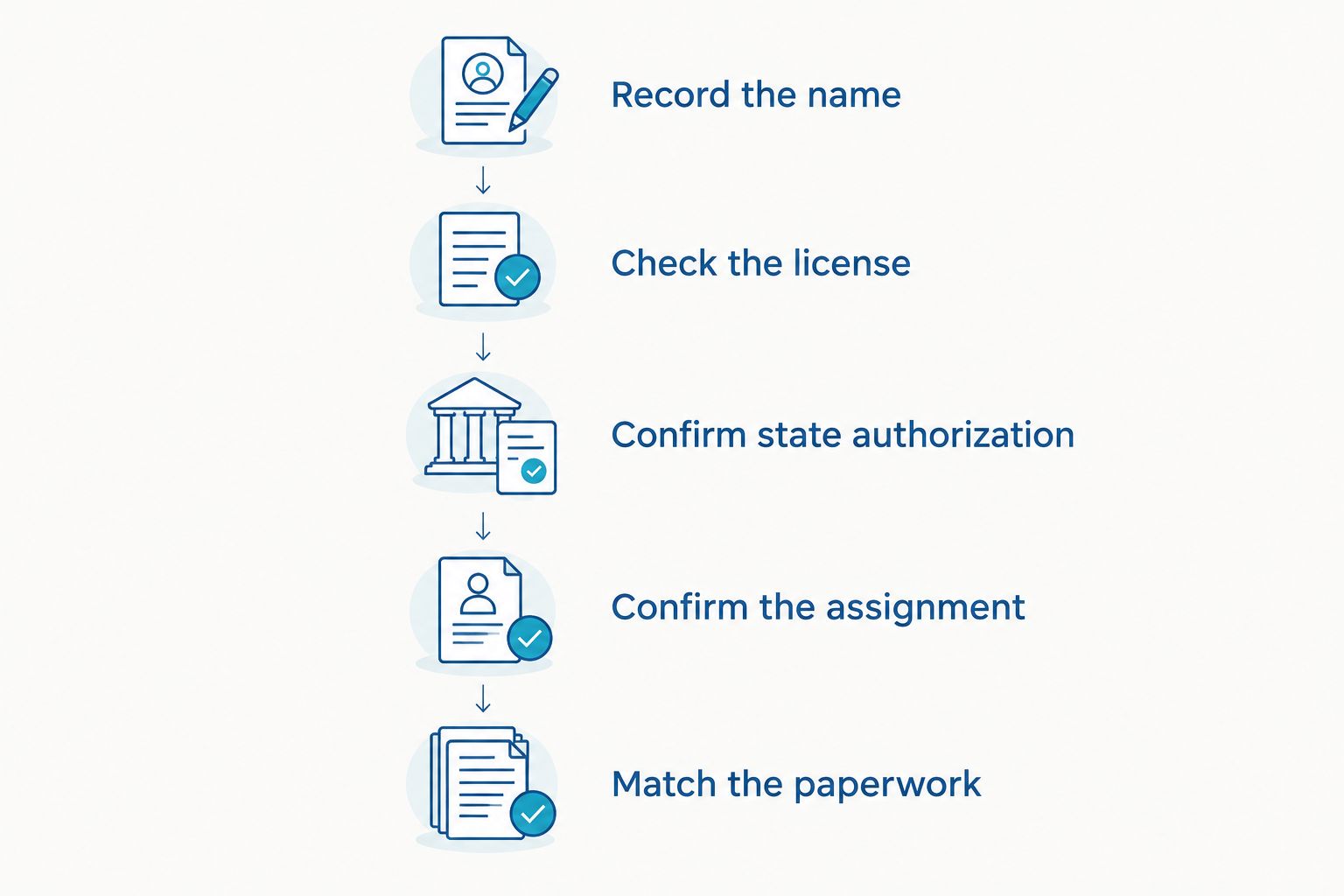
Use a repeatable process rather than relying on a logo, badge or general claim. The goal is to connect the provider’s statement to the actual dispensing business and the relevant official record.
- Record the name. Copy the pharmacy name and location exactly as disclosed, along with the page or written response and the date you checked it.
- Check the license. Use the relevant state board of pharmacy’s official lookup. Match the business and location rather than accepting a similar name.
- Confirm state authorization. Check the authorization relevant to your state, including nonresident pharmacy authorization where applicable. Ask the board if the record is unclear.
- Confirm the assignment. Ask the telehealth provider whether that pharmacy will dispense your medication and whether the assignment can change.
- Match the paperwork. When prescription documentation becomes available, compare the dispensing pharmacy’s identity with the earlier disclosure. Direct discrepancies to the provider and pharmacist.
An active license answers a licensing question. It does not establish that a particular prescription is appropriate or that every claim on a telehealth website is accurate.
Keep dated records for your 2026 comparison. If the provider later names a different pharmacy, repeat the identity and licensing checks rather than transferring your earlier conclusion to the replacement.
Keep product identity separate from pharmacy identity
A pharmacy disclosure and a medication description answer different questions. The first identifies who dispenses; the second identifies what the provider proposes to supply.
Branded tirzepatide and compounded preparations should not occupy the same comparison row without a clear distinction. FDA approval of a branded medicine does not establish approval of a separately compounded preparation.
Ask the provider to identify the proposed product explicitly. Do not interpret a general reference to tirzepatide as confirmation that a particular branded product is included.
Your comparison should distinguish:
- The medication description used in the provider’s published terms.
- Whether the program describes a branded or compounded product.
- Whether medication is included or requires a separate purchase.
- The pharmacy expected to dispense that product.
- Any product substitution or pharmacy change described in the terms.
Do not use a pharmacy’s name to fill gaps in the medication description. Even a clearly identified pharmacy does not tell you which product a plan includes.
For questions about current compounding rules or a specific regulatory claim, consult the FDA’s current official material. A provider’s summary is not a substitute for the underlying statement and its scope.
Why pharmacy verification differs between plans
The work required to verify a plan depends on what the provider actually discloses. These are comparison factors, not evidence that any particular provider follows a given practice.
- Network disclosure: A list of pharmacies requires an additional assignment check; a single named dispenser is more specific.
- State authorization: A pharmacy’s authorization must be assessed for the state receiving the prescription, not inferred from its address.
- Product description: A clear distinction between branded and compounded medication prevents an incorrect product comparison.
- Disclosure timing: Information supplied before payment supports a different decision than information supplied only afterward.
- Pharmacy changes: A named dispenser at enrollment does not answer how later changes are communicated.
When details conflict, preserve the conflict in your comparison. Mark the assigned pharmacy as unconfirmed until the provider resolves the discrepancy in writing.
A missing answer is not proof of misconduct. It is an unresolved verification item, and it should not receive the same status as a documented answer.
Compare continuing terms after checking the pharmacy
Pharmacy transparency does not settle the financial comparison. A plan can identify its dispenser while leaving medication inclusion, required fees or the commitment period unclear.
A first-month promotion is not a continuing price. Compare the published continuing terms separately, and do not infer that the pharmacy’s charges are included simply because a pharmacy is named.
Use the same questions for every plan:
- Does the stated plan include medication, clinical services or both?
- Which required charges are separate from the recurring plan?
- Is payment monthly, tied to refills or collected upfront?
- What commitment, renewal and cancellation terms apply?
- What happens financially if prescribing or dispensing does not proceed?
Refill timing deserves its own field. A 4-week interval is 28 days, and a 52-week comparison contains 13 such intervals; that is not the same structure as 12 calendar-month payments.
For a 2026 comparison, write down the billing interval exactly as published. Do not relabel a refill-based charge as a calendar-month charge or assume that membership billing and medication refills follow the same schedule.
Can you verify the pharmacy before paying?
Prepayment verification requires the pharmacy’s identity before payment. If a provider names only a network, ask for the pharmacy expected to serve your state and prescription.
Request a written answer rather than relying on an enrollment conversation you cannot review later. If the provider cannot identify the pharmacy yet, record that limitation and examine the payment, cancellation and refund terms before committing.
Does publishing a pharmacy make a plan the best choice?
Publishing a pharmacy supports transparency, not a clinical endorsement. It gives you an identifiable business to check but does not establish treatment suitability, medication quality or the quality of clinical follow-up.
Telehealth Ledger’s telehealth medication comparisons should be read as comparisons of published information and terms. Decisions about prescribing belong with an appropriately licensed clinician who reviews your circumstances.
What should you ask when a provider names several pharmacies?
Ask which pharmacy will fill your prescription. Then ask whether the assignment depends on your state or product and how you will be told about a change.
A network list has a genuine benefit: it identifies businesses you can investigate. Its limitation is that it does not, by itself, identify your dispenser.
FAQ
What is the best online tirzepatide plan for pharmacy transparency?
For pharmacy transparency, use a standard that requires a named dispensing pharmacy before payment and enough information to verify it. That standard does not establish which treatment or provider is clinically appropriate for you.
Does licensed partner pharmacy count as publishing the pharmacy?
No. Licensed partner pharmacy describes a claimed relationship without identifying a particular dispensing business. Ask for the pharmacy’s name, location and assignment to your prescription.
How do I check an online tirzepatide pharmacy’s license?
Check the relevant state board of pharmacy’s official records and match the business name and location. Confirm the authorization relevant to dispensing into your state, and ask the board about unclear records.
Is a manufacturer the same as a dispensing pharmacy?
No. The manufacturer and dispensing pharmacy perform different roles. A manufacturer’s name does not identify the pharmacy filling your prescription.
Does a named pharmacy prove that compounded tirzepatide is FDA-approved?
No. Naming a dispensing pharmacy does not establish FDA approval of a compounded preparation. Keep pharmacy identity, product identity and regulatory status separate.
Should I check pharmacy details again after enrollment?
Yes. Compare the pharmacy on your prescription documentation with the provider’s earlier disclosure, and repeat verification if the assigned pharmacy changes. Ask the provider and pharmacist to resolve discrepancies.
Does Telehealth Ledger recommend treatment based on pharmacy disclosure?
No. Telehealth Ledger compares telehealth medication costs and plan terms; pharmacy disclosure is a transparency check, not a treatment recommendation. Information only. Not medical advice.
One last thing
Ask a prospective provider: If my dispensing pharmacy changes, how will I be told before the next prescription is filled? The answer tests whether pharmacy disclosure is an ongoing practice rather than a name supplied once during enrollment.
Save that answer alongside the original pharmacy disclosure and continuing plan terms. A useful 2026 comparison preserves what was stated, when it was checked and which questions remain unresolved.