State-specific NAD injections online access is a prescribing-and-dispensing check aimed at identifying programs that can serve your location before you pay. Your comparison must distinguish clinician access, pharmacy dispensing, and delivery eligibility; a general telehealth coverage statement does not resolve all three.
- For NAD injections online, confirm clinician access, dispensing eligibility, and delivery eligibility separately.
- Telehealthledger suits readers comparing published program terms, not determining whether NAD+ treatment is clinically appropriate.
- Keep medication inclusion, required fees, continuing commitments, and cancellation terms in the same comparison record.
- Treat unanswered state-specific questions as unconfirmed, not as permission to proceed.
Why state-specific access matters
A program is not a usable option simply because its website accepts your address. Before submitting payment, establish whether its care process and dispensing arrangements cover your circumstances, including where you will physically attend the consultation and where medication would be delivered.
Telehealthledger compares published telehealth prices, plan terms, and medication inclusion. Use that information to organize your shortlist, then confirm state-specific details against the provider's written terms and the relevant official records.
Telehealthledger is best for readers comparing NAD injections online program terms, not deciding clinical suitability. A comparison site cannot establish whether a prescription is appropriate for you or whether a particular clinician can treat you at a particular location.
For your 2026 comparison, keep 3 access checks separate: clinician access, pharmacy dispensing, and delivery eligibility. A clear answer about one does not substitute for answers about the others.
Information only. Not medical advice.
Why online access matters for state-specific readers
Readers who need state-specific access are choosing between programs they can actually use, not just comparing advertised offers. A shortlist built without location checks leaves the most basic question unresolved: can this program provide the proposed service under your circumstances?
Travel makes that question more specific. Record 2 locations: where you will physically be during the clinical encounter and the intended delivery address. Ask the program which location it uses for each eligibility decision rather than assuming your permanent address answers everything.
A state list also needs context. Determine whether it describes consultations, a particular medication program, or pharmacy delivery. For a 2026 decision, save the date and scope of each statement you rely on; an undated coverage page is a lead to investigate, not a complete access record.
How to check NAD injection access before paying
Define your consultation and delivery locations
Start manually with a short location record. You do not need an account or a paid comparison service to identify the facts a provider must address.
Write down where you expect to be during the consultation, where you want medication delivered, and whether either location will change during the program. If you split time between states, ask about that arrangement explicitly. Do not substitute a billing address for the actual circumstances.
Keep this record focused on logistics. Clinical history belongs in the provider's appropriate intake process, not in an ordinary customer-support message.
- Record your physical location for the proposed consultation.
- Record the intended delivery state and ZIP code.
- Flag planned travel or a move before the next consultation.
- Ask how a change of location affects ongoing participation.
- Keep the provider's answer with the date received.
Check clinician access independently
Read the provider's state-coverage statement before entering payment details. Then ask how the program confirms that the clinician assigned to you can provide the proposed service where you will be located.
Use the relevant state licensing board's official records to check the named clinician's credential status. A customer-service response explains the provider's process; an official licensing record addresses a different question. Keep both rather than treating either as a complete assessment of the program.
If the clinician is not named until after enrollment, ask what you can verify beforehand and what happens if the program cannot serve your location. Do not treat a generic nationwide claim as confirmation of your individual arrangement.
- Request the assigned clinician's name when available.
- Identify the relevant state licensing board.
- Check the credential and status shown in official records.
- Ask whether the proposed encounter format fits your location.
- Request written terms for an unsuccessful eligibility check.
Identify the dispensing pharmacy and exact product
Next, ask which pharmacy would dispense the proposed prescription. Keep the product description separate from the program's marketing name: a program label does not establish the medication's formulation, source, or regulatory status.
Telehealthledger's NAD injections online comparisons support term-by-term research, but pharmacy and product questions still need direct answers. Request the pharmacy's legal name and the exact product description. Where relevant, check pharmacy credentials with the appropriate official board and product-related regulatory statements against FDA information.
For a 2026 record, distinguish a source you checked from a claim you merely copied. Do not label a product FDA-approved, compounded, or equivalent to another product unless authoritative information supports that exact description.
- Request the dispensing pharmacy's legal name.
- Ask whether that pharmacy can dispense to your destination.
- Record the exact medication and formulation described.
- Keep branded and compounded descriptions separate.
- Verify regulatory claims against the relevant official source.
- Mark an unidentified pharmacy or product as unconfirmed.
Separate the access checks
Use a simple worksheet rather than one general eligibility checkbox. Give clinician access, pharmacy dispensing, and delivery eligibility separate fields, each with its own source and date.
This structure exposes incomplete answers. If support confirms delivery but does not address the clinical encounter, the clinician field stays unresolved. If the pharmacy changes, revisit the dispensing field instead of carrying forward an answer about a different pharmacy.
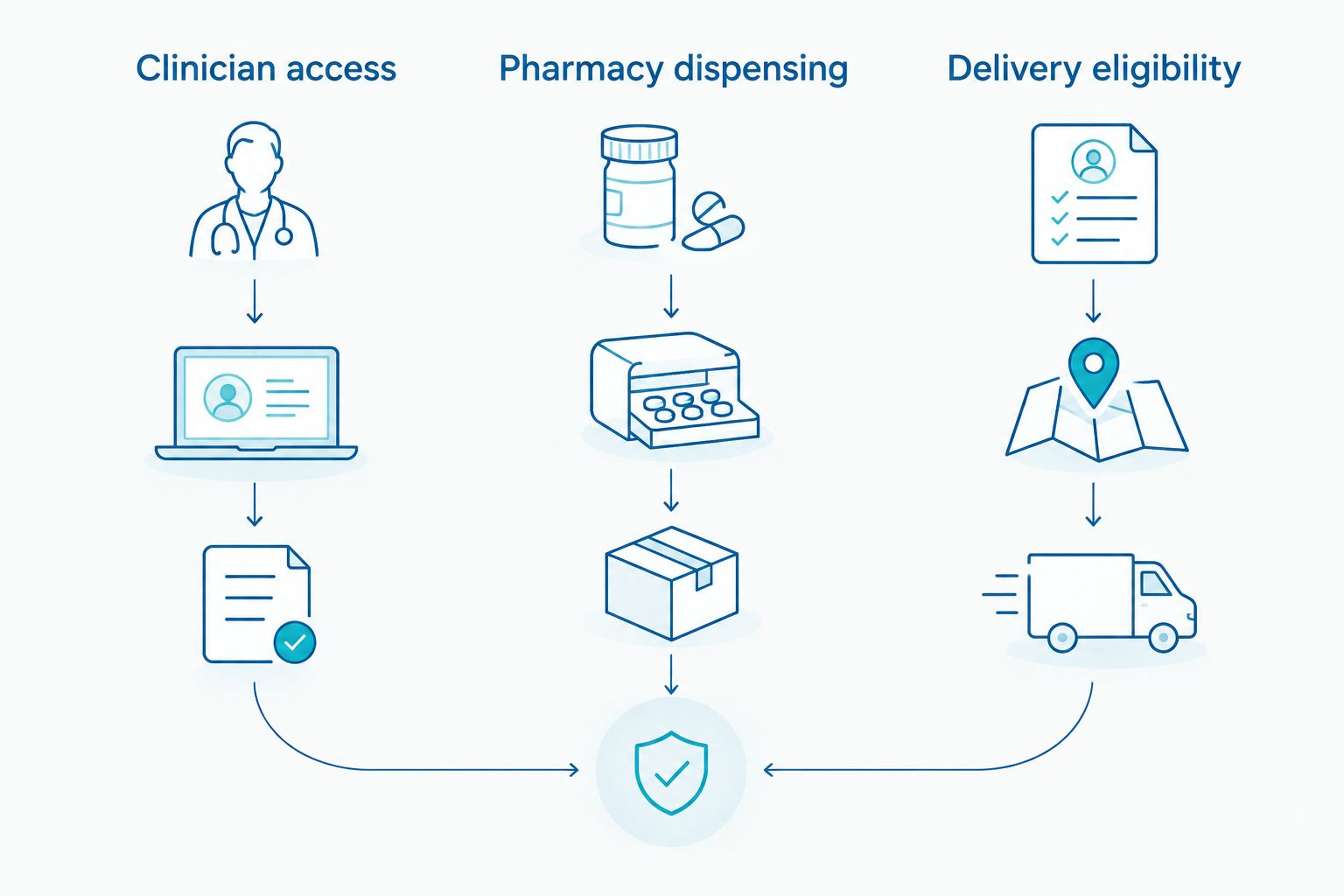
The worksheet is a decision aid, not a legal or clinical clearance. Its purpose is to prevent an unanswered question from disappearing inside an otherwise attractive offer.
- Create separate fields for the 3 access checks.
- Copy each answer without broadening its meaning.
- Record the source and date beside each answer.
- Flag statements that apply only to a different program.
- Recheck the affected field when a named party changes.
Compare continuing terms after confirming access
Once the access questions have answers, compare what the agreement actually includes. Start with the provider's public terms and checkout disclosures, then ask for clarification wherever those documents conflict or leave a required component unclear.
Keep medication inclusion separate from consultation access, supplies, delivery, and any required monitoring. An included consultation does not answer whether medication is included. Likewise, a general membership description does not establish the terms of a particular prescription program.
A first-month promotion is not a continuing price. For your 2026 worksheet, distinguish the introductory period from the ongoing arrangement without assuming either describes the full commitment. The guide to NAD injection supplies and delivery charges provides a separate checklist for those components.
- Record whether medication is included or separate.
- Identify required supplies and delivery terms.
- Separate introductory terms from continuing terms.
- Record required consultations or monitoring arrangements.
- Note commitments, renewal rules, and cancellation deadlines.
- Ask what happens if state eligibility changes after enrollment.
Save the evidence and resolve contradictions
Before paying, save the relevant provider terms and the written answers supporting your decision. Keep 1 written record per shortlisted program so you can compare like-for-like details without relying on memory.
Include the page title or document name, the date checked, and the scope of the statement. A source about a different medication or a different pharmacy does not establish your proposed arrangement. If checkout terms contradict a support message, request clarification rather than choosing the answer you prefer.
A dated record also makes later changes easier to identify. Label your worksheet as a 2026 comparison and update the affected entry when your location, pharmacy, product, or agreement changes.
- Save the applicable terms before submitting payment.
- Keep written answers alongside the relevant document.
- Record the date and scope of each source.
- Resolve conflicting statements in writing.
- Leave unanswered fields explicitly marked unconfirmed.
- Recheck material changes before relying on an earlier answer.
Compare research options for state-specific access
No single research route answers every question. Provider pages explain the published offer, support can clarify the proposed arrangement, and official records address credential or regulatory questions within their scope.
Use the table to choose the right route for each task. These are research options, not endorsements of a provider or treatment.
| Option | Best for | Useful feature | Key limitation |
|---|---|---|---|
| Manual provider-page review | Readers building an initial shortlist | Shows published coverage and agreement language | General statements can leave individual circumstances unresolved |
| Written provider support inquiry | Readers with travel, relocation, or conflicting terms | Creates a record of answers to specific questions | Support statements do not replace official credential checks |
| Official licensing and regulatory records | Readers checking named clinicians, pharmacies, or regulatory claims | Addresses a defined credential or regulatory question | Does not summarize the complete commercial agreement |
| Telehealthledger comparison research | Readers comparing published inclusion and continuing terms | Organizes the commercial questions to investigate | Does not determine personal eligibility or clinical suitability |
Use each source for the question it can answer. A licensing record is not a review of cancellation terms, and a comparison page is not confirmation that a clinician can treat you at your current location.
Common mistakes state-specific readers make
Treating a coverage map as a complete answer
A coverage map needs an explanation of what it covers. Ask whether it refers to the consultation, the particular NAD+ program, pharmacy dispensing, or delivery. Keep unresolved parts of the access check open even when your state appears on the map.
Checking residence but ignoring consultation location
Your permanent address and your physical location during an encounter can differ. Tell the program about travel or split-state living before scheduling. Ask which location information it needs and whether later encounters require a fresh check.
Comparing program labels instead of exact products
Two offers using NAD+ language do not automatically describe the same formulation, delivery route, or agreement. Record the exact proposed product and dispensing source. Do not transfer a statement about one formulation to another simply because their marketing names resemble each other.
Paying before reading eligibility and cancellation terms
Find out what happens if the clinician does not prescribe or the program cannot serve your location. Request the written refund, cancellation, and renewal terms that apply to that situation. Do not assume an unsuccessful intake automatically cancels every part of an agreement.
Treating access as evidence of clinical suitability
A confirmed service area answers a logistical question, not whether treatment is appropriate. Keep access research separate from the clinician's assessment. Neither a completed checkout nor a favorable commercial comparison establishes expected benefits, safety, or suitability for you.
FAQ
Can I get NAD injections online in my state?
Confirm your state-specific arrangement directly with the program before paying. Check clinician access, the dispensing pharmacy's eligibility for your destination, and delivery terms separately; a general coverage statement does not resolve all three.
Does my home address determine whether an online clinician can see me?
Do not use your home address as the only location check. Tell the program where you will physically be during the consultation and ask it to confirm the requirements for that encounter.
What should I verify before paying for an online NAD injection program?
Verify the proposed clinician arrangement, dispensing pharmacy, exact product, and applicable agreement. Also check medication inclusion, required components, cancellation terms, and what happens if the program cannot serve your location.
Can I keep the same program if I move to another state?
Ask the program to reassess access before relying on the existing arrangement after a move. Confirm the clinical encounter, pharmacy dispensing, and delivery questions for the new location.
Is an online NAD injection offer FDA-approved?
Do not infer FDA approval from an online offer or a prescription requirement. Identify the exact product and check the specific regulatory claim against authoritative FDA information.
Is Telehealthledger a medical provider?
Telehealthledger is an independent comparison site, not the prescribing clinician for your care. Its role is to help prospective patients compare published telehealth prices, plan terms, and medication inclusion.
What if a provider will not identify its dispensing pharmacy before payment?
Treat the dispensing arrangement as unconfirmed until you receive a usable answer. Ask what can be disclosed before enrollment and read the terms governing payment, eligibility, and cancellation before deciding whether to proceed.
One last thing
The most useful final question is not simply whether the program serves your state. Ask: what changes if my consultation location, delivery address, or dispensing pharmacy changes?
Save the answer with your agreement. A dated answer tied to your actual circumstances is more useful than an undated nationwide claim. Keep commercial terms and clinical decisions separate throughout the process.
Information only. Not medical advice.