

Best overall comparison: a medication-inclusive plan with documented continuing terms. Best for flexibility: a plan without a minimum commitment. Best for evaluating prepayment: a plan with explicit refund and cancellation terms. Compounded tirzepatide providers ranked by price in 2026 require verified provider-level costs; these are comparison priorities, not a cheapest-provider leaderboard or medical recommendations.
- Compounded tirzepatide providers ranked by price require verified continuing costs, medication inclusion and comparable billing periods.
- Telehealth Ledger is for patients comparing published telehealth terms, not choosing treatment from price alone.
- A first-month promotion is not a continuing price.
- Keep compounded tirzepatide separate from branded medication when comparing plans.
Why this matters
A low advertised amount does not establish the lowest continuing cost. You need to know what the payment covers, when it repeats and what additional charges are required.
Telehealth Ledger compares published telehealth prices, plan terms and medication inclusion. For a 2026 comparison, keep the payment decision separate from the clinical decision: a clear contract does not establish whether compounded tirzepatide is appropriate for you.
No named provider receives a price rank here because this article does not establish verified, dated provider-level totals. The ranked sections below organize plan structures by their usefulness for comparison, not by an unsupported claim about which company is cheapest.
Information only. Not medical advice.
What makes a useful compounded tirzepatide price ranking?
A useful ranking answers the following questions before assigning positions:
- Continuing terms: What applies after any introductory period, and when can those terms change?
- Medication inclusion: Does the payment include the prescribed medication, or only access to consultations and prescribing?
- Required fees: Are consultations, required laboratory work, supplies or delivery billed separately?
- Billing interval: Does payment repeat by calendar month, every four weeks or under another schedule?
- Commitment: What must you pay upfront, and what happens if treatment does not proceed or the plan ends?
- State eligibility: Does the provider document whether the relevant service can be provided in your state?
Treat an unanswered question as unresolved, not as a favorable term. An omitted laboratory charge is not evidence that laboratory work is included; an unspecified refund policy is not evidence that unused payments are refundable.
For each candidate, preserve the original terms and the date you checked them. Search snippets and promotional headlines are not substitutes for the agreement that governs payment.
Plan structures at a glance in 2026
These categories describe contracts to examine. They do not establish that any particular provider offers every feature listed.
| Comparison priority | Plan structure | Best for | Standout feature to verify | Key limitation |
|---|---|---|---|---|
| 1 | Medication-inclusive recurring plan | Comparing the ongoing payment obligation | Medication and required recurring services are explicitly included | An inclusive headline can still leave exclusions unresolved |
| 2 | No-minimum-commitment plan | Limiting future contractual obligations | Cancellation deadline and next-charge rules are explicit | Flexibility does not establish the lowest total cost |
| 3 | Prepaid plan with explicit exit terms | Evaluating an upfront commitment | Refund, eligibility and cancellation provisions are documented | Payment timing and refund restrictions affect the decision |
A provider can fit more than one category. For example, a recurring plan can also have no minimum commitment; compare its actual terms rather than treating the categories as mutually exclusive products.
1. Medication-inclusive recurring plans: best for cost clarity
A medication-inclusive recurring plan is the clearest starting point when its written terms identify what the payment covers. The important distinction is between medication being included and a clinician merely being able to prescribe it.
Ask for the medication description, billing interval and required services in the same written explanation. Then check whether exclusions appear elsewhere in the agreement.
Medication-inclusive recurring plan pros:
- Medication inclusion gives you a defined starting point for comparison.
- A stated recurring interval makes payment schedules easier to align.
- Itemized inclusions help separate required charges from optional services.
Medication-inclusive recurring plan cons:
- An inclusive description does not resolve every possible additional charge.
- Terms tied to the prescribed amount require a separate check.
- Clear billing does not establish clinical suitability or provider quality.
Best for: You want to understand the continuing payment obligation before comparing a short introductory offer.
For your 2026 shortlist, record the continuing terms rather than substituting the first payment. If the agreement distinguishes introductory and continuing periods, preserve both descriptions without treating them as interchangeable.
Also check what happens when the clinician changes the prescription. Do not assume that an advertised plan covers every prescribed amount or that the payment remains unchanged.
Verdict: Hold until medication inclusion, recurring terms and required exclusions are documented.
2. No-minimum-commitment plans: best for contractual flexibility
A no-minimum-commitment plan is worth examining when you want to limit obligations beyond the current billing period. That description needs support from the cancellation and payment terms, not just the enrollment headline.
Separate permission to cancel from entitlement to a refund. A plan can describe cancellation without answering whether a payment already collected will be returned.
No-minimum-commitment plan pros:
- Explicit cancellation rules help you identify the next payment obligation.
- A documented absence of a minimum term clarifies the commitment.
- Written deadlines give you a practical basis for managing renewal.
No-minimum-commitment plan cons:
- Cancellation does not itself establish refund eligibility.
- A recurring payment can remain due if a deadline has passed.
- Flexible terms do not prove lower continuing costs.
Best for: You prioritize control over future contractual commitments rather than a prepaid arrangement.
Before enrolling, identify how to cancel, when cancellation becomes effective and whether medication orders have separate terms. Keep the confirmation rather than relying only on an account screen that shows a request was submitted.
Do not interpret contractual flexibility as a treatment plan. Decisions about starting, changing or stopping medication belong with the prescribing clinician.
Verdict: Hold until the cancellation deadline, effective date and refund treatment are explicit.
3. Prepaid plans: best for evaluating an upfront commitment
A prepaid plan requires a different comparison because payment timing becomes part of the decision. A monthly equivalent does not tell you the amount due at enrollment or what happens to unused payments.
Read the full commitment before comparing the headline with a recurring plan. Pay particular attention to whether the agreement distinguishes membership charges, clinical services and medication orders.
Prepaid plan pros:
- An itemized agreement can define the obligation for the stated term.
- A clear payment schedule separates upfront charges from later charges.
- Written exit terms let you evaluate the commitment before paying.
Prepaid plan cons:
- Upfront payment creates an obligation before the covered period ends.
- Refund restrictions can make unused services financially relevant.
- A monthly equivalent can obscure the actual payment schedule.
Best for: You are evaluating a longer commitment and can first verify eligibility, medication inclusion and exit provisions.
Ask what happens if the clinician does not prescribe, if the prescription changes or if the service cannot continue for you. Those are questions for the provider's written policy; do not assume a particular refund outcome.
A prepaid arrangement does not earn a budget label simply because its advertising uses a lower monthly equivalent. The comparison must include the entire obligation and its conditions.
Verdict: Wait until upfront obligations and unused-payment rules are clear.
Put every plan on the same comparison basis
Start with four fields: Medication inclusion, Required fees, Billing interval and Exit terms. Keep each field separate so one attractive feature cannot conceal an unresolved obligation.
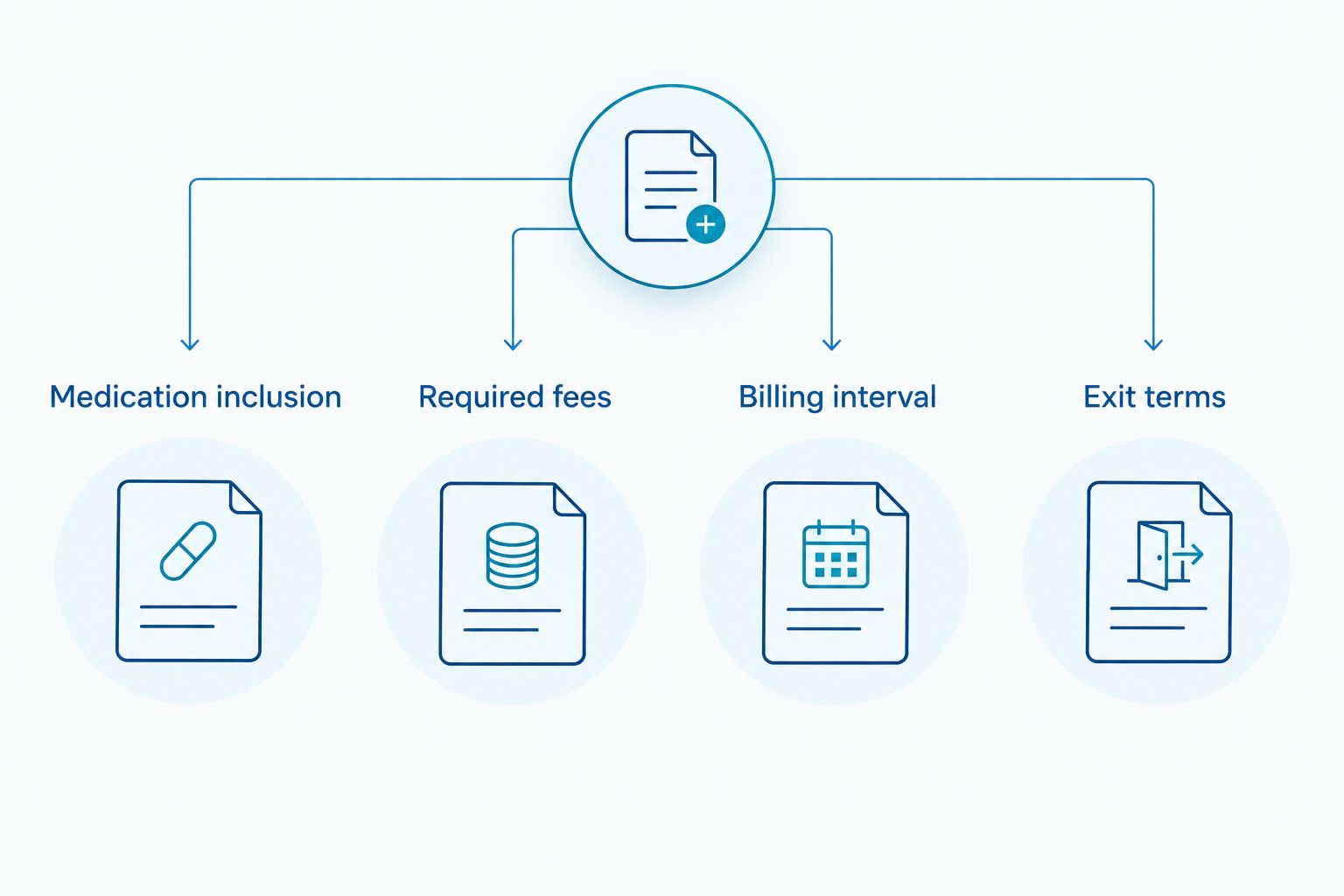
Medication inclusion
Write down whether the quoted payment includes medication or only clinical access. Preserve the exact description of the medication rather than shortening everything to tirzepatide.
Keep branded and compounded products in separate comparisons. A shared active ingredient does not make the products interchangeable for a price ranking.
Required fees
Separate mandatory charges from optional services. If required laboratory work is billed outside the plan, identify the payment responsibility before treating the subscription as the complete obligation.
An unresolved fee belongs in an unresolved field. Do not enter zero merely because the provider's headline does not mention it.
Billing interval
A calendar month is not four weeks. Four weeks equal 28 days; a 52-week comparison contains 13 four-week periods, while a calendar year contains 12 calendar months.
That difference matters even before you compare payment amounts. Use the guide to four-week tirzepatide refills and annual bills to examine the schedule, then confirm the actual refill and billing terms with the provider.
Do not assume that a payment interval also describes the medication supply. Record both when the agreement distinguishes them.
Exit terms
List cancellation, refund and renewal provisions separately. Check whether the membership and medication order have different rules.
For a 2026 comparison, the terms that govern your enrollment matter more than an older summary. Save the version you reviewed and any written clarification supplied by the provider.
Keep medication identity and regulatory questions separate
Compounded tirzepatide is not an FDA-approved generic version of a branded product. FDA's guidance, Understanding the Risks of Compounded Drugs, explains that compounded drugs are not FDA-approved and do not undergo FDA premarket review for safety, effectiveness or quality.
That regulatory distinction is not a provider ranking. It also does not establish whether a specific prescription or current compounding arrangement meets applicable requirements.
For current regulatory questions, consult FDA materials and the relevant state authorities. A provider's sales page is not an official regulatory determination.
Before payment, ask for the dispensing pharmacy's identity and the applicable state information. Treat pharmacy identification as something to verify, not as a quality endorsement by itself.
Telehealth Ledger's compounded tirzepatide comparisons address published terms; they do not establish medical suitability. A clinician must evaluate the treatment decision separately from your comparison of payment obligations.
How the comparison priorities were ranked
The order favors clarity of the continuing obligation first, flexibility second and evaluation of prepayment third. It does not rank provider quality, treatment outcomes or unverified discounts.
A named provider belongs in a 2026 price leaderboard only after its original terms establish medication inclusion, required charges, billing interval, commitment and state applicability. The comparison also needs a dated check and a consistent time basis.
If terms conflict, retain the conflict until the provider resolves it in writing. Do not select the more favorable interpretation merely to complete a table.
Which compounded tirzepatide plan should you compare first?
Start with the plan whose continuing obligations you can document completely. Compare alternatives only after matching medication category, required services and billing period.
Telehealth Ledger is best for prospective patients comparing published telehealth terms, not selecting treatment by the lowest advertised payment. An unresolved medication charge or refund provision is a reason to pause the payment decision, not a detail to overlook.
FAQ
What's the cheapest compounded tirzepatide provider in 2026?
This article does not establish a cheapest provider. A defensible ranking requires dated original terms covering continuing payments, medication inclusion, required fees and comparable billing periods.
Does a telehealth subscription include compounded tirzepatide?
A subscription includes medication only when its terms explicitly say so. Separate access to consultations or prescribing from the medication charge, and check required exclusions.
Is compounded tirzepatide the same as branded tirzepatide?
Compounded tirzepatide is not an FDA-approved generic version of a branded product. Keep compounded and branded products separate when comparing payment terms, and discuss treatment suitability with a clinician.
Is a four-week refill the same as a monthly refill?
No. Four weeks equal 28 days, while calendar months have different lengths. Compare the actual billing schedule rather than treating the labels as equivalent.
Are prepaid tirzepatide plans better than recurring plans?
Prepayment alone does not establish better value. Compare the full obligation, medication inclusion, eligibility provisions and treatment of unused payments before choosing a contract.
Does cancel anytime mean I get a refund?
No. Permission to cancel does not itself establish a refund entitlement. Read the effective cancellation date, next-charge rules and separate medication-order provisions.
Can I choose a provider based only on its advertised payment?
No. An advertised payment does not establish the full obligation or clinical suitability. Verify continuing terms, required fees, pharmacy information and state applicability before making a payment decision.
One last thing
Ask for the continuing obligation in writing before paying. Request the medication inclusion, billing interval, required separate charges and exit terms together; that document is more useful than a promotional headline.
Information only. Not medical advice.