

Best overall: an NAD+ injection provider that identifies its prescriber and dispensing pharmacy, documents continuing plan terms, and confirms access in your state. Best for flexibility: a provider with clear cancellation terms. No named provider receives a best-overall or budget designation here without verified provider-specific terms.
- The best nad injection providers must be compared on pharmacy transparency, continuing costs, medication inclusion, and state-specific access.
- Telehealth Ledger is best for readers comparing published telehealth terms, not seeking a prescribing recommendation.
- A first-month promotion is not a continuing price; check refill charges and required fees separately.
- Do not treat transparent billing as evidence that NAD+ injections are clinically appropriate for you.
Why this matters
An NAD+ injection comparison needs to answer two separate questions: what does the program require you to pay, and what clinical service does it actually provide? A clear answer to the first question does not settle the second.
Telehealth Ledger compares published telehealth prices, plan terms, and medication inclusion. For NAD+ injections in 2026, the useful comparison is the complete arrangement: the consultation, prescription decision, dispensing pharmacy, medication, supplies, delivery, refill process, and cancellation obligations.
Information only. Not medical advice. A prescribing clinician must assess clinical suitability. This guide explains how to evaluate provider disclosures; it does not recommend treatment or rank medical quality.
What makes the best NAD+ injection providers?
Use these criteria before looking at a promotion or choosing a subscription. An unanswered question remains unknown; it does not become an included service or a favorable policy.
- Clinical accountability: The provider explains who evaluates you, how the consultation works, and how to contact the clinical team.
- Pharmacy transparency: The provider identifies the dispensing pharmacy and explains how you receive prescription and product information.
- Continuing plan terms: The provider separates introductory offers from continuing charges, required fees, and commitments.
- Medication inclusion: The provider states whether medication, injection supplies, delivery, and any required testing are included.
- State-specific access: The provider confirms the service and prescribed product can be supplied in your state.
- Refill and exit rules: The provider explains renewals, cancellation deadlines, prepaid obligations, and what happens if treatment does not proceed.
Start with what you can verify before paying for NAD injections online. Obtain the relevant terms before entering a recurring payment agreement, not after the first shipment.
NAD+ provider profiles at a glance
The profiles below rank purchasing priorities, not named companies. No provider-specific prices, pharmacy disclosures, state lists, or contracts are established in this comparison, so assigning company-level winners would turn unknown details into recommendations.
| Provider profile | Best for | Standout requirement | Key limitation |
|---|---|---|---|
| Fully documented program | Readers starting a shortlist | Written clinical, pharmacy, billing, and refill terms | Complete disclosures do not establish clinical suitability |
| Flexible renewal program | Readers avoiding a long commitment | Clear cancellation and renewal rules | Flexibility does not establish medication inclusion |
| Itemized medication-inclusive program | Readers comparing the full bill | Medication and required extras explicitly identified | An inclusive label can still leave exclusions |
| State-confirmed program | Readers resolving location restrictions | Confirmation for the reader's state and prescribed product | State access does not answer clinical or billing questions |
Do not interpret a profile as a claim that a particular provider offers those terms. Use the profiles to decide which written evidence a provider must supply before joining your shortlist.
1. Fully documented program: best for building a shortlist
A fully documented NAD+ injection program makes the parties and obligations visible before you commit. It identifies the clinical service, explains the prescription process, names the dispensing pharmacy, and provides written billing terms.
For your 2026 shortlist, request 3 documents: the clinical-service description, the medication-and-pharmacy disclosure, and the billing-and-cancellation terms. These can be separate documents or clearly identified sections of the same agreement. The point is coverage, not document format.
Fully documented program pros:
- You can distinguish the prescribing service from the pharmacy's role.
- You can check whether the quoted plan includes medication.
- You have written terms to compare against checkout disclosures.
- You can identify unanswered questions before authorizing payment.
Fully documented program cons:
- Clear paperwork does not establish treatment effectiveness or clinical suitability.
- Published terms still need to match your specific prescription and location.
- A detailed website does not replace access to a clinician when needed.
Best for: Readers who want an auditable starting point rather than a promotion-led shortlist.
Ask who handles a clinical question, a dispensing question, and a billing dispute. Those responsibilities should not disappear behind a single customer-service label.
Verdict: Hold until the clinical, pharmacy, and billing responsibilities are documented.
2. Flexible renewal program: best for avoiding commitments
A flexible renewal program explains how recurring charges begin and how they stop. Look for the renewal trigger, cancellation method, deadline, and treatment of payments already collected.
Review 2 billing events separately: initial enrollment and the first refill. Ask what each payment authorizes, whether another consultation is required, and whether a recurring membership continues independently of medication orders.
Flexible renewal program pros:
- Written exit terms let you understand your obligations before enrollment.
- Separate refill rules help distinguish a membership from a medication order.
- A stated cancellation process gives you a concrete action to follow.
Flexible renewal program cons:
- Canceling a membership does not necessarily cancel an order already processed; check both policies.
- A short commitment does not establish what the plan includes.
- Flexibility alone says nothing about clinical follow-up or pharmacy transparency.
Best for: Readers who place the highest purchasing priority on avoiding an unclear continuing commitment.
For a 2026 comparison, record the exact cancellation language rather than summarizing it as flexible. Note the action required, its deadline, and the provider's stated treatment of pending orders.
Verdict: Hold until renewal and cancellation obligations are clear in writing.
3. Itemized medication-inclusive program: best for comparing the full bill
A medication-inclusive program must explicitly state what medication is included and which related services remain separate. The phrase all-inclusive is not a substitute for an itemized description.
Check the consultation, prescribed medication, injection supplies, delivery, required testing, and follow-up separately. Also ask whether a different prescription or refill arrangement changes the billing terms. Do not infer an answer from a headline offer.
Itemized medication-inclusive program pros:
- An inclusion list lets you distinguish medication charges from service fees.
- Itemization makes exclusions visible before checkout.
- Separate refill terms help you compare continuing obligations.
Itemized medication-inclusive program cons:
- Included medication does not establish that every required service is included.
- Different quantities or refill arrangements prevent a direct comparison unless reconciled.
- A clearly described package still requires a separate clinical suitability assessment.
Best for: Readers trying to understand the complete payment obligation rather than the advertised entry offer.
Do not declare a budget winner until equivalent services, medication quantities, billing periods, and required fees can be compared. A first-month promotion is not a continuing price.
Verdict: Hold until the inclusion list and continuing obligations match the written agreement.
4. State-confirmed program: best for resolving location restrictions
A state-confirmed program answers whether its clinical service and prescribed product can be provided where you live. A national advertising campaign does not answer that question for an individual patient.
Confirm access for 1 state first: your own. Then verify that the answer applies to NAD+ injections, not another treatment advertised by the same company. A general statement about telehealth coverage is not product-specific confirmation.
State-confirmed program pros:
- You can resolve a location question before committing to enrollment.
- Product-specific confirmation separates NAD+ injections from other services.
- A written answer gives you a reference if checkout information conflicts.
State-confirmed program cons:
- State access does not mean a prescription will be issued.
- Location confirmation does not establish medication inclusion or cancellation rights.
- A previous answer should not substitute for checking the current arrangement.
Best for: Readers whose first unanswered question is whether the service applies to their location.
For 2026 enrollment, ask what happens to any collected fees if the clinical service or dispensing arrangement cannot proceed. Keep access confirmation and payment obligations in the same comparison record.
Verdict: Hold until the provider confirms the relevant service for your state.
How to compare continuing plan terms
Telehealth Ledger's NAD+ injection comparison method separates what is published from what remains unresolved. Use the same fields for every candidate; otherwise, a detailed provider can look more expensive simply because another provider omits required charges.
Published terms
Save the offer, service agreement, cancellation policy, and relevant checkout disclosures. Record the date you accessed each source. A 2026 page heading is not proof that every term on that page was recently checked.
Continuing obligations
Write down what happens after enrollment: recurring membership, medication orders, required follow-up, refill authorization, and cancellation. Keep a promotional offer separate from the continuing arrangement.
Medication inclusion
Identify what the provider says is included and mark everything else unknown. Do not assume supplies or delivery are covered because medication appears in the offer.
Unresolved details
If the website, checkout, and support response disagree, preserve the conflicting language and request clarification. Do not select the most favorable version and treat it as confirmed.
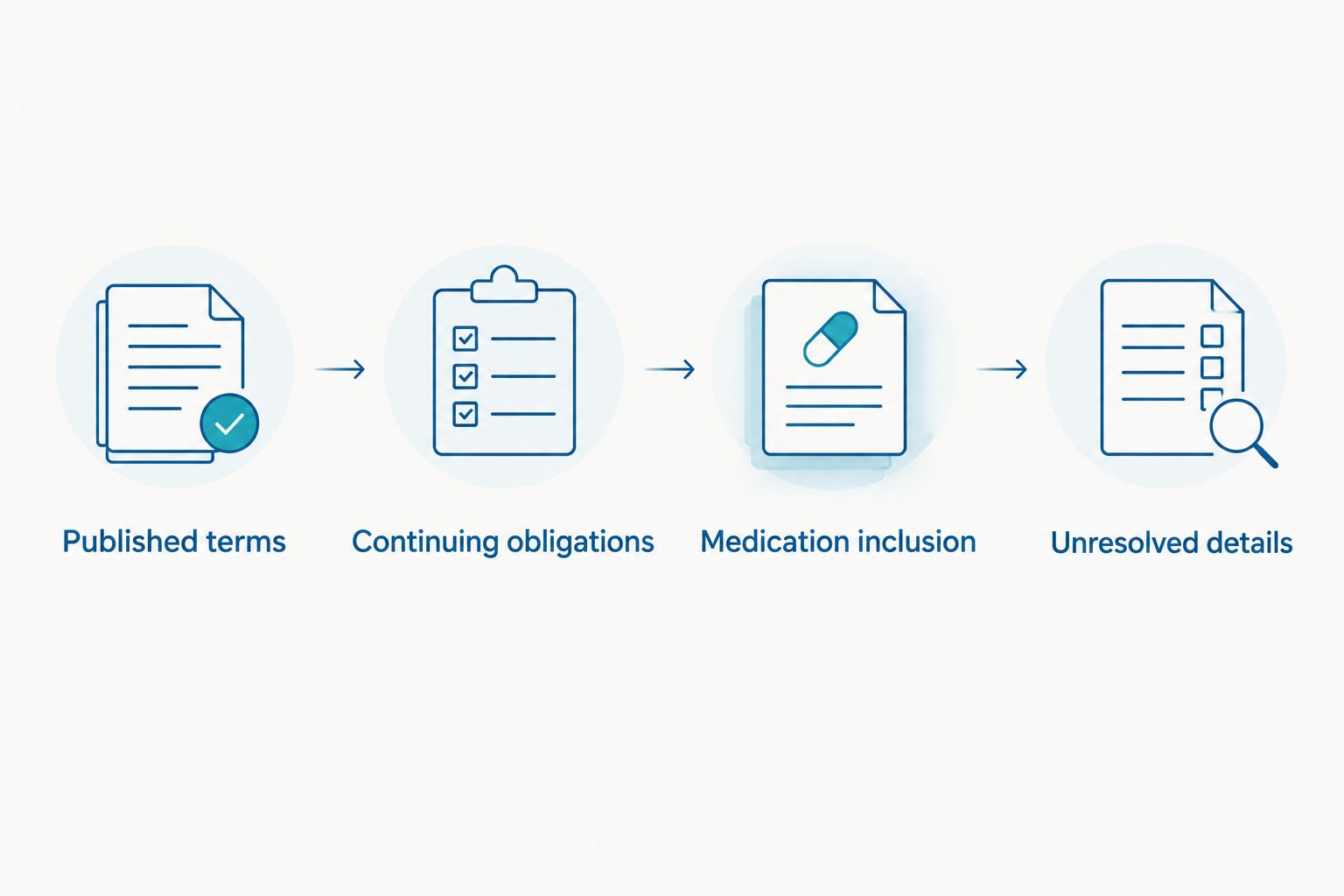
A comparable record also needs the original source for each entry. Cite the provider's own terms for billing claims and authoritative sources for medical or regulatory statements. Record the date and the exact product or policy covered; a general claim cannot settle a product-specific question.
How the profiles are ranked
The fully documented program comes first because you need identifiable clinical, pharmacy, and contractual responsibilities to evaluate the other profiles. Flexibility, itemization, and state confirmation then address distinct purchasing problems.
This is a document-based selection framework, not a completed provider audit. No named provider has been scored, no current provider terms are represented as verified, and no clinical outcome comparison is implied.
Telehealth Ledger separates commercial clarity from medical suitability. A transparent agreement supports an informed purchasing decision; it does not establish that NAD+ injections are appropriate for you.
Which NAD+ injection provider should you choose?
Default to documentation, not a provider name. Begin with candidates that answer the clinical, pharmacy, inclusion, state-access, and cancellation questions in writing. Then compare equivalent continuing obligations.
Use the flexible-renewal profile when commitment is your main concern. Use the itemized profile when inclusions are unclear. Resolve state-specific access before treating either as an actionable option.
Do not choose a provider solely because it fits one profile. A provider with clear cancellation terms still needs an identifiable clinical service and pharmacy. A provider that confirms your state still needs complete billing disclosures.
FAQ
What's the best NAD injection provider in 2026?
No named provider receives a best-overall designation in this guide because provider-specific terms have not been verified here. Build your shortlist around documented clinical responsibility, pharmacy identity, continuing obligations, medication inclusion, and state-specific access.
Which NAD+ injection provider is cheapest?
This guide does not identify a cheapest provider. A defensible comparison requires equivalent medication quantities, billing periods, included services, and required fees, with introductory offers separated from continuing obligations.
Are NAD+ injections included in a telehealth membership?
Medication inclusion must be confirmed in the specific plan's written terms. Check medication, supplies, delivery, required testing, and follow-up separately rather than inferring inclusion from a membership label.
Can I get NAD+ injections online in my state?
Confirm state-specific access directly with the provider for the exact service and prescribed product. General telehealth coverage does not establish that NAD+ injections can be provided to you.
Does a transparent provider mean NAD+ injections are right for me?
No. Transparent billing and identifiable clinical responsibilities do not establish clinical suitability; that requires an individual assessment by a prescribing clinician.
What should I check before paying for an NAD+ injection plan?
Check the clinical-service description, dispensing pharmacy, medication inclusion, continuing obligations, and cancellation terms. Ask what happens to collected fees if the prescription or service does not proceed.
Are NAD+ injections and NAD+ nasal sprays interchangeable for a provider comparison?
No. Compare the exact product and route offered rather than transferring injection-plan assumptions to a nasal-spray program. Clinical questions about different products belong with a qualified clinician.
One last thing
Before paying, ask the provider to identify every charge that continues if no further medication order is placed. That question separates an ongoing service commitment from a medication purchase without assuming the two are linked.
Keep the answer with your dated terms. If the provider cannot explain the continuing obligation plainly, pause the purchase rather than filling the gap yourself.
Information only. Not medical advice.