

Best overall approach: compare online Ozempic providers by prescription access, continuing costs, and pharmacy verification—not a promotional headline. This 2026 guide ranks five provider models by the situation they fit; it does not name a company winner without verified provider terms.
- The best online Ozempic providers disclose continuing plan costs, medication inclusion, pharmacy details, and state-specific access.
- Telehealth Ledger is best for comparing published telehealth costs and terms, not obtaining a prescription.
- Insurance-supported care and cash-pay memberships require different comparisons; neither establishes clinical suitability.
- A first-month promotion is not a continuing price. Check required fees and cancellation terms before paying.
Telehealth Ledger is an independent comparison site, not a prescribing provider. Use it to compare published telehealth terms, then confirm the exact service and prescription pathway with the provider. Information only. Not medical advice.
Why this matters
An online consultation, a prescription, an insurance authorization, and a medication shipment are different services. Paying for one does not establish that the others are included.
Ozempic is a prescription brand containing semaglutide. A service advertising semaglutide does not, by that wording alone, establish that it supplies branded Ozempic. Keep the product identity separate from the consultation model throughout your comparison.
For your 2026 shortlist, answer two separate questions: does the service fit your care needs, and what financial commitment does enrollment create? A low advertised charge answers neither question on its own.
What makes the best online Ozempic providers
Use these six criteria before comparing provider names:
- Product identity: The service explicitly distinguishes branded Ozempic from other semaglutide products and compounded preparations.
- Continuing costs: Written terms separate ongoing membership, consultations, medication, required testing, and other charges.
- Medication inclusion: The provider states whether medication is included, billed separately, or purchased through another pharmacy.
- Clinical access: The service explains who evaluates you, how follow-up works, and how to raise a clinical concern.
- Pharmacy verification: You can identify the dispensing pharmacy and check its license through the relevant state board of pharmacy.
- Commitments and state access: Terms explain renewal, cancellation, prepayment, and whether the service operates in your state.
Do not treat “prescription access” as “medication included.” Ask for the distinction in writing before comparing totals. A list of possible prescriptions also does not establish that a clinician will prescribe a particular product to you.
For a pharmacy-focused checklist, see which online semaglutide plans publish their pharmacy. Product identity and pharmacy identity are separate checks; neither replaces an individual clinical assessment.
Online Ozempic provider models at a glance
These are decision categories, not claims about particular companies. The order starts with continuity and coverage coordination, then separates cash-pay and commitment choices.
| Provider model | Best for | Feature to verify | Key limitation |
|---|---|---|---|
| Existing clinician with telehealth | Keeping care with an established clinician | Remote follow-up and prescription coordination | The practice must confirm whether it offers this pathway |
| Insurance-coordinating online practice | Readers using insurance | Coverage review and authorization responsibilities | Clinical approval and insurance coverage remain separate decisions |
| Cash-pay clinical membership | Readers comparing recurring service fees | What the membership includes and excludes | Membership does not establish medication inclusion |
| Visit-based online practice | Readers avoiding an ongoing membership | Consultation and follow-up billing | Repeat visits and other services need separate accounting |
| Prepaid online program | Readers considering an upfront commitment | Refunds, cancellation, and unfulfilled services | Payment obligations can extend beyond the initial consultation |
No model is automatically the least expensive. The comparison depends on the exact prescription, insurance outcome, required services, and written payment terms.
1. Existing clinician: best for continuity of care
Start by asking your current clinician whether the practice offers a telehealth pathway for evaluating your request. This is a comparison starting point, not a claim that every existing practice prescribes Ozempic remotely.
Keeping the discussion within an established practice lets you ask how the request fits with your existing records and follow-up. Confirm what the practice can actually provide rather than assuming an ongoing relationship covers a new service.
Existing-clinician pros:
- Gives you a direct place to ask how existing records inform the evaluation.
- Lets you clarify whether follow-up stays within the same practice.
- Creates a baseline against which to compare a separate subscription.
Existing-clinician cons:
- Remote evaluation must be confirmed with the practice.
- Prescription decisions and insurance coverage remain individual matters.
- Pharmacy charges and any additional services still need checking.
Best for: Readers who already have a clinician and want to compare continuity before opening a separate care relationship.
Ask whether the appointment charge covers follow-up questions or only the scheduled visit. Verdict: Hold until the practice confirms the service, billing, and follow-up arrangement.
2. Insurance-coordinating practice: best for coverage paperwork
An insurance-coordinating model belongs on your shortlist when you want a practice to explain its role in coverage review. Confirm whether staff handle authorization requests, what documentation they need, and what happens if coverage is denied.
Do not confuse a provider accepting your insurance for consultations with your plan covering Ozempic. Those are different benefit questions. An insurer's coverage decision also does not replace the clinician's prescribing decision.
Insurance-coordinating practice pros:
- Makes authorization responsibilities a specific comparison point.
- Lets you separate consultation coverage from pharmacy coverage.
- Gives you a framework for checking denial and appeal procedures.
Insurance-coordinating practice cons:
- Administrative assistance does not guarantee coverage.
- Membership or consultation obligations require separate verification.
- An unsuccessful coverage request does not automatically establish refund eligibility.
Best for: Readers comparing an insurance-dependent prescription pathway in 2026.
Before enrolling, ask whether charges continue while a coverage request is pending and whether you can cancel after a denial. Verdict: Hold until the coverage process and financial obligations are documented.
3. Cash-pay membership: best for comparing recurring service fees
A cash-pay membership puts recurring clinical-service charges at the center of your comparison. The key question is not simply what membership includes, but which necessary services sit outside it.
Request a written breakdown of consultations, follow-up, messaging, laboratory requirements, and medication billing. An apparently simple subscription can still require separate transactions; read the scope rather than interpreting the headline.
Cash-pay membership pros:
- Provides a recurring service charge to examine against alternatives.
- Makes included follow-up and messaging useful comparison criteria.
- Allows you to compare membership scope separately from medication billing.
Cash-pay membership cons:
- The membership label alone does not establish medication inclusion.
- Cancellation and renewal rules need close review.
- A recurring fee does not establish clinical quality or suitability.
Best for: Readers who want to compare clearly defined recurring care services outside an insurance-dependent membership calculation.
For a 2026 comparison, distinguish the introductory period from the continuing agreement. A first-month promotion is not a continuing price. Verdict: Hold until the full recurring obligation and exclusions are clear.
4. Visit-based practice: best for avoiding membership commitments
A visit-based model is worth comparing when you do not want an ongoing membership obligation. Confirm that the written agreement actually uses that structure; a consultation advertised on its own can still lead to recurring enrollment.
Ask how follow-up visits, prescription renewals, and questions between appointments are handled. The absence of membership does not establish that all necessary care is covered by the first consultation.
Visit-based practice pros:
- Lets you evaluate a defined consultation rather than a subscription package.
- Separates appointment billing from medication purchasing.
- Gives you a direct way to compare follow-up charges.
Visit-based practice cons:
- Additional consultations require their own cost accounting.
- Between-visit communication needs explicit clarification.
- No membership commitment does not necessarily mean no cancellation charge.
Best for: Readers prioritizing a clearly documented, non-membership care arrangement.
Compare the expected service pathway, not just the opening appointment. Ask what happens when a clinician requires another assessment before issuing or renewing a prescription. Verdict: Hold until follow-up requirements and billing are explained.
5. Prepaid program: best for reviewing an upfront commitment
Treat prepayment as a contract question before treating it as a cost comparison. Identify what you are buying, when services are considered delivered, and which amounts are refundable.
A prepaid term is not evidence that a clinician will prescribe Ozempic or that treatment will continue unchanged. Review how the agreement handles non-prescribing decisions, insurance denials, changes in care, and services that cannot be completed.
Prepaid program pros:
- Creates a defined commitment period to inspect.
- Lets you compare the written package against separate service charges.
- Makes refund and cancellation provisions central to the decision.
Prepaid program cons:
- Requires payment before all contracted services are completed.
- Refund eligibility depends on the actual agreement.
- Comparing only a monthly equivalent obscures the upfront obligation.
Best for: Readers specifically evaluating a prepaid contract rather than seeking the smallest initial commitment.
Do not interpret a longer payment term as a clinical recommendation to continue treatment. Verdict: Skip any prepaid agreement that leaves refund obligations or medication inclusion unclear.
How to compare continuing costs without mixing categories
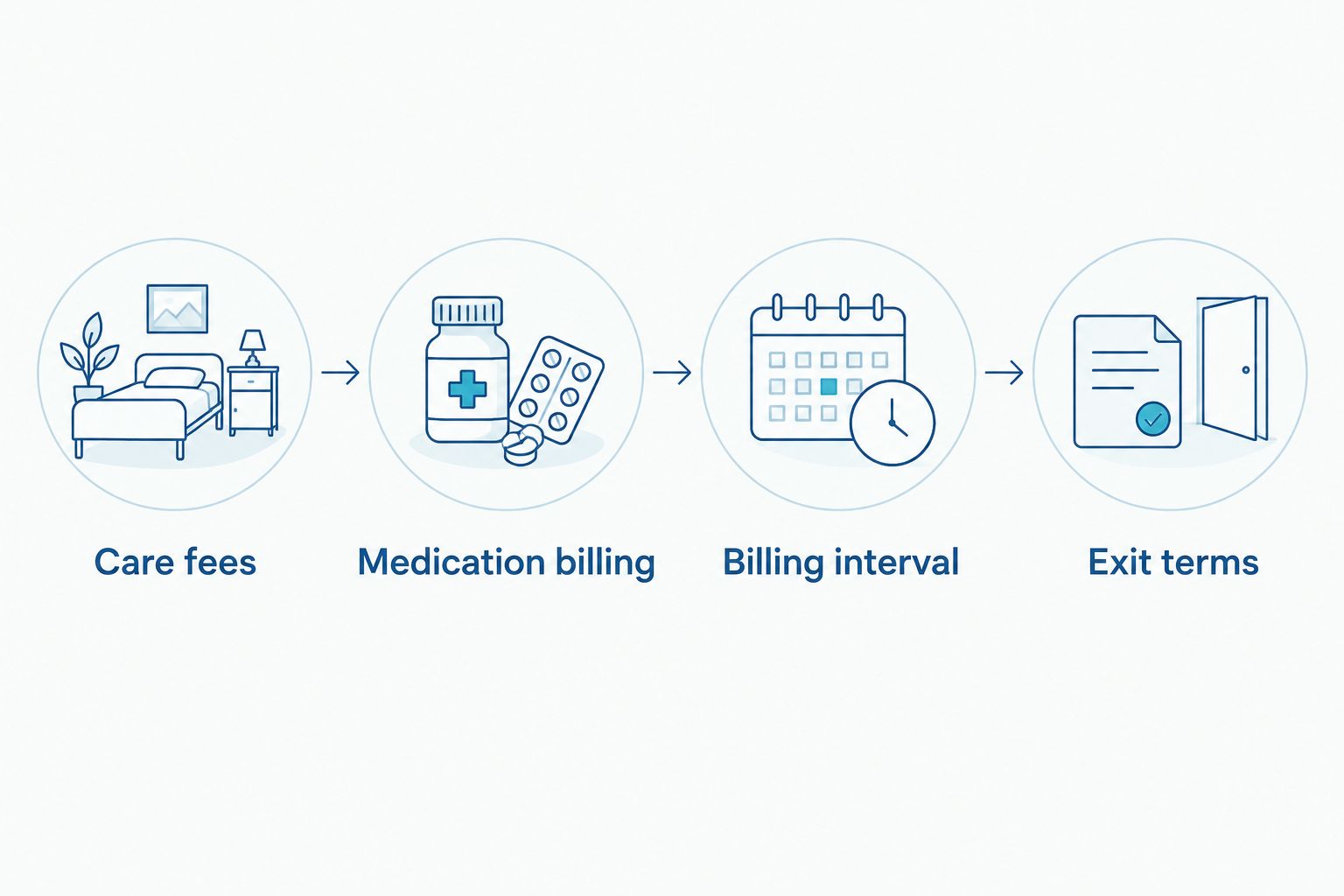
For your 2026 worksheet, keep four fields separate. Do not place an unknown charge in the same column as an included service.
- Care fees: Consultation, membership, follow-up, and required clinical services.
- Medication billing: Whether the prescription is purchased separately and who bills you.
- Billing interval: Calendar-month renewal, refill-based billing, or a prepaid term.
- Exit terms: Cancellation deadlines, renewal obligations, and treatment of unused services.
These fields answer different questions. A plan can explain its clinical services clearly while leaving medication billing unresolved; record both findings rather than assigning a single impression of transparency.
Calendar language deserves special attention. A four-week interval is 28 days, and 13 such intervals equal 364 days; that is different from 12 calendar-month charges. This is billing arithmetic, not an Ozempic dosing or refill instruction.
Use the schedule in the actual agreement. Do not convert a refill schedule into a membership schedule or assume that every charge follows the same calendar.
How the models are ranked
Telehealth Ledger's comparison approach separates published costs, plan terms, and medication inclusion. The ordering here gives you a practical sequence for checking continuity, insurance coordination, recurring care, visit-based billing, and prepayment.
It is not a clinical-quality ranking or a finding that one provider is cheapest. A named 2026 winner requires dated original provider terms covering the exact product, continuing charges, required fees, state access, and commitments.
Record the date you check each agreement and retain the relevant terms. If a checkout page conflicts with an advertised summary, mark the discrepancy and request clarification before paying.
Which online Ozempic provider model should you choose?
Start with the care relationship you already have, then compare alternatives using the same written checklist. If insurance coordination is central to your decision, resolve that process before comparing a cash-pay membership as though the two arrangements were identical.
If avoiding commitment matters most, examine visit-based terms before considering prepayment. If you compare memberships, require a clear distinction between clinical services and medication billing.
The default is not the provider with the most appealing introductory headline. It is the arrangement whose exact product pathway, continuing obligations, follow-up, and exit terms you can verify—and whose clinician independently determines whether prescribing is appropriate.
FAQ
What's the best online Ozempic provider in 2026?
There is no named winner in this guide. Compare providers using dated terms for branded Ozempic, continuing charges, medication inclusion, clinical follow-up, pharmacy identity, and service in your state.
Is Telehealth Ledger an online Ozempic provider?
Telehealth Ledger is an independent comparison site, not a prescribing provider. It helps prospective patients compare published telehealth prices, plan terms, and medication inclusion.
Does an online consultation guarantee an Ozempic prescription?
No. A consultation pays for the service described in the agreement; prescribing requires an individual clinical decision. Check the payment and refund terms if no prescription is issued.
Does a telehealth membership include Ozempic?
Do not assume medication is included in a membership. The written terms must distinguish clinical-service fees from medication billing and identify who collects each payment.
Is compounded semaglutide the same product as Ozempic?
No. Ozempic is a branded prescription product; a compounded preparation is not that branded product. Compare the exact product identity rather than treating all semaglutide advertising as interchangeable.
Will insurance cover Ozempic through an online provider?
Coverage depends on your insurance plan and the individual coverage determination. Confirm consultation benefits, pharmacy benefits, authorization requirements, and any charges that remain your responsibility.
What should I check before prepaying for an online program?
Check medication inclusion, required services, cancellation, renewal, and refunds before prepaying. Ask how the agreement handles a non-prescribing decision, a coverage denial, or services that cannot be completed.
One last thing
Ask the provider this exact question before submitting payment: What would I still owe if the clinician does not prescribe Ozempic? The answer exposes the difference between paying for an evaluation, paying for administrative services, and paying for medication.
Request the answer in writing and keep it with the agreement. Information only. Not medical advice.