

Best overall: a clinician-led service that can continue your diabetes care. Best for coordinated remote care: an integrated telehealth practice. Best for coverage questions: a service that documents insurance support. Best for avoiding subscriptions: a visit-based practice with written follow-up terms. These are care models to compare in 2026, not a ranking of named providers with unverified terms.
- The best mounjaro providers document the exact medication, continuing plan costs, clinical follow-up, and state eligibility.
- Mounjaro is a branded tirzepatide product; a compounded tirzepatide offer is not a Mounjaro offer.
- Telehealthledger helps compare published telehealth terms; clinical suitability requires a prescribing clinician.
- Compare medication inclusion, required fees, insurance responsibilities, and cancellation terms before paying.
Why this matters
Choosing a Mounjaro telehealth service means choosing both a clinical relationship and a billing arrangement. A consultation charge does not establish that medication is included, and insurance assistance does not establish that your insurer will cover a prescription.
Telehealthledger is a comparison resource, not a prescribing service. Telehealthledger is best for readers comparing published telehealth costs and plan terms before choosing a provider.
Mounjaro contains tirzepatide. Its FDA-approved indication includes improving blood sugar control in adults with type 2 diabetes alongside diet and exercise; Zepbound is a separate tirzepatide brand with different approved uses. FDA prescribing information distinguishes these products, so a weight-management advertisement alone does not establish that a service offers Mounjaro specifically.
Information only. Not medical advice.
What makes the best Mounjaro providers
Use these criteria for your 2026 shortlist before comparing headline offers:
- Exact medication: The service explicitly identifies branded Mounjaro rather than using “tirzepatide” as an interchangeable label.
- Continuing costs: Written terms separate continuing care charges, medication charges, required tests, and other mandatory fees.
- Clinical continuity: The service explains who reviews your history, handles follow-up, and responds to treatment questions.
- Insurance responsibilities: The service distinguishes benefits checks, prior authorization assistance, prescribing, and claim approval.
- Commitment terms: You can identify renewal timing, cancellation deadlines, and what happens if treatment is not prescribed.
- State eligibility: The service confirms whether its clinicians can treat patients in your state before you commit financially.
A first-month promotion is not a continuing price. Compare the arrangement that applies after introductory terms end, not just the enrollment screen.
Mounjaro telehealth options at a glance
The order below prioritizes continuity, then coordination, coverage administration, and billing flexibility. Each option describes a provider model; it does not establish that a particular business offers Mounjaro or meets these requirements.
| Care model | Best for | Feature to verify | Key limitation |
|---|---|---|---|
| Existing diabetes care team with telehealth | Continuing an established clinical relationship | Remote appointments and prescription follow-up | Remote care must be confirmed; some care still requires in-person services |
| Integrated telehealth practice | Coordinating remote care through one practice | Shared records, follow-up responsibilities, and test coordination | A broad service description does not prove these functions are included |
| Insurance-support telehealth service | Understanding prescription coverage requirements | Written scope of benefits checks and authorization assistance | Administrative support cannot guarantee insurer approval |
| Visit-based telehealth practice | Avoiding an ongoing membership commitment | Separate visit charges and a clear follow-up pathway | Separate appointments can create additional administrative work |
1. Existing diabetes care team: best for continuity
An existing diabetes clinician is the first service to ask about remote Mounjaro care. If that team offers telehealth, you can evaluate remote appointments without automatically replacing an established clinical relationship.
This recommendation is about continuity, not an endorsement of any prescription. Your clinician must still assess whether Mounjaro is appropriate and what monitoring is needed.
Existing diabetes care team pros:
- You can ask the clinician already involved in your diabetes care about remote follow-up.
- You can discuss how a proposed prescription fits your existing medicines and care plan.
- You can clarify which appointments or tests require a separate location.
Existing diabetes care team cons:
- Your practice must confirm that it offers suitable telehealth appointments.
- Pharmacy, laboratory, and appointment billing still need separate review.
- An established relationship does not guarantee prescribing or insurance coverage.
Best for: Readers who already have a diabetes care team and want to preserve continuity.
Before enrolling elsewhere, ask your current practice who handles prescription questions between visits, how records are shared, and whether remote appointments change your responsibilities. Request written billing information rather than assuming telehealth follows the same arrangement as an office visit.
Verdict: Hold off on switching until your existing care team explains its remote-care options.
2. Integrated telehealth practice: best for coordinated remote care
An integrated telehealth practice is a candidate when you need a new remote-care relationship rather than an isolated prescribing appointment. The relevant distinction is documented coordination: who reviews records, arranges follow-up, receives test results, and handles questions.
Do not infer coordination from a claim that a service provides “ongoing support.” Ask what that phrase includes.
Integrated telehealth practice pros:
- Written care terms can identify responsibility for appointments, records, and follow-up.
- A documented process helps you understand where to send questions and results.
- Clear coordination requirements give you a basis for comparing services beyond enrollment charges.
Integrated telehealth practice cons:
- A membership description can leave the frequency and scope of clinician contact unclear.
- Laboratory and pharmacy services require their own inclusion checks.
- A remote practice still needs a plan for issues requiring in-person assessment.
Best for: Readers establishing a new care relationship who prioritize coordination.
Use the same written questions for every candidate. Identify whether follow-up is scheduled or patient-initiated, whether clinician access is included, and what happens when an issue falls outside the service's scope.
The tirzepatide care and plan terms guide provides a related comparison framework. Keep branded Mounjaro separate from other tirzepatide offers when applying it.
Verdict: Hold enrollment until the practice documents care responsibilities and continuing terms.
3. Insurance-support service: best for coverage administration
An insurance-support telehealth service is a candidate when understanding prescription coverage is your main administrative obstacle. Evaluate the stated work, not the promise of “insurance help.”
A benefits check, a prior authorization submission, an appeal, and a coverage decision are different actions. Ask which actions the service performs and which remain your responsibility.
Insurance-support service pros:
- Written terms can clarify who gathers and submits required documentation.
- A defined process helps separate clinician responsibilities from insurer decisions.
- Clear administrative scope lets you compare support without assuming a successful outcome.
Insurance-support service cons:
- Assistance does not guarantee approval or a particular patient payment.
- Your care charges can be separate from pharmacy billing.
- A service's general insurance statement does not establish participation in your specific plan.
Best for: Readers who need a documented process for prescription coverage questions.
For a 2026 comparison, check your current plan documents and ask the service to confirm its role in writing. Determine what happens to paid service fees if coverage is denied or the clinician does not prescribe.
Verdict: Hold payment until both the administrative scope and financial obligations are clear.
4. Visit-based practice: best for avoiding subscriptions
A visit-based practice separates appointments from an ongoing membership arrangement. Treat that description as a billing model to verify, not proof that the service has no recurring obligations.
The important question is whether you can obtain appropriate follow-up without an unclear renewal commitment. A single appointment is not automatically a complete continuing-care plan.
Visit-based practice pros:
- Separate appointment terms let you evaluate each visit's scope.
- Written billing terms can make a membership commitment unnecessary.
- You can compare follow-up requirements before accepting an ongoing arrangement.
Visit-based practice cons:
- Additional appointments can carry separate charges.
- Messaging, paperwork, and prescription-related requests need explicit inclusion checks.
- You must understand how continuing clinical responsibility is maintained between visits.
Best for: Readers prioritizing billing flexibility who still want a defined follow-up pathway.
Ask whether a refill request requires another appointment, whether document requests carry mandatory fees, and how cancellation works. Do not equate “no membership” with “no continuing costs.”
Verdict: Skip any visit-based offer that leaves continuing care or required follow-up charges undefined.
Compare continuing costs on the same basis
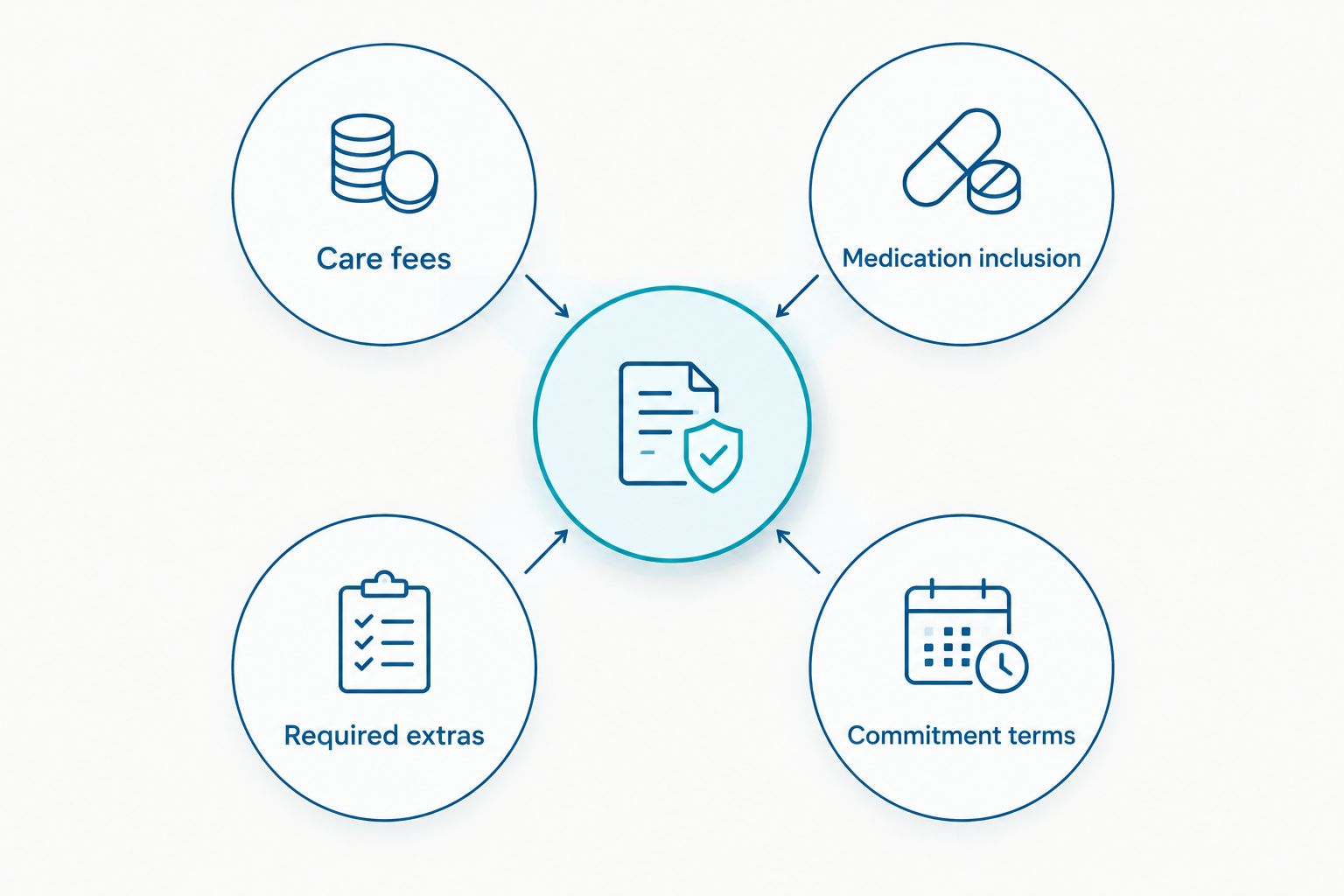
For your 2026 comparison, separate these components rather than treating an enrollment amount as the whole arrangement:
- Care fees: Appointments, memberships, messaging, and required follow-up.
- Medication inclusion: Whether the stated plan includes branded Mounjaro or excludes medication entirely.
- Required extras: Mandatory laboratory work, administrative charges, or delivery charges where applicable.
- Commitment terms: Renewal intervals, prepaid obligations, cancellation deadlines, and refund conditions.
Billing intervals also matter. A 4-week interval is 28 days, not a calendar month. Thirteen 28-day intervals span 364 days, whereas calendar-month billing ordinarily creates 12 billing dates in a year.
Those figures describe calendar arithmetic, not any provider's actual policy. Check whether the agreement bills by calendar month, refill, shipment, or another interval before comparing continuing obligations.
Telehealthledger's comparison approach separates published terms from assumptions. Mark a detail “not stated” when the provider does not explain it; do not treat silence as medication inclusion, unlimited support, or permission to cancel without conditions.
How these options are ranked
This guide ranks care models by continuity, coordination, coverage administration, and commitment flexibility. It does not award a named provider an overall or budget position without current, provider-specific evidence.
For a defensible named comparison, record the original provider terms, the date checked, the exact medication, state eligibility, and all mandatory charges. If enrollment copy conflicts with the service agreement, identify the conflict rather than choosing the more attractive statement.
Price alone does not establish clinical suitability or provider quality. Likewise, a provider's prescribing pathway does not establish insurance coverage.
Which Mounjaro provider should you choose?
Start with your existing diabetes care team if it offers suitable remote care. If you need a new service, favor a practice that explains clinical responsibility and continuing obligations before requesting payment.
For 2026, keep your shortlist narrow enough to compare the actual agreements. Eliminate any offer that substitutes an unspecified tirzepatide product for branded Mounjaro, leaves required fees unresolved, or presents insurance assistance as guaranteed coverage.
Choose the service whose documented care model fits your needs—not the advertisement with the strongest promise.
FAQ
What's the best Mounjaro telehealth provider?
There is no defensible universal winner without current provider-specific terms and your care requirements. Start with an existing diabetes care team if it offers suitable telehealth, then compare clinical responsibility, continuing costs, and state eligibility.
Is Mounjaro the same as compounded tirzepatide?
No. Mounjaro is a branded tirzepatide product; a compounded tirzepatide offer is not a Mounjaro offer. Require the provider to identify the exact prescribed product.
Does a telehealth membership include Mounjaro?
A membership does not establish medication inclusion. The written terms must explicitly state whether medication is included and identify separate pharmacy or other required charges.
Can a telehealth provider guarantee insurance approval?
No. A provider can describe its administrative assistance, but the insurer determines coverage under the applicable plan. Ask separately about benefits checks, prior authorization submissions, and appeals.
Is Mounjaro the same product as Zepbound?
No. Both contain tirzepatide, but they are distinct branded products with different FDA-approved uses. A clinician must assess the appropriate product for your circumstances.
Does a four-week refill mean monthly billing?
No. Four weeks is 28 days, while calendar months vary in length. Confirm whether billing follows the calendar, a refill, or a shipment before comparing plan obligations.
What should I check before paying a Mounjaro telehealth service?
Check the exact medication, state eligibility, clinician responsibilities, continuing charges, and cancellation terms. Also determine what happens to service fees if treatment is not prescribed or insurance coverage is denied.
One last thing
Check the medication name in the agreement, not just the advertisement. A page headed “tirzepatide” does not, by itself, establish a branded Mounjaro offer. Resolve that distinction before comparing anything else.
Information only. Not medical advice.