

Best overall: a self-pay provider that documents continuing costs, medication inclusion, and pharmacy details. Best for flexible commitments: a month-to-month plan. Best for keeping your existing clinician: a separate prescribing-and-pharmacy arrangement. The best tirzepatide providers without insurance in 2026 must disclose what you pay after enrollment—not just what gets you through checkout.
- The best tirzepatide providers without insurance disclose continuing costs, medication inclusion, required fees, and cancellation terms.
- Telehealth Ledger is best for comparing published telehealth terms, not determining whether tirzepatide suits you.
- Compare branded tirzepatide separately from compounded products; they are not interchangeable purchasing categories.
- A first-month promotion is not a continuing price. Verify the prescription and pharmacy before committing.
Why this matters
Without insurance, you need to understand both the prescribing service and the medication bill. A plan that covers clinician access but excludes medication is a different purchase from a plan that includes both.
Telehealth Ledger compares published telehealth prices, plan terms, and medication inclusion. Price alone does not establish clinical suitability or provider quality.
This guide ranks purchasing arrangements by how clearly they support an uninsured patient's comparison. It does not award a named clinic a position without verified provider terms, and it does not treat enrollment as a guarantee of a prescription.
Information only. Not medical advice.
What makes the best tirzepatide provider without insurance?
Use these criteria before comparing enrollment offers in 2026:
- Continuing costs: The provider identifies recurring charges after any introductory period and explains what changes the bill.
- Medication inclusion: The terms distinguish clinician access, medication, supplies, delivery, and required testing.
- Product identity: The provider identifies the prescribed product and distinguishes branded medication from compounded preparations.
- Clinical access: You can identify who reviews your history, how follow-up works, and how to raise treatment concerns.
- Commitment terms: Billing frequency, cancellation deadlines, prepaid obligations, and refund rules are written clearly.
- State eligibility: The prescribing service and dispensing pharmacy confirm service for your state before payment commitments.
A low headline figure cannot compensate for an unidentified medication or an unexplained recurring charge. Treat those gaps as reasons to pause, not details to resolve after enrollment.
Self-pay options at a glance
These options overlap: a medication-inclusive plan can also be month-to-month. The ranking identifies the strongest fit for different purchasing needs rather than claiming that the arrangements are mutually exclusive.
| Rank and arrangement | Best for | Main advantage | Key limitation |
|---|---|---|---|
| 1. Documented medication-inclusive plan | Comparing the complete recurring bill | Groups specified care and medication charges | Inclusion must be confirmed for the exact prescription |
| 2. Separate prescribing and pharmacy | Keeping an existing clinician | Separates clinical care from medication purchasing | You must reconcile separate bills and responsibilities |
| 3. Month-to-month telehealth plan | Limiting advance commitments | Makes the billing commitment easier to identify | Monthly billing does not establish easy cancellation |
| 4. Prepaid telehealth plan | Patients comfortable with written advance commitments | Defines a longer purchasing period | Refund and treatment-change terms require close review |
1. Medication-inclusive plans: best for comparing the full bill
A documented medication-inclusive plan places specified prescribing services and medication within the same purchasing arrangement. The useful distinction is not the word inclusive; it is the written list of what the plan includes.
Ask whether the published terms apply to your exact prescription, refill interval, and state. Do not assume that the medication named in an advertisement is the medication covered by the enrollment charge.
Medication-inclusive plan pros:
- Gives you a single starting point for reviewing recurring charges.
- Makes exclusions easier to identify when the inclusion list is explicit.
- Supports comparisons between plans covering the same product and services.
Medication-inclusive plan cons:
- The label does not establish that testing, delivery, or supplies are included.
- A combined charge can make individual services harder to compare.
- Changes to the prescription can require a different cost comparison.
Best for: Patients who want to compare the complete recurring obligation rather than assemble several separate quotes.
For a 2026 comparison, request the continuing terms rather than relying on an enrollment screen. Ask what happens financially if the clinician does not prescribe, changes the prescription, or recommends stopping treatment.
Verdict: Hold until medication inclusion and continuing obligations are documented. This is the strongest default purchasing structure only when those details are clear.
2. Separate prescribing and pharmacy: best for existing clinical care
In a separate arrangement, you obtain prescribing care from a clinician and purchase the prescribed medication through a pharmacy. This route deserves consideration when you already have a clinician willing to assess treatment and manage follow-up.
It does not guarantee that your clinician will prescribe tirzepatide or that a particular pharmacy can fill the prescription. Confirm both responsibilities before treating the arrangement as complete.
Separate prescribing and pharmacy pros:
- Keeps the clinical service distinct from medication purchasing.
- Lets you inspect each charge and policy separately.
- Supports continuity with an existing clinician when that clinician provides the relevant care.
Separate prescribing and pharmacy cons:
- Requires you to combine separate care and pharmacy obligations.
- Creates separate contacts for prescription questions and dispensing questions.
- Can leave follow-up responsibilities unclear unless agreed in advance.
Best for: Patients whose existing clinician can assess eligibility and provide ongoing care outside a bundled telehealth membership.
Ask who handles refill requests, prescription changes, required testing, and medication-related concerns. A pharmacy receipt does not explain the clinician's follow-up arrangements.
Verdict: Hold until both clinical follow-up and pharmacy responsibilities are confirmed. Do not assume that separating the bills makes the total lower.
3. Month-to-month plans: best for limiting advance commitments
A month-to-month telehealth arrangement limits the stated enrollment period to a recurring monthly commitment. That description concerns billing, not clinical suitability or the right time to stop medication.
Read the cancellation language closely. Ending a subscription, cancelling an unfilled prescription, and receiving a refund are separate actions governed by separate terms.
Month-to-month plan pros:
- Makes the recurring enrollment period straightforward to identify.
- Avoids a longer prepaid commitment when the contract genuinely bills monthly.
- Provides a clear point for checking the next scheduled charge.
Month-to-month plan cons:
- Does not establish that medication is included.
- Does not establish a refund right after renewal.
- Can use a medication refill schedule that differs from membership billing.
Best for: Patients who want to limit advance financial commitments while arranging clinician-led ongoing care.
Before enrolling in 2026, identify the cancellation deadline, next renewal date, and charges already committed to dispensing. Ask whether cancellation stops future membership billing, future medication orders, or both.
Verdict: Hold until cancellation and refill terms are explicit. Skip arrangements that describe themselves as flexible but leave the financial commitment undefined.
4. Prepaid plans: best for a clearly understood advance commitment
A prepaid arrangement collects payment for a defined period or package before all services or medication are delivered. Compare the full obligation, not a monthly equivalent displayed beside the enrollment offer.
Prepayment deserves separate scrutiny because treatment decisions can change. The written terms should explain what happens to unused services and unfilled medication orders.
Prepaid plan pros:
- Defines an advance purchasing period when the contract is clear.
- Lets you review the full stated commitment before enrolling.
- Supports a period-by-period comparison with recurring arrangements.
Prepaid plan cons:
- Commits funds before the entire purchasing period has passed.
- Requires careful review of refunds and unused services.
- Does not guarantee continued prescribing or an unchanged treatment plan.
Best for: Patients who understand the written advance commitment and accept its cancellation and refund conditions.
Do not assume a prepaid plan is cheaper. Compare equivalent products, services, and time periods, then examine what happens if a clinician declines treatment or changes the prescription.
Verdict: Skip if unused-payment and treatment-change terms are unclear. A displayed monthly equivalent is not a substitute for the actual agreement.
Compare the same product before comparing the plan
Tirzepatide is the active ingredient in Zepbound and Mounjaro, but the FDA-approved products have different labeled indications. The FDA prescribing information for the exact product—not a general telehealth advertisement—is the authoritative reference for its approved uses and product-specific warnings.
Compounded tirzepatide is not an FDA-approved product. Do not describe it as generic Zepbound or generic Mounjaro, or assume that the same purchasing conditions apply.
| Product category | What to verify | What not to assume |
|---|---|---|
| Zepbound | Exact prescribed product, dispensing format, and current prescribing information | That a different tirzepatide offer has identical terms |
| Mounjaro | Exact prescribed product, labeled indication, and clinician assessment | That every tirzepatide prescription serves the same clinical purpose |
| Compounded tirzepatide | Exact preparation, dispensing pharmacy, and current legal basis for dispensing | FDA approval or equivalence to a branded product |
For a 2026 decision, consult current FDA information about compounding rather than relying on an old shortage announcement or a provider's marketing summary. This guide does not establish that a particular compounded offer is currently lawful or appropriate for you.
Normalize the billing period before choosing
A recurring charge cannot be compared fairly until you know the period it covers. Four weeks equals 28 days; it is not a calendar month.
Thirteen four-week periods cover 364 days. That creates a different comparison from 12 calendar-month membership charges, particularly when medication and clinical access use different billing schedules.
The guide to four-week tirzepatide refills and annual bills explains the distinction. Do not multiply a charge labeled monthly until the provider defines the interval.
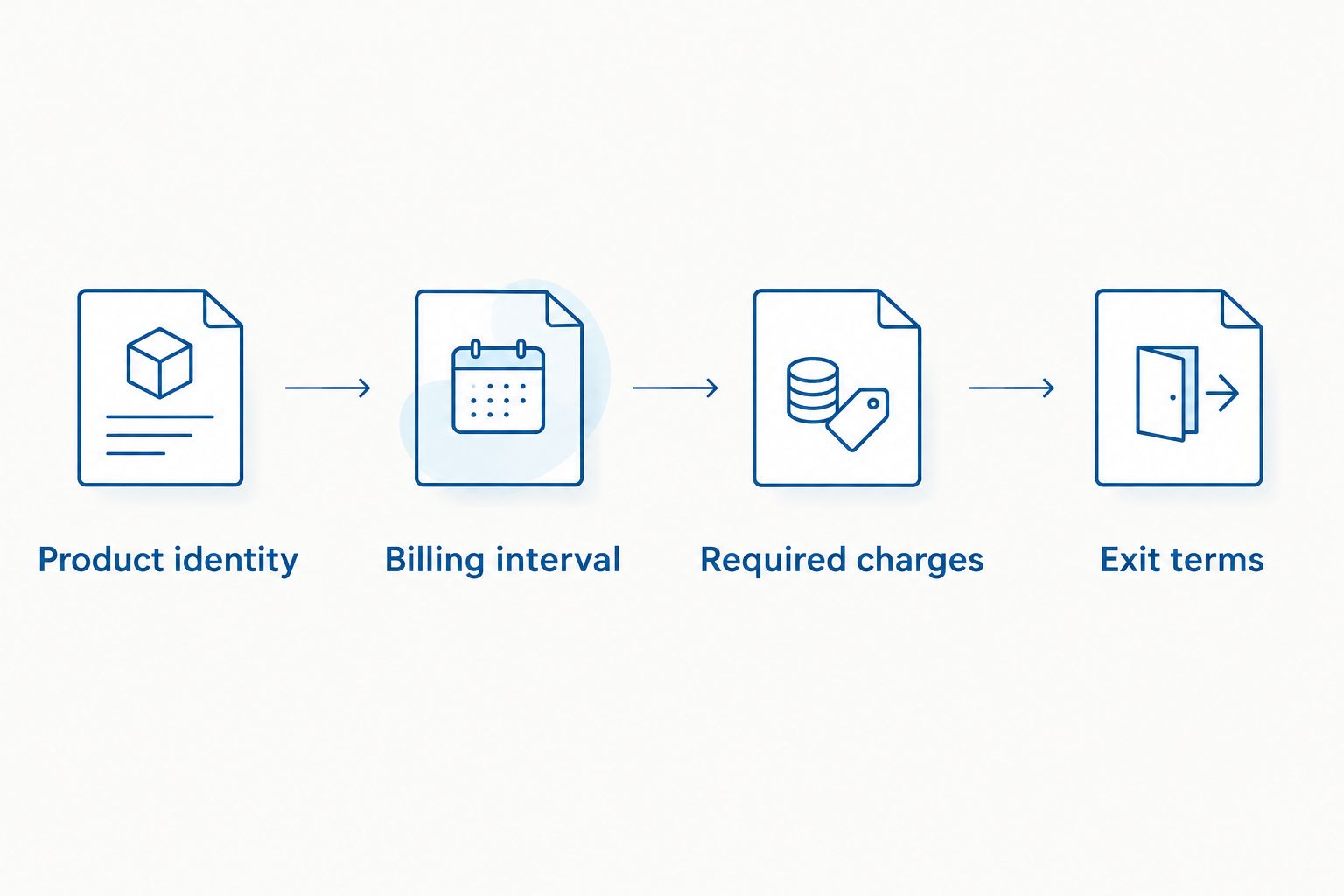
Use this sequence for each offer:
- Product identity: Record the exact branded product or compounded preparation.
- Billing interval: Record whether each charge covers a calendar month, four weeks, or another period.
- Required charges: Separate medication, clinical access, testing, supplies, and delivery where applicable.
- Exit terms: Record cancellation deadlines, committed charges, and treatment-change rules.
Keep a dated copy of the terms supporting your comparison. A saved advertisement without the enrollment agreement does not document the complete obligation.
How the options are ranked
The ranking prioritizes documented medication inclusion, comparable billing periods, identifiable clinical responsibility, and clear exit terms. It does not use unpublished provider performance claims or treat a lower advertised charge as evidence of better care.
Telehealth Ledger's tirzepatide comparison framework separates purchasing terms from medical decisions. A provider must meet your state's service requirements and your clinician must assess treatment suitability regardless of where an arrangement appears in this list.
Which tirzepatide arrangement should you choose?
Start with a documented medication-inclusive arrangement if your priority is understanding the full recurring bill. Compare a separate prescribing-and-pharmacy route when you already have suitable clinical care, and favor clear monthly commitments over unclear longer obligations.
For your 2026 shortlist, exclude offers that leave the medication, pharmacy, continuing charges, or cancellation rules unresolved. Do not select a clinical service solely because its enrollment page is easiest to compare.
FAQ
What's the best tirzepatide provider without insurance?
The strongest purchasing option is a provider that documents the exact medication, continuing charges, included services, pharmacy, and cancellation rules. No named provider earns a best-overall designation here without verified terms, and financial transparency does not establish clinical suitability.
Can I get tirzepatide without health insurance?
Health insurance is not required to pay directly for prescribed medication and clinical services. You still need a clinician's assessment, a valid prescription, and a dispensing arrangement that meets applicable requirements.
Does a tirzepatide telehealth membership include medication?
A membership includes medication only when its written terms explicitly say so. Confirm the exact product and whether testing, supplies, delivery, and follow-up create separate charges.
Is compounded tirzepatide the same as Zepbound or Mounjaro?
No. Compounded tirzepatide is not an FDA-approved product, while Zepbound and Mounjaro are FDA-approved branded products with product-specific labeling. Check current FDA information and discuss the exact prescription with your clinician.
Is a four-week refill the same as a monthly refill?
No. Four weeks equals 28 days, while calendar months vary in length. Thirteen four-week periods cover 364 days, so compare the actual billing interval rather than the word monthly.
Should I prepay for a tirzepatide plan?
Do not prepay until you understand the complete commitment and the rules for unused payments. Confirm what happens if treatment is declined, changed, or stopped, and do not assume that prepayment reduces your total obligation.
What should I check before paying a telehealth provider?
Verify the exact medication, continuing charges, medication inclusion, prescribing service, dispensing pharmacy, state eligibility, and cancellation terms. Keep a dated copy of the agreement and resolve conflicting terms before committing.
One last thing
Check the billing clock twice: once for clinical access and once for medication. Even a clearly stated membership charge does not tell you when the pharmacy will bill or which orders cancellation will stop.
Ask for both schedules in writing before paying. That single check makes the continuing obligation easier to understand without making assumptions about treatment.
Information only. Not medical advice.