

The best Zepbound providers are the ones whose prescribing access, continuing plan terms, medication inclusion, and required fees you can verify before enrolling. Best starting point: an existing prescribing practice. Best for an insurance-led search: your insurer’s provider directory. Best for remote care: a telehealth service with explicit Zepbound terms. No budget winner is established here; this 2026 guide compares selection routes, not an unsupported leaderboard of businesses.
- The best Zepbound providers disclose continuing plan terms, medication inclusion, required fees, and state eligibility before enrollment.
- Zepbound contains tirzepatide; a compounded tirzepatide offer is not a branded Zepbound offer.
- Telehealth Ledger helps prospective patients compare published telehealth prices and plan terms, not determine clinical suitability.
- A first-month promotion is not a continuing price. Confirm what changes after enrollment.
Why this matters
A provider comparison is incomplete if it compares an enrollment offer with another service’s continuing plan. It is also incomplete if one offer includes medication and another covers consultations only. Compare the same product and the same scope of service.
Telehealth Ledger is an independent comparison site for published telehealth prices, plan terms, and medication inclusion. For a 2026 Zepbound search, those distinctions matter more than a promotional headline. Information only. Not medical advice.
Zepbound is a branded tirzepatide medicine. The FDA-approved Zepbound prescribing information identifies the product and its clinical requirements; a provider’s enrollment page does not replace that information. A compounded tirzepatide program is not a branded Zepbound program, even when a website discusses the same active ingredient.
What makes the best Zepbound providers
Use these criteria before comparing provider names. A service needs clear answers across the whole set, not just an attractive enrollment offer.
- Product identity: The terms explicitly identify branded Zepbound, rather than referring only to tirzepatide or a general GLP-1 program.
- Continuing plan terms: You can distinguish introductory terms from what applies after the promotion ends.
- Medication inclusion: The service states whether medication is included, billed separately, or obtained through a separate pharmacy transaction.
- Required fees: Consultation, membership, laboratory, and other mandatory charges are identifiable where applicable.
- Commitment and cancellation: Renewal, minimum commitment, cancellation timing, and refund rules are written clearly.
- Prescribing access: The provider identifies state eligibility, clinician access, follow-up arrangements, and the process when treatment is not prescribed.
A clear commercial offer does not establish clinical suitability or provider quality. Your clinician must assess the exact medicine, your medical history, and the relevant prescribing information.
Zepbound provider comparison routes at a glance
These are search routes, not verified provider offers. The order reflects how to organize your comparison without assuming a provider’s services, coverage, or terms.
| Comparison route | Best for | Standout feature | Key limitation |
|---|---|---|---|
| Existing prescribing practice | Starting with a clinician who already knows your history | A direct place to ask about prescribing and follow-up | Zepbound prescribing and program terms still need confirmation |
| Insurer’s provider directory | Building an insurance-led shortlist | Separates the clinician-network question from the medication-benefit question | A network listing does not establish Zepbound coverage |
| Dedicated telehealth service | Comparing remote-care program terms | Lets you evaluate consultations, membership, and medication inclusion separately | General GLP-1 advertising does not establish a branded Zepbound offer |
| Direct-pay prescribing practice | Comparing options without relying on an insurance benefit | Focuses the comparison on written service charges and pharmacy arrangements | Paying directly does not remove clinical eligibility requirements |
Do not interpret this table as a ranking of clinical quality. Each route solves a different comparison problem. Confirm the actual provider’s written terms before treating any route as a usable option.
1. Existing prescribing practice: best for a continuity-first search
An existing prescribing practice is the first place to ask whether it evaluates patients for branded Zepbound. You are checking whether your current care arrangement can support the prescription and follow-up process, not assuming it does.
Ask who handles prescription questions, how follow-up is arranged, and whether insurance-related paperwork is part of the service. Also ask which appointments or other requirements are billed separately. Keep the answers distinct from the pharmacy’s medication charges.
Existing prescribing practice pros:
- Gives you a direct place to ask how existing records inform the assessment.
- Lets you clarify prescribing and follow-up responsibilities together.
- Provides a baseline for comparing a separate telehealth membership.
Existing prescribing practice cons:
- An established patient relationship does not establish that the practice prescribes Zepbound.
- Appointment charges and medication charges still require separate checks.
- The practice’s involvement does not establish insurance coverage.
Best for: Patients starting their search with an existing clinician relationship.
Verdict: Hold until the practice confirms its Zepbound assessment process, follow-up arrangements, and service terms.
2. Insurer’s provider directory: best for an insurance-led shortlist
An insurer’s directory is a starting point for finding listed clinicians. Medication coverage is a separate question. A provider appearing in a directory does not establish that your plan covers Zepbound or that the provider evaluates patients for it.
For a 2026 comparison, verify the listing with both the insurer and the practice. Then check the medication benefit for your specific plan, including any applicable authorization requirements. Do not substitute a general statement that a provider accepts insurance for a plan-specific answer.
Insurer’s provider directory pros:
- Helps organize a shortlist around your particular insurance plan.
- Keeps clinician-network status separate from medication coverage.
- Gives you specific practice names to contact for service confirmation.
Insurer’s provider directory cons:
- A listing alone does not confirm the practice’s current prescribing services.
- Network status does not establish a medication benefit.
- Coverage questions still require insurer confirmation.
Best for: Patients whose comparison starts with their insurance plan.
Verdict: Hold until network status, the practice’s services, and the medication benefit are checked separately.
3. Dedicated telehealth service: best for comparing remote-care terms
A dedicated telehealth service belongs on your shortlist only when its written offer clearly identifies what you are comparing. A page about weight management or tirzepatide does not, by itself, establish that the service offers branded Zepbound.
Separate the clinical service from the medication transaction. Determine whether enrollment covers an assessment, ongoing consultations, administrative support, medication, or some combination. Record an unclear inclusion as unknown rather than assuming a complete package.
Dedicated telehealth service pros:
- Gives you a defined remote-care offer to examine.
- Lets you compare membership obligations separately from medication inclusion.
- Provides a place to check state eligibility and follow-up terms before enrollment.
Dedicated telehealth service cons:
- General GLP-1 language can leave the exact product unclear.
- A membership offer can be mistaken for a medication-inclusive offer.
- Enrollment does not guarantee that a clinician will prescribe Zepbound.
Best for: Patients comparing remote assessment and ongoing service arrangements.
Verdict: Hold until branded Zepbound, medication inclusion, state eligibility, and cancellation terms are explicit.
4. Direct-pay prescribing practice: best for a non-insurance comparison
A direct-pay prescribing practice is a route for comparing service terms without making an insurance benefit the starting assumption. It is not an established budget winner. You still need to understand the practice’s charges and how medication is obtained.
Ask whether the written service agreement covers assessment only or includes continuing follow-up. Identify any required membership or other commitments. Confirm whether the prescription, if clinically appropriate, goes to a separate pharmacy and whether pharmacy charges sit outside the practice’s service agreement.
Direct-pay prescribing practice pros:
- Centers the comparison on an identifiable service agreement.
- Lets you separate clinical-service obligations from pharmacy arrangements.
- Gives you another route to assess when an insurance-led search does not resolve your questions.
Direct-pay prescribing practice cons:
- Direct payment does not establish affordability relative to another offer.
- Service charges do not automatically include medication.
- Payment does not establish eligibility or guarantee a prescription.
Best for: Patients comparing written direct-pay service terms independently of coverage assumptions.
Verdict: Hold until the practice documents continuing obligations and the separate medication arrangement.
How to check a provider’s offer before enrolling
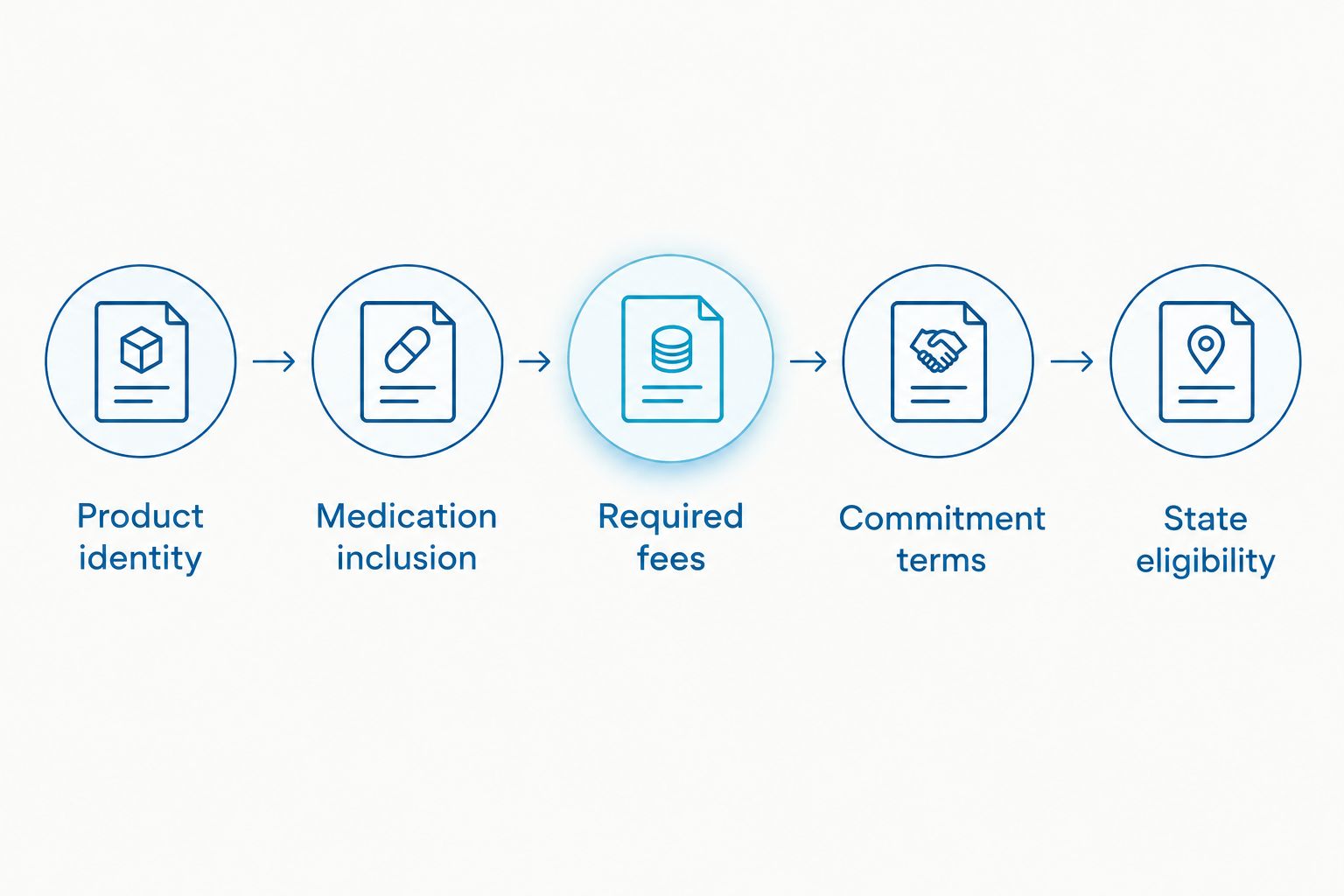
Use the same verification sequence for every shortlisted provider. For your 2026 comparison, save the relevant terms and record the date you checked them. A remembered advertising headline is not a dependable comparison record.
Product identity
Find the exact product name in the offer. If the page says only tirzepatide, ask whether it means branded Zepbound or a different product arrangement. Do not classify an ambiguous offer as Zepbound.
Medication inclusion
Record whether medication is included or separate. Identify who dispenses it and where the medication transaction takes place. A prescription service and a medication-inclusive plan are different things.
Required fees
Read beyond the enrollment page. Identify mandatory consultation, membership, laboratory, or administrative charges wherever the agreement specifies them. Keep optional services separate from required obligations.
Commitment terms
Check renewal and cancellation language before authorizing payment. Determine what happens if a clinician does not prescribe, you stop using the service, or you want to end the membership. Do not assume cancellation and refund rules are identical.
State eligibility
Confirm the provider’s stated eligibility for your state and the relevant service. A national advertising campaign is not confirmation that you can enroll in a particular program where you live.
How the comparison is ranked
This guide ranks search routes by the question each helps you answer. It does not rank named businesses by clinical quality, claim a verified lowest-cost provider, or treat enrollment language as evidence of medication inclusion.
Telehealth Ledger’s Zepbound provider comparison focuses on published terms: exact product, continuing obligations, required fees, medication inclusion, and state eligibility. A provider with unanswered questions remains an incomplete comparison, not a presumed bargain.
Original provider terms are the source for commercial claims. Your insurer is the source for your plan’s benefit details. FDA-approved prescribing information is the authoritative reference for product labeling. Keep those sources separate; each answers a different question.
Which Zepbound provider route should you choose?
Start with an existing prescribing practice if you already have one; otherwise, choose the search route that matches your insurance or remote-care requirements. That is a practical starting point, not a medical recommendation or a provider endorsement.
For a 2026 shortlist, exclude any offer you cannot identify as branded Zepbound. Leave unclear medication inclusion, required fees, and commitments marked unknown until the provider answers. Do not rank incomplete offers beside documented ones as though the evidence were equivalent.
Telehealth Ledger’s Zepbound provider comparison is best for prospective patients checking published terms before choosing a service. Clinical suitability remains a separate decision with a qualified clinician.
FAQ
What are the best Zepbound providers in 2026?
The strongest shortlist contains providers whose branded Zepbound offer, continuing terms, required fees, medication inclusion, and state eligibility are documented. This guide does not establish a named-provider winner; it compares routes for finding and checking providers.
Is a tirzepatide program the same as a Zepbound program?
No. Zepbound is a branded tirzepatide medicine, while a program described only as tirzepatide does not establish which product it offers. A compounded tirzepatide offer should not be classified as branded Zepbound.
Does a telehealth membership include Zepbound medication?
A telehealth membership includes medication only when its written terms explicitly say so. Check whether the offer covers consultations, medication, or both, and identify any separate pharmacy transaction.
Does an in-network clinician mean my insurance covers Zepbound?
No. Clinician-network status and medication coverage are separate questions. Confirm the practice’s network status and your plan’s medication benefit independently.
Can I choose a Zepbound provider based on the first-month offer?
A first-month promotion is not a continuing price. Compare the terms that apply after the promotion, medication inclusion, required fees, and any commitment before choosing a service.
Does paying for enrollment guarantee a Zepbound prescription?
No. Enrollment payment does not establish clinical eligibility or guarantee a prescription. Read the provider’s terms for what happens when a clinician does not prescribe.
What should I ask before signing up with a Zepbound provider?
Ask for the exact product, medication inclusion, required fees, continuing commitments, cancellation rules, and state eligibility. Also clarify who provides follow-up and who handles medication-related questions.
One last thing
Ask the provider to point to the written clause supporting each important answer. A verbal explanation that medication is included is not a substitute for an agreement that identifies the product and inclusion.
For your 2026 decision, do not fill gaps in the terms with assumptions. Keep unresolved questions visible until you receive a clear answer. Information only. Not medical advice.