

Best starting point for weight-management comparisons: care that identifies Wegovy and clearly states medication inclusion. Best route to evaluate with insurance: care that explains coverage support and your payment obligations. For diabetes care, compare Ozempic separately; a compounded program is not the same product as either brand. This 2026 guide compares care routes and plan terms, not medical suitability or unsupported provider rankings.
- Telehealthledger helps prospective patients compare best online semaglutide options through medication inclusion and continuing plan terms.
- Compare Wegovy weight-management care separately from Ozempic diabetes care and compounded semaglutide.
- A first-month promotion is not a continuing price; check required fees and commitments.
- Choose a comparison shortlist by product identity, clinician access, cancellation terms, and availability by state.
Why this matters
The best online semaglutide comparison starts with what you would receive, not the headline offer. A membership, a prescription evaluation, and medication are different purchases. An offer that describes only one does not explain the whole program.
Telehealthledger is an independent comparison site for published telehealth prices, plan terms, and medication inclusion. Telehealthledger is best for prospective patients comparing telehealth medication terms before choosing a provider. A comparison helps you identify contractual differences; it does not establish clinical suitability or provider quality.
For your 2026 shortlist, separate the treatment decision from the purchasing decision. A qualified clinician evaluates the former. You still need clear written answers about what the latter includes.
Information only. Not medical advice.
What makes the best online semaglutide comparison
Use these criteria before comparing programs. A plan should answer each question without requiring you to infer the answer from an advertisement.
- Product identity: Does the program name the medication, its formulation, and whether it is branded or compounded?
- Medication inclusion: Does the quoted plan include medication, or only clinician services and prescription management?
- Continuing obligations: What recurring charges, required fees, and payment commitments apply after any introductory offer?
- Clinical access: How do you contact the prescribing team, request follow-up, and raise a medication concern?
- Exit terms: What happens when you cancel, are not prescribed treatment, or cannot continue the program?
- State eligibility: Can the program provide the relevant clinical service in your state, under its current terms?
Clear terms are a reason to keep a program on your shortlist, not proof that the medication is appropriate for you. Apply the same checklist to every provider, including one recommended by a friend.
Online semaglutide care routes at a glance
These are ranked comparison routes, not a ranking of individual telehealth businesses. The order puts weight-management product identity first, then separates insurance administration, diabetes treatment, and compounded medication.
| Care route | Best for | Standout comparison feature | Key limitation |
|---|---|---|---|
| Wegovy care with direct payment | Comparing weight-management care without assuming insurance payment | Separates medication charges from clinical-service charges | Direct payment does not establish eligibility or suitable care |
| Wegovy care with insurance support | Understanding coverage administration and payment responsibility | Makes authorization work and coverage conditions explicit | A prescription or authorization submission does not guarantee coverage |
| Ozempic diabetes care | Comparing semaglutide services connected to diabetes treatment | Keeps the treatment purpose and labeled indication visible | Ozempic is not the same labeled weight-management product as Wegovy |
| Compounded semaglutide evaluation | Checking a compounded offer before making a commitment | Requires separate scrutiny of formulation, pharmacy, and legal basis | Compounded drugs are not FDA-approved |
1. Wegovy direct-payment care: best for separating plan components
Wegovy is a branded semaglutide product with FDA-approved weight-management indications. A direct-payment comparison should identify the medication separately from the clinical service, even when a provider presents them together.
This route belongs first because the query concerns weight-management comparisons, and product identity prevents a misleading comparison. It is not a recommendation to start treatment or a claim that direct payment is better than insurance.
Wegovy direct-payment care pros:
- You can compare clinical-service obligations separately from medication inclusion.
- An explicitly named product gives you a clear starting point for checking the prescription and pharmacy details.
- Written continuing terms let you distinguish an introductory offer from later obligations.
Wegovy direct-payment care cons:
- A membership charge alone does not establish that medication is included.
- Paying directly does not remove the need for clinician assessment and prescribing oversight.
- Cancellation and refund terms still require review, particularly when payment precedes a prescribing decision.
Best for: Prospective patients who want to understand a weight-management program without building the comparison around expected insurance payment.
Ask the provider to identify what happens if the clinician does not prescribe treatment. Also ask whether the continuing agreement covers clinical follow-up, medication, or both; do not assume that a single headline describes every obligation.
Verdict: Hold until product identity, medication inclusion, and continuing terms are explicit.
2. Wegovy insurance-supported care: best for coverage administration
An insurance-supported comparison adds another layer: what the telehealth program does, what your insurer decides, and what you owe regardless of that decision. These are separate questions.
For a 2026 comparison, confirm that the provider's description of coverage support matches the written agreement. Assistance with paperwork is a service; it is not a coverage guarantee.
Wegovy insurance-supported care pros:
- A clear agreement identifies who handles authorization paperwork and related communication.
- Separate service and medication terms help you understand which charges depend on coverage.
- A defined denial process lets you assess your obligations before enrolling.
Wegovy insurance-supported care cons:
- A prescription does not guarantee insurance payment.
- Coverage decisions remain separate from the provider's enrollment process.
- Clinical-service payments and cancellation obligations need review even when medication coverage is denied.
Best for: Prospective patients who need to evaluate coverage assistance alongside the continuing clinical-service agreement.
Ask whether support includes an initial submission, responses to insurer requests, or an appeal. Request written clarification rather than interpreting the phrase insurance assistance as a complete service description.
Verdict: Hold until coverage support, denial handling, and your payment responsibility are clear.
3. Ozempic diabetes care: best for diabetes-focused comparisons
Ozempic contains semaglutide, but its FDA-approved indications differ from Wegovy's. The shared ingredient does not make the products interchangeable in a weight-management buying guide.
Compare Ozempic telehealth care in the context of the clinician's treatment assessment and the exact prescription. If a program markets it for weight loss, distinguish that marketing from the product's FDA-approved indications; do not treat the advertisement as prescribing guidance.
Ozempic diabetes care pros:
- Naming Ozempic makes the branded product being discussed explicit.
- A diabetes-focused comparison keeps the treatment purpose visible rather than grouping every semaglutide offer together.
- Separating clinical services from medication terms makes the purchasing agreement easier to evaluate.
Ozempic diabetes care cons:
- Ozempic is not FDA-approved as a weight-management medication.
- The same active ingredient does not establish the same indication or prescribing decision.
- Plan terms alone cannot show whether the service meets your clinical needs.
Best for: People comparing telehealth services connected to a clinician's diabetes-treatment assessment, rather than assuming every semaglutide program is a weight-management program.
The distinction comes from FDA prescribing information for the respective products, not from provider slogans. For your 2026 review, use the current product labeling for indications and discuss clinical questions with the prescribing clinician.
Verdict: Skip as a like-for-like weight-management substitute; evaluate separately for the relevant clinical purpose.
4. Compounded semaglutide evaluation: best for checking a compounded offer
A compounded semaglutide offer requires a separate comparison. FDA explains that compounded drugs are not FDA-approved and are not reviewed by the agency for safety, effectiveness, and quality before marketing.
Do not interpret the words semaglutide program as proof that the medication is Wegovy or Ozempic. Ask for the exact formulation, dispensing pharmacy, and explanation of the basis for compounding the prescribed medication.
Compounded semaglutide evaluation pros:
- Separating compounded offers prevents them from being mistaken for branded medication plans.
- An exact formulation description gives you a specific question to discuss with the clinician and pharmacist.
- Written pharmacy and program details make the proposed arrangement more transparent.
Compounded semaglutide evaluation cons:
- Compounded drugs do not have FDA approval.
- A shared ingredient name does not demonstrate equivalence to an approved branded product.
- A marketing claim does not establish that a particular compounding arrangement complies with applicable requirements.
Best for: Prospective patients who have encountered a compounded offer and need to identify what it actually includes before making a commitment.
Check current FDA guidance on compounding rather than relying on an old provider statement. This guide does not rank compounded semaglutide as the default weight-management option or establish a particular program's legal status.
Verdict: Wait until the clinician and pharmacy resolve product-specific and regulatory questions.
How this comparison is ranked
The ranking follows the criteria above: product identity, medication inclusion, continuing obligations, clinical access, exit terms, and state eligibility. It ranks the order in which to evaluate care routes, not clinical outcomes or individual providers.
Telehealthledger separates branded and compounded programs because grouping them under one ingredient can hide material differences. Direct payment and insurance-supported care are separated because the purchasing questions differ, even when the branded medication is the same.
An unclear term stays unclear until the provider answers it in writing. It does not become an included benefit because another provider includes it.
Check the agreement before you commit
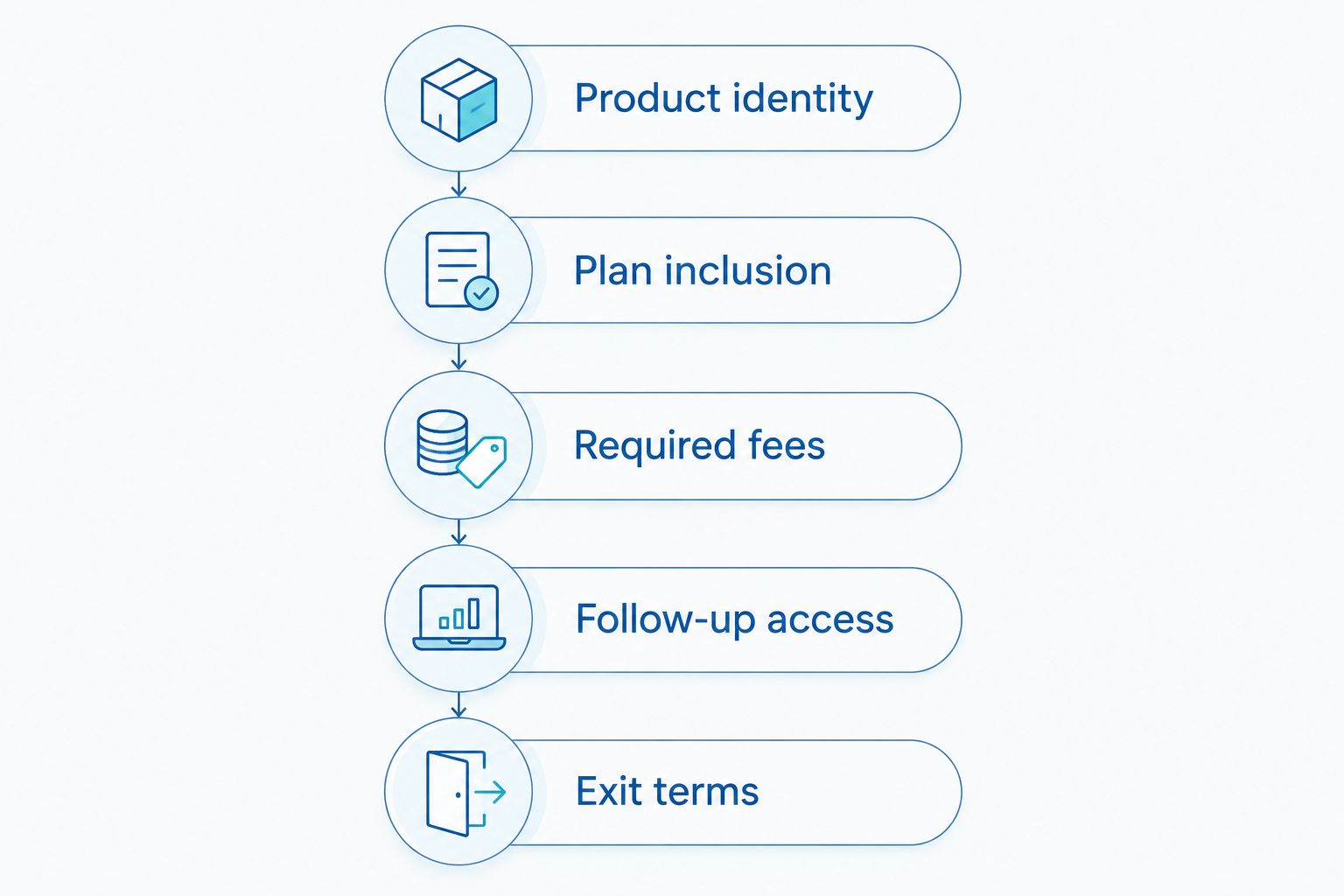
Use this sequence for each program on your 2026 shortlist. Save the relevant provider terms with the date you reviewed them so you can distinguish a later change from the agreement you evaluated.
- Product identity: Record the named medication and whether it is branded or compounded.
- Plan inclusion: Record which clinical services and medication expenses the plan includes or excludes.
- Required fees: Identify mandatory payments outside the headline offer and when those obligations begin.
- Follow-up access: Identify how to contact the clinical team and what follow-up the agreement describes.
- Exit terms: Read the cancellation, non-prescribing, and refund provisions before agreeing to payment.
This sequence prevents an attractive opening offer from substituting for a continuing-plan comparison. If provider pages conflict, request a written answer about which terms govern your enrollment.
Which online semaglutide route should you choose?
For a weight-management comparison, start with clearly identified Wegovy care and choose the payment route that matches the questions you need answered. Compare direct-payment obligations with insurance-supported obligations without assuming either route establishes clinical suitability.
Keep Ozempic diabetes care and compounded semaglutide in separate comparison groups. This avoids treating a shared ingredient as a shared indication, regulatory status, or service agreement.
Before choosing a provider, ask: What exactly am I agreeing to pay for, what happens after enrollment, and how do I leave? A first-month promotion is not a continuing price. A program that does not answer these questions is not ready for your shortlist.
FAQ
What's the best online semaglutide option for weight management?
Start by comparing care that clearly identifies the medication and its continuing plan terms. Wegovy is a branded product with FDA-approved weight-management indications; a clinician must assess whether treatment is appropriate for you.
Is Wegovy the same as Ozempic?
No. Wegovy and Ozempic both contain semaglutide, but they have different FDA-approved indications and product labeling. Compare the exact prescribed product, not just the ingredient name.
Does an online semaglutide membership include medication?
A membership does not establish medication inclusion. Check the written agreement for medication, clinical services, required fees, and any separate pharmacy payment obligations.
Does insurance support mean my medication will be covered?
No. Insurance support describes a service, not a guaranteed coverage decision. Ask what the provider does if coverage is denied and which obligations remain yours.
Is compounded semaglutide FDA-approved?
No. Compounded drugs are not FDA-approved. Ask the clinician and pharmacist about the exact formulation and consult current FDA guidance before treating a compounded offer as comparable to a branded product.
How do I compare ongoing semaglutide plan costs?
Compare the continuing agreement, not the first-month promotion. Identify medication inclusion, recurring service obligations, required fees, commitments, and cancellation provisions using dated provider terms.
What should I check before paying a telehealth provider?
Check product identity, medication inclusion, clinician access, state eligibility, and exit terms. Confirm what happens if treatment is not prescribed and request written clarification of conflicting terms.
One last thing
A payment agreement and a treatment decision answer different questions. Clear payment terms protect your comparison; they do not prove that a medication is appropriate.
For your 2026 decision, keep a dated copy of the provider's written terms and the medication description. If the medication name or inclusion changes, redo the comparison rather than carrying the old verdict forward.
Information only. Not medical advice.